


Anticonvulsant and reproductive toxicological studies of the imidazole-based histamine H3R antagonist 2-18 in mice
- PMID: 29403264
- PMCID: PMC5783147
- DOI: 10.2147/DDDT.S144730
Anticonvulsant and reproductive toxicological studies of the imidazole-based histamine H3R antagonist 2-18 in mice
Abstract
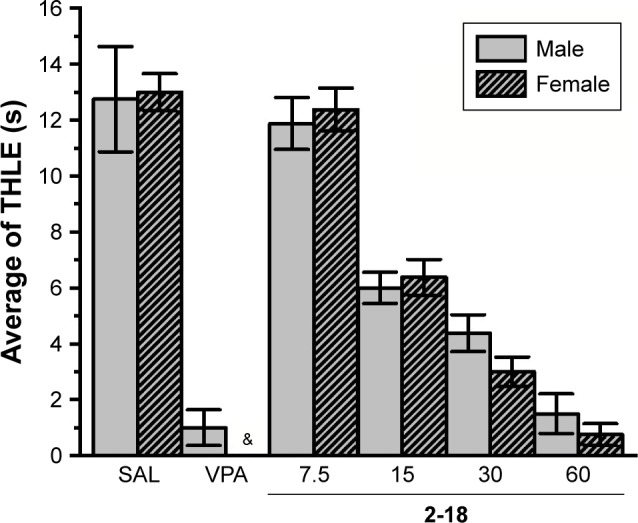
The imidazole-based H3R antagonist 2-18 with high in vitro H3R antagonist affinity, excellent in vitro selectivity profile, and high in vivo H3R antagonist potency was tested for its anticonvulsant effect in maximal electroshock (MES)-induced convulsions in mice having valproic acid (VPA) as a reference antiepileptic drug (AED). Additionally, H3R antagonist 2-18 was evaluated for its reproductive toxicity in the same animal species. The results show that acute systemic administration (intraperitoneal; i.p.) of H3R antagonist 2-18 (7.5, 15, 30, and 60 mg/kg, i.p.) significantly and dose dependently protected male as well as female mice against MES-induced convulsion. The protective action observed for H3R antagonist 2-18 in both mice sexes was comparable to that of VPA and was reversed when mice were pretreated with the selective H3R agonist (R)-alpha-methylhistamine (RAMH, 10 mg/kg, i.p.). Moreover, the results show that acute systemic administration of single (7.5, 15, 30, or 60 mg/kg, i.p.) or multiple doses (15×3 mg/kg, i.p.) of H3R antagonist 2-18 on gestation day (GD) 8 or 13 did not affect the maternal body weight of mice when compared with the control group. Furthermore, no significant differences were observed in the average number of implantations and resorptions between the control and H3R antagonist 2-18-treated group at the early stages of gestation and the organogenesis period. However, oral treatment with H3R antagonist 2-18 (15 mg/kg) on GD 8 induced a reduced number of live embryos when compared with the i.p.-treated mice. In addition, no significant changes in the fetal body and placental weights were observed after injection of H3R antagonist 2-18 with all selected doses. However, three dose groups of i.p. and oral 15 mg/kg on GD 13 significantly affected the placental weight when compared with control group. Notably, the treatment of pregnant female with the H3R antagonist 2-18 did not produce significant malformation in the fetus in both groups. In conclusion, the novel H3R antagonist 2-18 proves to be a very safe compound and displays a low incidence of malformations, demonstrating that H3R antagonist 2-18 may have a potential future therapeutic value in epilepsy.
Keywords: H3R receptor antagonist; anticonvulsant; gestation; malformation; maximal electroshock; mice.
Conflict of interest statement
Disclosure The authors report no conflicts of interest in this work.
Figures


References
-
- Fisher RS. Commentary: consciousness of epilepsy. Epilepsia. 2014;55(8):1153. - PubMed
-
- Fisher RS, van Emde Boas W, Blume W, et al. Epileptic seizures and epilepsy: definitions proposed by the International League Against Epilepsy (ILAE) and the International Bureau for Epilepsy (IBE) Epilepsia. 2005;46(4):470–472. - PubMed
-
- Kamei C, Ishizawa K, Kakinoki H, Fukunaga M. Histaminergic mechanisms in amygdaloid-kindled seizures in rats. Epilepsy Res. 1998;30(3):187–194. - PubMed
-
- Kamei C, Ohuchi M, Sugimoto Y, Okuma C. Mechanism responsible for epileptogenic activity by first-generation H1-antagonists in rats. Brain Res. 2000;887(1):183–186. - PubMed
MeSH terms
Substances
LinkOut - more resources
Full Text Sources
Other Literature Sources
Miscellaneous
