


Short-term Efficacy of Hand-Arm Bimanual Intensive Training on Upper Arm Function in Acute Stroke Patients: A Randomized Controlled Trial
- PMID: 29403422
- PMCID: PMC5780635
- DOI: 10.3389/fneur.2017.00726
Short-term Efficacy of Hand-Arm Bimanual Intensive Training on Upper Arm Function in Acute Stroke Patients: A Randomized Controlled Trial
Abstract
Background: Rehabilitation training during the acute phase of stroke (<48 h) markedly improves impaired upper-limb movement. Hand-arm bimanual intensive training (HABIT) represents an intervention that promotes improvements in upper extremity function in children with cerebral palsy. This study repurposed HABIT in acute stroke patients and assessed recovery of upper extremity function when compared with a conventional rehabilitation program (CRP).
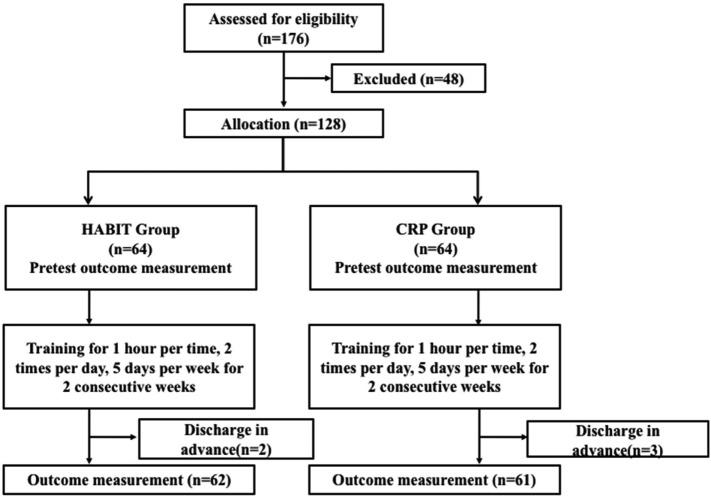
Methods: In a randomized trial, 128 patients with acute stroke were assigned to the HABIT or the CRP groups. The primary endpoint was clinical motor functional assessment that was guided by the Fugl-Meyer motor assessment (FMA) and outcomes of the action research arm test (ARAT). The secondary endpoint was an improved neurophysiological evaluation according to the motor-evoked potential amplitude (AMP), resting motion threshold (RMT), and central motor conduction time (CMCT) scores over the 2-week course of therapy. In both groups, scores were evaluated at baseline, 1 week from commencing therapy, and post-therapy.
Results: After 2 weeks, the HABIT group showed improved scores as compared the CRP group for FMA (51.7 ± 6.44 vs. 43.5 ± 5.6, P < 0.001), ARAT (34.5 ± 6.2 vs. 33.3 ± 6.3, P = 0.022), and AMP (1.1 ± 0.1 vs. 1.0 ± 0.1, P < 0.001). However, CMCT (8.6 ± 1.0 vs. 9.1 ± 0.6, P = 0.054) and RMT (55.3 ± 4.2 vs. 57.5 ± 4.1, P = 0.088) were similar when comparing between groups.
Conclusion: HABIT significantly improved motor functional and neuro-physiological outcomes in patients with acute stroke, which suggested that HABIT might represent an improved therapeutic strategy as compared CRP.
Keywords: dysfunction; hand-arm bimanual intensive training; randomized controlled trial; stroke; upper extremity.
References
-
- Fugl-Meyer AR, Jaasko L, Leyman I, Olsson S, Steglind S. The post-stroke hemiplegic patient. 1. A method for evaluation of physical performance. Scand J Rehabil Med (1975) 7(1):13–31. - PubMed
LinkOut - more resources
Full Text Sources
Other Literature Sources
Medical
Research Materials
Miscellaneous
