Review
. 2018 Jan 22:8:381.
doi: 10.3389/fendo.2017.00381. eCollection 2017.

From Diabetes Care to Diabetes Cure-The Integration of Systems Biology, eHealth, and Behavioral Change

Affiliations
Review

From Diabetes Care to Diabetes Cure-The Integration of Systems Biology, eHealth, and Behavioral Change

Ben van Ommen et al. Front Endocrinol (Lausanne). .

Abstract

From a biological view, most of the processes involved in insulin resistance, which drives the pathobiology of type 2 diabetes, are reversible. This theoretically makes the disease reversible and curable by changing dietary habits and physical activity, particularly when adopted early in the disease process. Yet, this is not fully implemented and exploited in health care due to numerous obstacles. This article reviews the state of the art in all areas involved in a diabetes cure-focused therapy and discusses the scientific and technological advancements that need to be integrated into a systems approach sustainable lifestyle-based healthcare system and economy. The implementation of lifestyle as cure necessitates personalized and sustained lifestyle adaptations, which can only be established by a systems approach, including all relevant aspects (personalized diagnosis and diet, physical activity and stress management, self-empowerment, motivation, participation and health literacy, all facilitated by blended care and ehealth). Introduction of such a systems approach in type 2 diabetes therapy not only requires a concerted action of many stakeholders but also a change in healthcare economy, with new winners and losers. A "call for action" is put forward to actually initiate this transition. The solution provided for type 2 diabetes is translatable to other lifestyle-related disorders.

Keywords: cure; ehealth; lifestyle; nutrition; reversible; system; type 2 diabetes.


Figures
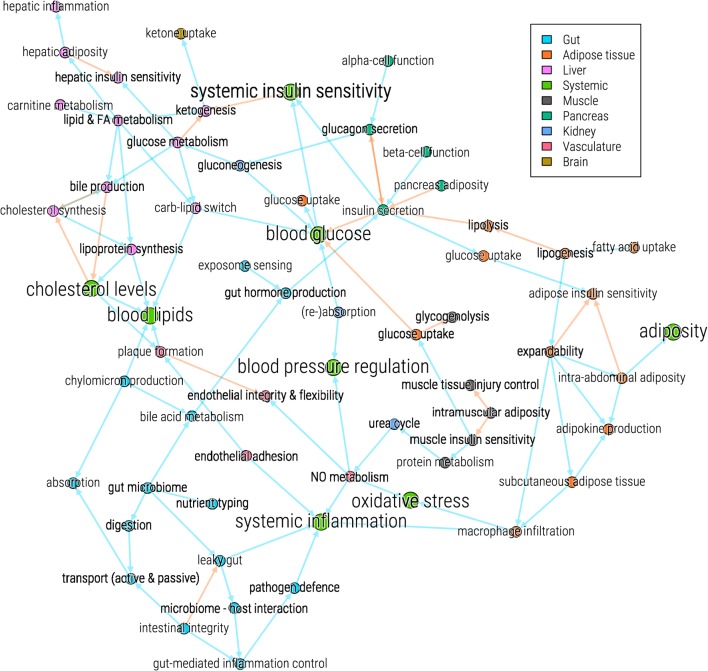
Figure 1
Figure 1
Systems view on processes involved in glucose control and type 2 diabetes. The processes (nodes) are colored according to their involvement with organs (see legend). Blue arrows (edges) indicate a positive effect of one process on another, red arrows indicate a negative effect.
Figure 2
Figure 2
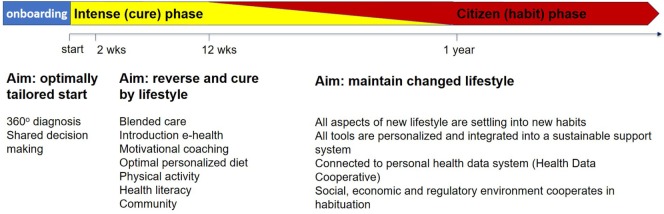
Schematic representation of a personal cure and maintenance trajectory. Depending on the personal 360° diagnosis, the duration and intensity of the cure and maintenance phases and the relative contribution of the components may vary.
Figure 3
Figure 3
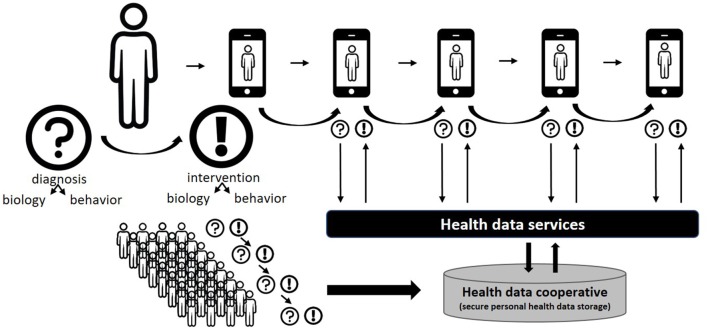
Schematic overview of a “life companion” approach. The citizen–patient interacts with a single ehealth (eHealth) platform (any combination of phone, desktop, life coach, healthcare provider) and receives interventions in all relevant areas (diet and lifestyle, behavior, information, etc.) at the right time in the right message format, based on both initial and continued diagnosis. The intervention is generated by “health services,” i.e., models that exploit personal health and behavior data. Timelines of diagnostic and intervention information are owned by the citizen/patient and may be shared within a community (health data cooperative), thus further strengthening the personal health data service with a “big data” component.

References

    1. Heymsfield SB, Wadden TA. Mechanisms, pathophysiology, and management of obesity. N Engl J Med (2017) 376(3):254–66. 10.1056/NEJMra1514009 - DOI - PubMed
    1. Arsenault BJ, Després J-P. Cardiovascular disease prevention: lifestyle attenuation of genetic risk. Nat Rev Cardiol (2017) 14:187–8. 10.1038/nrcardio.2017.20 - DOI - PubMed
    1. Perandini LA, de Sá-Pinto AL, Roschel H, Benatti FB, Lima FR, Bonfá E, et al. Exercise as a therapeutic tool to counteract inflammation and clinical symptoms in autoimmune rheumatic diseases. Autoimmun Rev (2012) 12(2):218–24. 10.1016/j.autrev.2012.06.007 - DOI - PubMed
    1. Anand P, Kunnumakara AB, Sundaram C, Harikumar KB, Tharakan ST, Lai OS, et al. Cancer is a preventable disease that requires major lifestyle changes. Pharm Res (2008) 25(9):2097–116. 10.1007/s11095-008-9661-9 - DOI - PMC - PubMed
    1. WCRS. Continuous Update Project (2017). Available from: http://www.wcrf.org/int/research-we-fund/continuous-update-project-cup (Accessed October 1, 2017).

LinkOut - more resources