


Bruton's Tyrosine Kinase, a Component of B Cell Signaling Pathways, Has Multiple Roles in the Pathogenesis of Lupus
- PMID: 29403475
- PMCID: PMC5786522
- DOI: 10.3389/fimmu.2017.01986
Bruton's Tyrosine Kinase, a Component of B Cell Signaling Pathways, Has Multiple Roles in the Pathogenesis of Lupus
Abstract
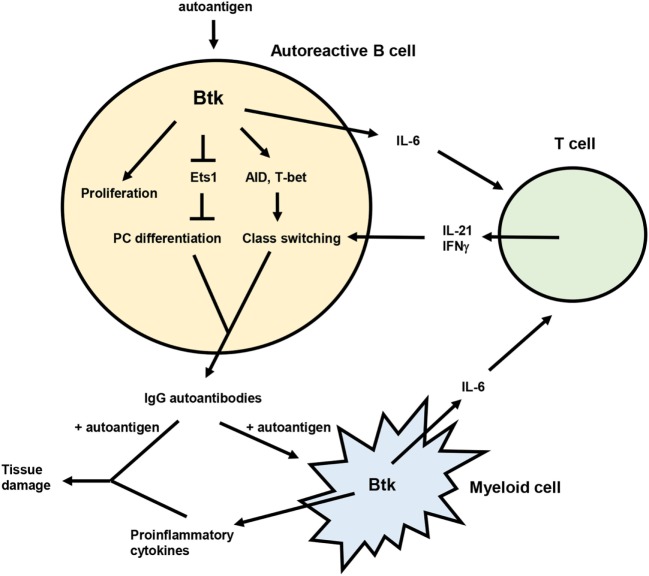
Systemic lupus erythematosus (SLE) is an autoimmune disease characterized by the loss of adaptive immune tolerance to nucleic acid-containing antigens. The resulting autoantibodies form immune complexes that promote inflammation and tissue damage. Defining the signals that drive pathogenic autoantibody production is an important step in the development of more targeted therapeutic approaches for lupus, which is currently treated primarily with non-specific immunosuppression. Here, we review the contribution of Bruton's tyrosine kinase (Btk), a component of B and myeloid cell signaling pathways, to disease in murine lupus models. Both gain- and loss-of-function genetic studies have revealed that Btk plays multiple roles in the production of autoantibodies. These include promoting the activation, plasma cell differentiation, and class switching of autoreactive B cells. Small molecule inhibitors of Btk are effective at reducing autoantibody levels, B cell activation, and kidney damage in several lupus models. These studies suggest that Btk may promote end-organ damage both by facilitating the production of autoantibodies and by mediating the inflammatory response of myeloid cells to these immune complexes. While Btk has not been associated with SLE in GWAS studies, SLE B cells display signaling defects in components both upstream and downstream of Btk consistent with enhanced activation of Btk signaling pathways. Taken together, these observations indicate that limiting Btk activity is critical for maintaining B cell tolerance and preventing the development of autoimmune disease. Btk inhibitors, generally well-tolerated and approved to treat B cell malignancy, may thus be a useful therapeutic approach for SLE.
Keywords: B cell; Bruton’s tyrosine kinase; Lyn; autoantibody; lupus; plasma cell.
Figures
References
Publication types
Grants and funding
LinkOut - more resources
Full Text Sources
Other Literature Sources
Miscellaneous
