


Long-term survival after surveillance and treatment in patients with chronic viral hepatitis and hepatocellular carcinoma
- PMID: 29404481
- PMCID: PMC5721434
- DOI: 10.1002/hep4.1047
Long-term survival after surveillance and treatment in patients with chronic viral hepatitis and hepatocellular carcinoma
Abstract
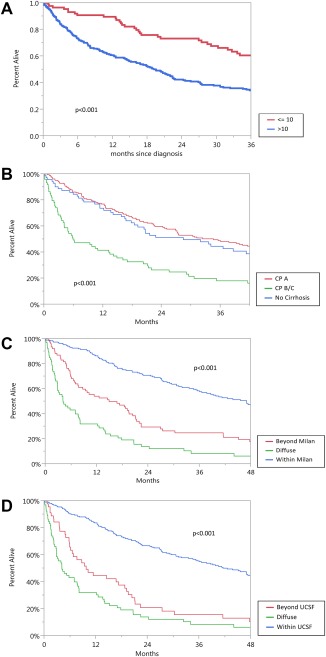
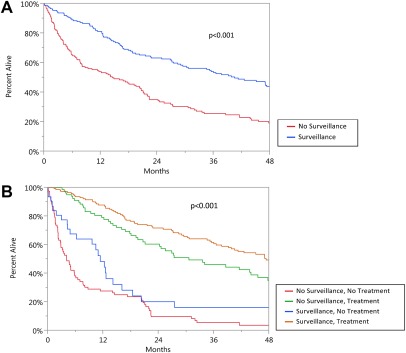
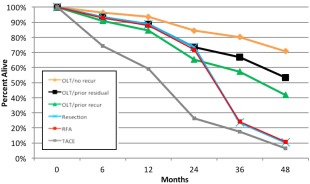
Hepatocellular carcinoma (HCC) is the main cause of mortality in patients with chronic viral hepatitis (CVH). We determined the impact of surveillance and treatments on long-term outcomes in patients with CVH who developed HCC. Between 1984 and 2014, 333 patients with HCC and with hepatitis B or hepatitis C virus infection were evaluated. An adjusted lead time bias interval was added to patients with HCC who presented with HCC (no surveillance), and their survival was compared to patients whose HCC was detected by surveillance. After HCC treatments, survival rates within and beyond 3 years of follow-up were compared. In 175 (53%) patients, HCC was detected through surveillance using alpha-fetoprotein and abdominal ultrasound examinations. Compared to 158 (47%) patients with HCC who had no surveillance, more patients with HCC detected by surveillance received surgical and locoregional treatments (P < 0.0001 to P < 0.001), and their 1-, 3-, and 5-year overall and disease-free survival rates were significantly higher (P < 0.001 for both). During the first 3 years of follow-up, patients with HCC receiving liver transplantation had similar survival rates as those with liver resection or radiofrequency ablation (RFA); however, due to HCC recurrence, survival in resection and RFA patients became significantly less when followed beyond 3 years (P = 0.001 to P = 0.04). Factors associated with mortality included tumors beyond University of California at San Francisco criteria (hazard ratio [HR] 2.02; P < 0.0001), Child-Pugh class B and C (HR, 1.58-2.26; P = 0.043 to P = 0.015, respectively), alpha-fetoprotein per log ng/mL increase (HR, 1.30; P < 0.0001), previous antiviral therapy in hepatitis B virus patients (HR, 0.62; P = 0.032), and treatments other than liver transplantation (HR, 2.38-6.45; P < 0.0001 to P < 0.003). Conclusion. Patients with HCC detected by surveillance had prolonged survival. Due to HCC recurrence, survival rates after liver resection and RFA were lower when followed beyond 3 years after treatments. (Hepatology Communications 2017;1:595-608).
Figures
References
-
- Ferenci P, Fried M, Labrecque D, Bruix J, Sherman M, Omata M, et al; World Gastroenterology Organisation Guidelines and Publications Committee. World Gastroenterology Organisation Guideline . Hepatocellular carcinoma (HCC): a global perspective. J Gastrointestin Liver Dis 2010;19:311‐317. - PubMed
-
- Wallace MC, Preen D, Jeffrey GP, Adams LA. The evolving epidemiology of hepatocellular carcinoma: a global perspective. Expert Rev Gastroenterol Hepatol 2015;9:765‐769. - PubMed
-
- El‐Serag HB, Rudolph KL. Hepatocellular carcinoma: epidemiology and molecular carcinogenesis. Gastroenterology 2007;132:2557‐2576. - PubMed
-
- Parkin DM. The global health burden of infection‐associated cancers in the year 2002. Int J Cancer 2006;118:3030‐3044. - PubMed
-
- European Association for the Study of the Liver, European Organisation for Research and Treatment of Cancer . EASL‐EORTC clinical practice guidelines: management of hepatocellular carcinoma. J Hepatol 2012;56:908‐943. - PubMed
LinkOut - more resources
Full Text Sources
Other Literature Sources
