


Effects of different growth temperatures on growth, development, and plastid pigments metabolism of tobacco (Nicotiana tabacum L.) plants
- PMID: 29404808
- PMCID: PMC5799153
- DOI: 10.1186/s40529-018-0221-2
Effects of different growth temperatures on growth, development, and plastid pigments metabolism of tobacco (Nicotiana tabacum L.) plants
Abstract
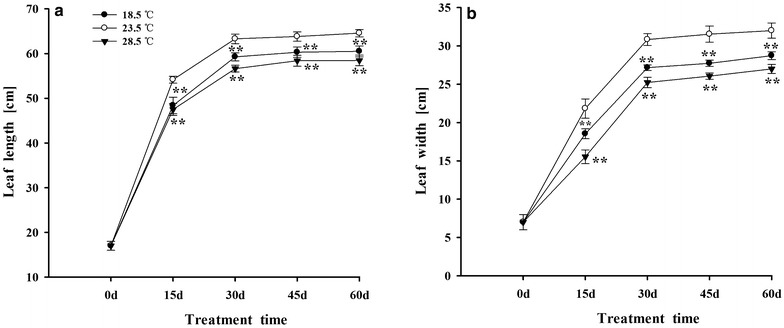
Background: Temperature remarkably affects the growth and metabolism of plants. Tobacco is an important cash crop, and the long-term effects of different growth temperatures (18.5, 23.5 and 28.5 °C, daily average) on growth, development and plastid pigments metabolism of tobacco plants were investigated in this study.
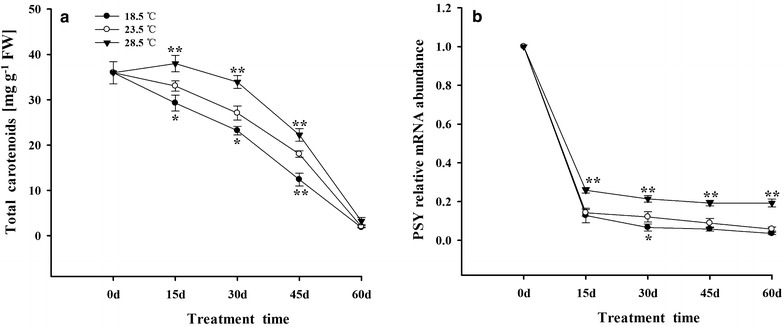
Results: Compared with tobacco plants grown under 23.5 °C, treatments with 18.5 and 28.5 °C inhibited the expansion of leaves. The contents of superoxide anion (O 2·- ), hydrogen peroxide (H2O2) and malonaldehyde (MDA) in the leaves were significantly increased under 28.5 °C from 0 to 60 days, which in turn accelerated the flowering and senescence of tobacco plants. By contrast, the treatment with 18.5 °C remarkably decreased O 2.- , H2O2 and MDA, and delayed the flowering and senescence. Furthermore, treatment with 18.5 °C significantly up-regulated the expression of glutamyl-tRNA reductase (Glu-TR) and magnesium chelatase (MgCH), and down-regulated the ferri chelatase (FeCH), protochlorophyllide oxidoreductase, chlorophyllase (CHLase), phaeophorbide a monooxygenase (PaO) and phytoene synthase (PSY), which further promoted the accumulation of chlorophyll (Chls) and reduced the carotenoids (Cars) in leaves. On the contrary, exposing to 28.5 °C remarkably down-regulated the Glu-TR and MgCH, and up-regulated the FeCH, CHLase, PaO and PSY, which in turn decreased the Chls and increased the Cars in tobacco leaves.
Conclusion: As compared with the plants grown under 23.5 °C, lower (18.5 °C) and higher (28.5 °C) growth temperature inhibited the growth of tobacco plants. In general, treatment with 28.5 °C accelerated the flowering and senescence of tobacco plants by enhancing the accumulation of O 2.- and H2O2 in leaves, while exposing to 18.5 °C had the opposite effects. Treatment with 18.5 °C increased the content of Chls and reduced the Cars in leaves. In contrast, Treatment with 28.5 °C decreased the Chls and increased the Cars. Moreover, both O 2.- and H2O2 took part in the breakdown of Chls in tobacco leaves to some extent. The results suggest that growth temperature could regulate growth, development, and plastid pigments metabolism, and 23.5 °C could be an optimal temperature for growth, development and metabolism of plastid pigments of tobacco plants under the experimental conditions.
Keywords: Growth and development; Growth temperature; Plastid pigments metabolism; Regulation; Tobacco plants.
Figures



References
-
- Adachi M, Shimokawa K. Evidence for the involvement of superoxide anion in the ethylene-inducted chlorophyll a catabolism of Raphanus sativus cotyledons. Phytochemistry. 1995;3:527–530. doi: 10.1016/0031-9422(95)00012-V. - DOI
-
- Apel K, Santel HJ, Redlinger TE, Falk H. The protochlorophyllide holochrome of barley (Hordeum Vulgare L.). Isolation and characterization of the NADPH: protochlorophyllide oxidoreductase. FEBS J. 1980;111:251–258. - PubMed
Grants and funding
- No. 31260064/National Natural Science Foundation of China
- No. 31460059/National Natural Science Foundation of China
- 110201101003 TS03/special project of science and technology State Tobacco Monopoly Bureau, China
- 2014YN16/China National Tobacco Corporation
- 01700205020516002/The New Ph.D. Candidate Academician Scholarship of Yunnan Province of 2016
LinkOut - more resources
Full Text Sources
Other Literature Sources
Research Materials
