


Mosquito repellents for malaria prevention
- PMID: 29405263
- PMCID: PMC5815492
- DOI: 10.1002/14651858.CD011595.pub2
Mosquito repellents for malaria prevention
Abstract
Background: Malaria is an important cause of illness and death across endemic regions. Considerable success against malaria has been achieved within the past decade mainly through long-lasting insecticide-treated nets (LLINs). However, elimination of the disease is proving difficult as current control methods do not protect against mosquitoes biting outdoors and when people are active. Repellents may provide a personal protection solution during these times.
Objectives: To assess the impact of topical repellents, insecticide-treated clothing, and spatial repellents on malaria transmission.
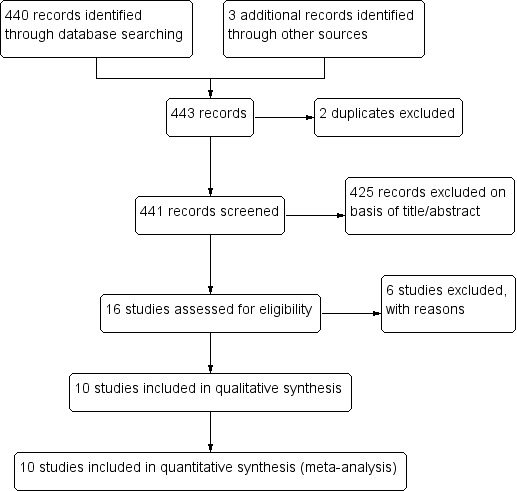
Search methods: We searched the following databases up to 26 June 2017: the Cochrane Infectious Diseases Group Specialized Register; the Central Register of Controlled Trials (CENTRAL), published in the Cochrane Library; MEDLINE; Embase; US AFPMB; CAB Abstracts; and LILACS. We also searched trial registration platforms and conference proceedings; and contacted organizations and companies for ongoing and unpublished trials.
Selection criteria: We included randomized controlled trials (RCTs) and cluster-randomized controlled trials of topical repellents proven to repel mosquitoes; permethrin-treated clothing; and spatial repellents such as mosquito coils. We included trials that investigated the use of repellents with or without LLINs, referred to as insecticide-treated nets.
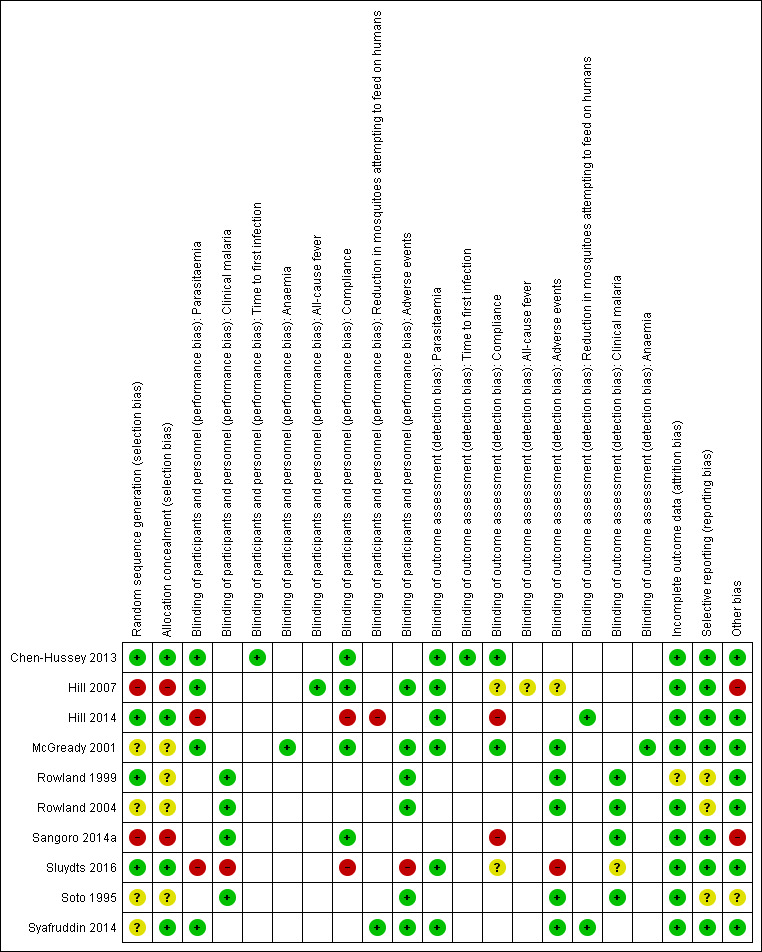
Data collection and analysis: Two review authors independently reviewed trials for inclusion, extracted the data, and assessed the risk of bias. A third review author resolved any discrepancies. We analysed data by conducting meta-analysis and stratified by whether the trials had included LLINs. We combined results from cRCTs with individually RCTs by adjusting for clustering and presented results using forest plots. We used GRADE to assess the certainty of the evidence.
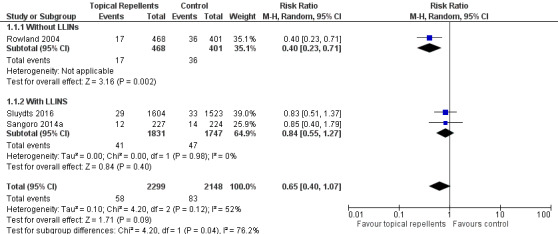
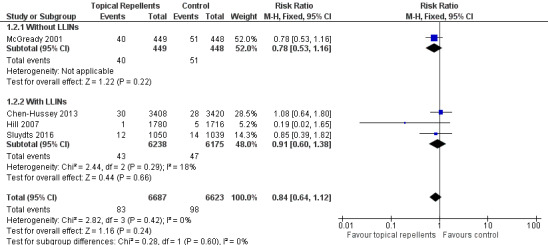
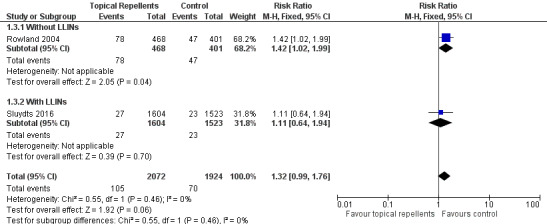
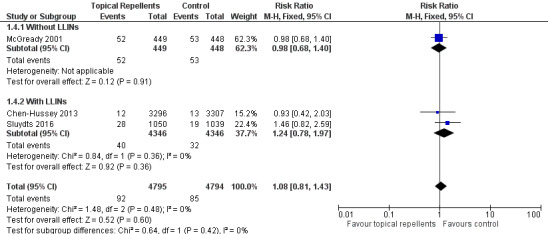
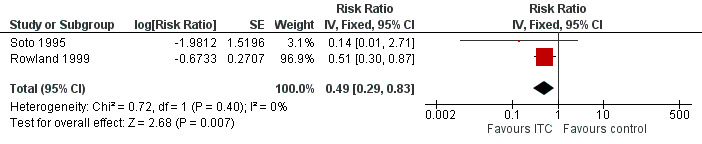
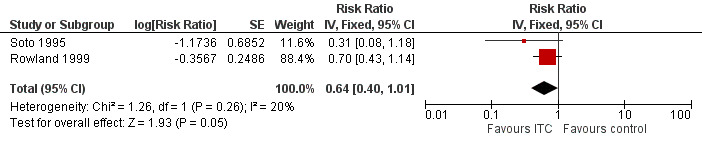
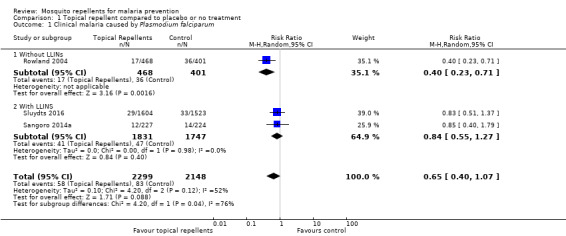
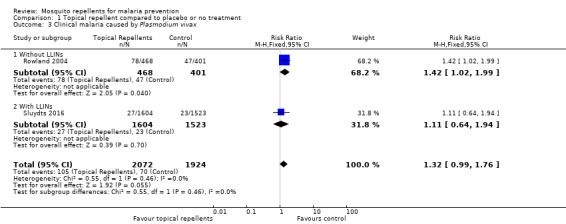
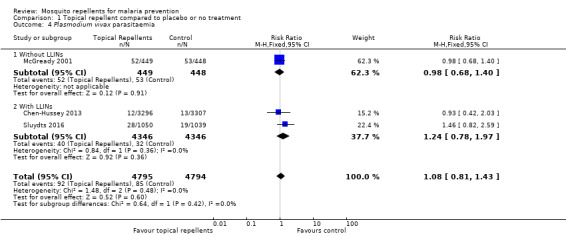
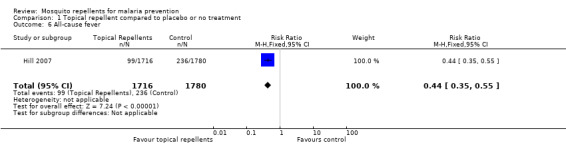
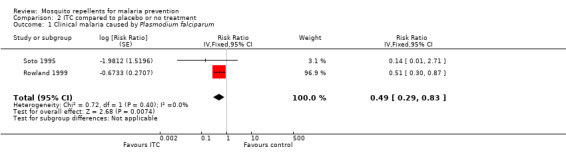
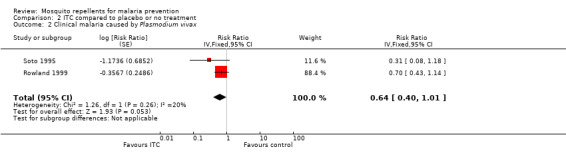
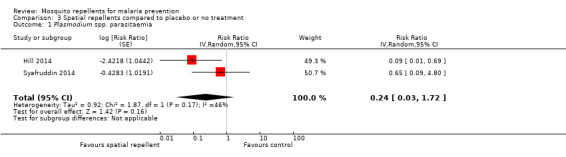
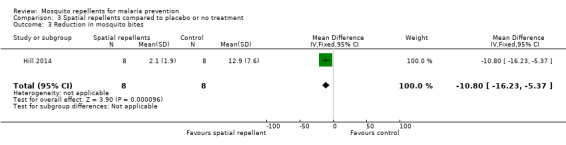
Main results: Eight cRCTs and two RCTs met the inclusion criteria. Six trials investigated topical repellents, two trials investigated insecticide-treated clothing, and two trials investigated spatial repellents.Topical repellentsSix RCTS, five of them cluster-randomized, investigated topical repellents involving residents of malaria-endemic regions. Four trials used topical repellents in combination with nets, but two trials undertaken in displaced populations used topical repellents alone. It is unclear if topical repellents can prevent clinical malaria (RR 0.65, 95% CI 0.4 to 1.07, very low certainty evidence) or malaria infection (RR 0.84, 95% CI 0.64 to 1.12, low-certainty evidence) caused by P. falciparum. It is also unclear if there is any protection against clinical cases of P. vivax (RR 1.32, 95% CI 0.99 to 1.76, low-certainty evidence) or incidence of infections (RR 1.07, 95% CI 0.80 to 1.41, low-certainty evidence). Subgroup analysis of trials including insecticide-treated nets did not show a protective effect of topical repellents against malaria. Only two studies did not include insecticide-treated nets, and they measured different outcomes; one reported a protective effect against clinical cases of P. falciparum (RR 0.40, 95% CI 0.23 to 0.71); but the other study measured no protective effect against malaria infection incidence caused by either P. falciparum or P. vivax.Insecticide-treated clothingInsecticide-treated clothing were investigated in trials conducted in refugee camps in Pakistan and amongst military based in the Colombian Amazon. Neither study provided participants with insecticide-treated nets. In the absence of nets, treated clothing may reduce the incidence of clinical malaria caused by P. falciparum by approximately 50% (RR 0.49, 95% CI 0.29 to 0.83, low-certainty evidence) and P. vivax (RR 0.64, 95% CI 0.40 to 1.01, low-certainty evidence).Spatial repellentsTwo cluster-randomized RCTs investigated mosquito coils for malaria prevention. We do not know the effect of spatial repellents on malaria prevention (RR 0.24, 95% CI 0.03 to 1.72, very low certainty evidence). There was large heterogeneity between studies and one study had high risk of bias.
Authors' conclusions: There is insufficient evidence to conclude topical or spatial repellents can prevent malaria. There is a need for better designed trials to generate higher certainty of evidence before well-informed recommendations can be made. Adherence to daily compliance remains a major limitation. Insecticide-treated clothing may reduce risk of malaria infection in the absence of insecticide-treated nets; further studies on insecticide-treated clothing in the general population should be done to broaden the applicability of the results.
Conflict of interest statement
MM, MK, MR, and CL have no conflicts of interest in any way related to the content of the review. They have no financial interests in relation to repellents for mosquito avoidance, either in the form of participations or incomes from commercial activities, patents, or from any form of sponsorship.
SJM has received salary coverage from BMGF research grant and PSI for two studies included in this review. However she did not have any role in deciding inclusion, assessment of risk of bias, data extraction, or interpretation of the results of those trials. In addition, SJM currently holds a research grant funded by the Deployed War Fighters Protection Fund evaluating permethrin‐treated clothing, which has been included in the review as an on‐going study. SJM declares no further known conflicts of interest.
Figures


Update of
References
References to studies included in this review
Chen‐Hussey 2013 {published data only}
Hill 2007 {published data only}
Hill 2014 {published data only}
-
- Hill N, Zhou HN, Wang P, Guo X, Carneiro I, Moore SJ. A household randomized, controlled trial of the efficacy of 0.03% transfluthrin coils alone and in combination with long‐lasting insecticidal nets on the incidence of Plasmodium falciparum and Plasmodium vivax malaria in Western Yunnan Province, China. Malaria Journal 2014;13:208. - PMC - PubMed
McGready 2001 {published data only}
-
- McGready R, Hamilton KA, Simpson J A, Cho T, Luxemburger C, Edwards R, et al. Safety of the insect repellent N,N‐diethyl‐M‐toluamide (DEET) in pregnancy. American Journal of Tropical Medicine and Hygiene 2001;65(4):285‐9. - PubMed
Rowland 1999 {published data only}
-
- Rowland M, Durrani N, Hewitt S, Mohammed N, Bouma M, Carneiro I, et al. Permethrin‐treated chaddars and top‐sheets: appropriate technology for protection against malaria in Afghanistan and other complex emergencies. Transactions of the Royal Society of Tropical Medicine and Hygiene 1999;93(5):465‐72. - PubMed
Rowland 2004 {published data only}
-
- Rowland M, Downey G, Rab A, Freeman T, Mohammad N, Rehman H, et al. DEET mosquito repellent provides personal protection against malaria: a household randomized trial in an Afghan refugee camp in Pakistan. Tropical Medicine & International Health 2004;9(3):335‐42. - PubMed
Sangoro 2014a {published data only}
-
- Miller JE. Low cost repellents for malaria prevention in rural Africa: the jury is still out. ASTMH 60th Annual Meeting, 2011 Dec 4‐8; Philadelphia. American Journal of Tropical Medicine and Hygiene 2011;6(Suppl. 1):369‐70.
-
- Sangoro P, Simfukwe E, Moore SJ. Cluster randomized controlled trial to determine the additional benefits of topical repellents to long lasting insecticide nets (LLINs) on malaria incidence. ASTMH 60th Annual Meeting, 2011 Dec 4‐8; Philadelphia. American Journal of Tropical Medicine and Hygiene 2011;6(Suppl. 1):229.
Sluydts 2016 {published data only}
-
- Sluydts V, Durnez L, Heng S, Gryseels C, Canier L, Kim S, et al. Efficacy of topical mosquito repellent (picaridin) plus long‐lasting insecticidal nets versus long‐lasting insecticidal nets alone for control of malaria: a cluster randomised controlled trial. Lancet Infectious Diseases 2016;16(10):1169‐77. - PubMed
Soto 1995 {published data only}
-
- Soto J, Medina F, Dember N, Berman J. Efficacy of permethrin‐impregnated uniforms in the prevention of malaria and leishmaniasis in Colombian soldiers. Clinical Infectious Diseases 1995;21(3):599‐602. - PubMed
References to studies excluded from this review
Abdulsalam 2014 {published data only}
-
- Abdulsalam YM, Muhammad H, Abduljalal A, Iliyasu Z, Muhammad B, Bello MM, et al. Effectiveness of transfluthrin‐coated inflammable‐fumes insecticide‐paper (Rambo) in the prevention of malaria in Kano, Nigeria. International Journal of Infectious Diseases 2014;21(1):154.
Dadzie 2013 {published data only}
Deressa 2014 {published data only}
Eamsila 1994 {published data only}
-
- Eamsila C, Frances S P, Strickman D. Evaluation of permethrin‐treated military uniforms for personal protection against malaria in northeastern Thailand. Journal of the American Mosquito Control Association 1994;10(4):515‐21. - PubMed
Hamza 2016 {published data only}
-
- Hamza M, Bello M, Ma'aruf M, Manu A, Ado A, Dalhatu Y, et al. Effectiveness of transfluthrin‐coated inflammable‐fumes insecticide‐paper (Rambo) in the prevention of malaria in Kano, Nigeria. Sub‐Saharan African Journal of Medicine 2016;3(2):111.
References to ongoing studies
ACTRN12616001434482 {published data only}
-
- ACTRN12616001434482. Effectiveness of mosquito repellent delivered through village health volunteers on malaria incidence in artemisinin resistance containment programs in South‐East Myanmar. www.anzctr.org.au/Trial/Registration/TrialReview.aspx?ACTRN=12616001434482 14‐10‐2016.
NCT02294188 {published data only}
-
- NCT02294188. Spatial Repellent Products for Control of Vector Borne Diseases ‐ Malaria ‐ Indonesia (SR‐M‐IDR). clinicaltrials.gov/ct2/show/NCT02294188 17‐11‐2014.
NCT02653898 {published data only}
-
- NCT02653839. Malaria elimination pilot study in military forces in Cambodia. clinicaltrials.gov/ct2/show/NCT02653839 08‐01‐2016.
NCT02938975 {published data only}
-
- NCT02938975. Field efficacy of insecticide treated uniforms and skin repellents for malaria prevention. clinicaltrials.gov/ct2/show/NCT02938975.
Additional references
Balshem 2011
-
- Balshem H, Helfand M, Schünemann HJ, Oxman AD, Kunz R, Brozek J, et al. GRADE guidelines: 3. Rating the quality of evidence. Journal of Clinical Epidemiology 2011;64(4):401‐6. - PubMed
Barbara 2011
-
- Barbara KA, Sukowati S, Rusmiarto S, Susapto D, Bangs MJ, Kinzer MH. Survey of Anopheles mosquitoes (Diptera:Culicidae) in West Sumba District, Indonesia. Southeast Asian Journal of Tropical Medicine and Public Health 2011;42(1):71‐82. - PubMed
CDC 2014
-
- Centers for Disease Control and Prevention. In: Brunette GW editor(s). CDC Health Information for International Travel. New York: Oxford University Press, 2014.
Durnez 2013
-
- Durnez L, Coosemans M. Chapter 21: Residual transmission of malaria: an old issue for new approaches. In: Manguin S editor(s). Anopheles mosquitoes ‐ new insights into malaria vectors. Rijeka, Croatia: Intech, 2013.
Garrett‐Jones 1964
-
- Garrett‐Jones C. Prognosis for interruption of malaria transmission through assessment of the mosquito's vectorial capacity. Nature 1964;204:1173‐5. - PubMed
Guyatt 2011
-
- Guyatt GH, Oxman AD, Schünemann HJ, Tugwell P, Knottnerus A. GRADE guidelines: a new series of articles in the Journal of Clinical Epidemiology. Journal of Clinical Epidemiology 2011;64(4):380‐2. - PubMed
Harbord 2006
-
- Harbord RM, Egger M, Sterne JA. A modified test for small‐study effects in meta‐analyses of controlled trials with binary endpoints. Statistics in Medicine 2006;25(20):3443‐57. - PubMed
Herodotus 1996
-
- Herodotus. Herodotus: The Histories. London: Penguin, 1996.
Higgins 2011
Kitchen 2009
-
- Kitchen LW, Lawrence KL, Coleman RE. The role of the United States military in the development of vector control products, including insect repellents, insecticides, and bed nets. Journal of Vector Ecology: Journal of the Society for Vector Ecology 2009;34(1):50‐61. - PubMed
Lefebvre 2011
-
- Lefebvre C, Manheimer E, Glanville J. Chapter 6: Searching for studies. In: Higgins JP, Green S, editor(s). Cochrane Handbook for Systematic Reviews of Interventions Version 5.1.0 (updated March 2011). The Cochrane Collaboration, 2011. Available from handbook.cochrane.org.
malERA 2011
Moore 2002
-
- Moore SJ, Lenglet A, Hill N. Field evaluation of three plant‐based insect repellents against malaria vectors in Vaca Diez Province, the Bolivian Amazon. Journal of the American Mosquito Control Association 2002;18(2):107‐10. - PubMed
Review Manager 2014 [Computer program]
-
- Nordic Cochrane Centre, The Cochrane Collaboration. Review Manager 5 (RevMan 5). Version 5.3. Copenhagen: Nordic Cochrane Centre, The Cochrane Collaboration, 2014.
Sangoro 2014b
-
- Sangoro PO, Moore SJ. Evaluation of Repellent Efficacy in Reducing Disease Incidencee. In: Debboun M, Frances SP, Strickman D editor(s). Repellents: principles, methods and uses. 2nd Edition. Boca Raton, Florida: CRC Press, 2014.
Sangoro 2014c
Sinka 2010
Sinka 2011
Snow 1998
-
- Snow RW, Peshu N, Forster D, Bomu G, Mitsanze E, Ngumbao E, et al. Environmental and entomological risk factors for the development of clinical malaria among children on the Kenyan coast. Transactions of the Royal Society of Tropical Medicine and Hygiene 1998;92(4):381‐5. - PubMed
Sturrock 2013
Tatem 2010
Van Roey 2014
White 2014
-
- White NJ, Pukrittayakamee S, Hien TT, Faiz MA, Mokuolu OA, Dondorp AM. Malaria. Lancet 2014;383(9918):723‐35. - PubMed
WHO 2012
-
- World Health Organization. International Travel and Health. Geneva: World Health Organization, 2012.
WHO 2017
-
- World Health Organization. World Malaria Report 2017. http://apps.who.int/iris/bitstream/10665/259492/1/9789241565523‐eng.pdf?... (accessed 4 February 2018).
WHOPES 1998
-
- WHOPES. Report of First Meeting of the Global Collaboration for the Development of Pesticides for Public Health (GCDPP). 1998 14‐15 October; WHO/HQ Geneva. www.who.int/whopes/gcdpp/en/oct98_gcdpp_report.pdf (accessed 25 March 2014).
WHOPES 2006
-
- WHOPES. Pesticides and their application: For the control of vectors and pests of public health importance. 6th edition. whqlibdoc.who.int/hq/2006/WHO_CDS_NTD_WHOPES_GCDPP_2006.1_eng.pdf (accessed 25 March 2014).
Wilson 2014
Publication types
MeSH terms
Substances
LinkOut - more resources
Full Text Sources
Other Literature Sources
Medical
Miscellaneous
