


Stress and marital adjustment in families of children with cancer
- PMID: 29405486
- PMCID: PMC6685199
- DOI: 10.1002/pon.4661
Stress and marital adjustment in families of children with cancer
Abstract
Objective: Pediatric cancer is highly stressful for parents. The current prospective study examines the impact of several stressors (financial strain, life threat, treatment intensity, treatment-related events, and negative life events) on the trajectory of marital adjustment across the first year following diagnosis. We examined whether average level of stressors across the year was related to (1) levels of marital adjustment at the end of the first year of treatment and () the rate of change in marital adjustment.
Method: One hundred and thirty families of children newly diagnosed with cancer (M age = 6.33 years, SD = 3.61) participated. Primary caregivers provided 12 monthly reports on marital adjustment and stressors.
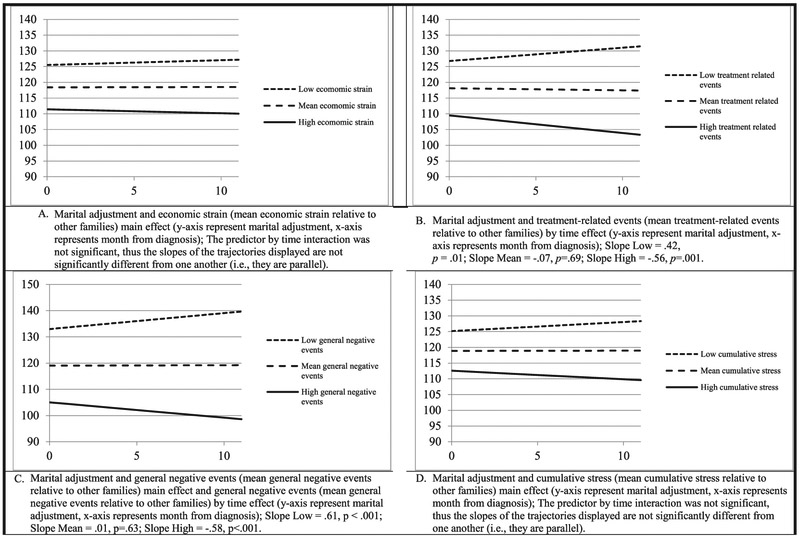
Results: Multilevel models indicated that although marital adjustment was stable across the first year on average, random effect estimates suggested that this was the result of differing trajectories between families (eg, some increasing and others decreasing). Five individual stress constructs and a cumulative stress composite were then used to predict this variability. Higher average economic strain was related to consistently poorer marital adjustment across time. Higher average frequency of treatment-related events and negative life events were associated with decreasing adjustment over time and lower adjustment at the end of the first year of treatment. Perception of life threat and treatment intensity were not associated with final levels or trajectory of adjustment. Finally, higher cumulative stress was associated with consistently poorer marital adjustment across time.
Conclusion: Implications for identification of at-risk families are discussed, and importance of delivering tailored interventions for this population.
Keywords: economic strain; life threat; marital adjustment; pediatric cancer; stress; treatment.
Copyright © 2018 John Wiley & Sons, Ltd.
Figures
References
-
- Evan EE, Zeltzer LK. Psychosocial dimensions of cancer in adolescents and young adults. Cancer. 2006;107(S7):1663–1671. - PubMed
-
- van Schoors M, Caes L, Knoble NB, Goubert L, Verhofstadt LL, Alderfer MA. Systematic review: Associations between family functioning and child adjustment after pediatric cancer diagnosis: A meta-analysis. J Pediatr Psychol. 2017;42(1):6–18. - PubMed
-
- Long KA, Marsland AL. Family adjustment to childhood cancer: A systematic review. Clin Child Fam Psychol Rev. 2011;14(1):57–88. - PubMed
-
- Katz LF, Gottman JM. Patterns of marital conflict predict children's internalizing and externalizing behaviors. Dev Psychol. 1993;29(6):940–950.
-
- Katz LF, Fladeboe K, Lavi I, King K, Kawamura J, Friedman D, et al. Longitudinal patterns of marital, parent-child and sibling conflict in the first year after a child's diagnosis of cancer. The 48th Annual Congress of the International Society of Paediatric Oncology; Dublin, Ireland 2016.
Publication types
MeSH terms
Grants and funding
LinkOut - more resources
Full Text Sources
Other Literature Sources
Medical
