


Risk scoring tool to predict respiratory syncytial virus hospitalisation in premature infants
- PMID: 29405612
- PMCID: PMC6099524
- DOI: 10.1002/ppul.23960
Risk scoring tool to predict respiratory syncytial virus hospitalisation in premature infants
Abstract
Background: The objective was to develop a risk scoring tool which predicts respiratory syncytial virus hospitalisation (RSVH) in moderate-late preterm infants (32-35 weeks' gestational age) in the Northern Hemisphere.
Methods: Risk factors for RSVH were pooled from six observational studies of infants born 32 weeks and 0 days to 35 weeks and 6 days without comorbidity from 2000 to 2014. Of 13 475 infants, 484 had RSVH in the first year of life. Logistic regression was used to identify the most predictive risk factors, based on area under the receiver operating characteristic curve (AUROC). The model was validated internally by 100-fold bootstrapping and externally with data from a seventh observational study. The model coefficients were converted into rounded multipliers, stratified into risk groups, and number needed to treat (NNT) calculated.
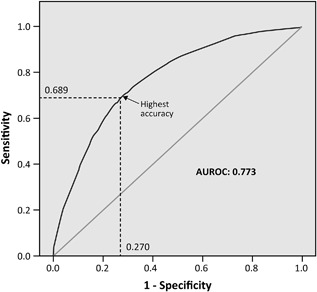
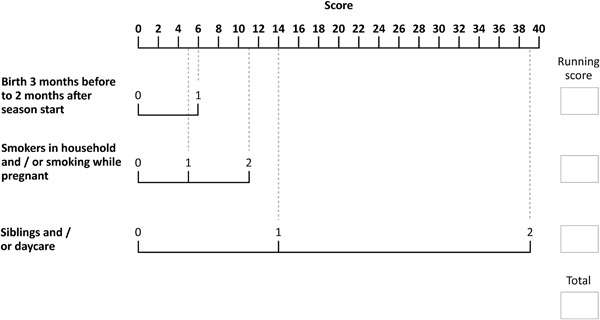
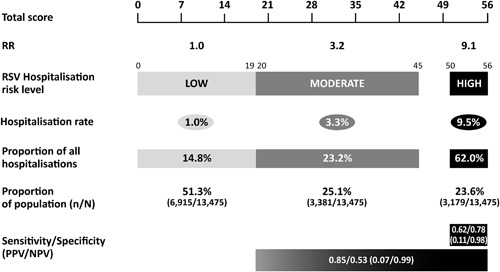
Results: The risk factors identified in the model included (i) proximity of birth to the RSV season; (ii) second-hand smoke exposure; and (iii) siblings and/or daycare. The AUROC was 0.773 (sensitivity: 68.9%; specificity: 73.0%). The mean AUROC from internal bootstrapping was 0.773. For external validation with data from Ireland, the AUROC was 0.707 using Irish coefficients and 0.681 using source model coefficients. Cut-off scores for RSVH were ≤19 for low- (1.0%), 20-45 for moderate- (3.3%), and 50-56 (9.5%) for high-risk infants. The high-risk group captured 62.0% of RSVHs within 23.6% of the total population (NNT 15.3).
Conclusions: This risk scoring tool has good predictive accuracy and can improve targeting for RSVH prevention in moderate-late preterm infants.
Keywords: bronchiolitis; lower respiratory tract infection; prematurity; risk assessment; risk factors.
© 2018 Wiley Periodicals, Inc.
Figures
References
-
- Palmer L, Hall CB, Katkin JP, et al. Respiratory outcomes, utilization and cost 12 months following a respiratory syncytial virus diagnosis among commercially insured late‐preterm infants. Curr Med Res Opin. 2011; 27:403–412. - PubMed
Publication types
MeSH terms
Substances
LinkOut - more resources
Full Text Sources
Other Literature Sources
Medical
