


What "likes" have got to do with it: Exposure to peers' alcohol-related posts and perceptions of injunctive drinking norms
- PMID: 29405864
- PMCID: PMC6317514
- DOI: 10.1080/07448481.2018.1431895
What "likes" have got to do with it: Exposure to peers' alcohol-related posts and perceptions of injunctive drinking norms
Abstract
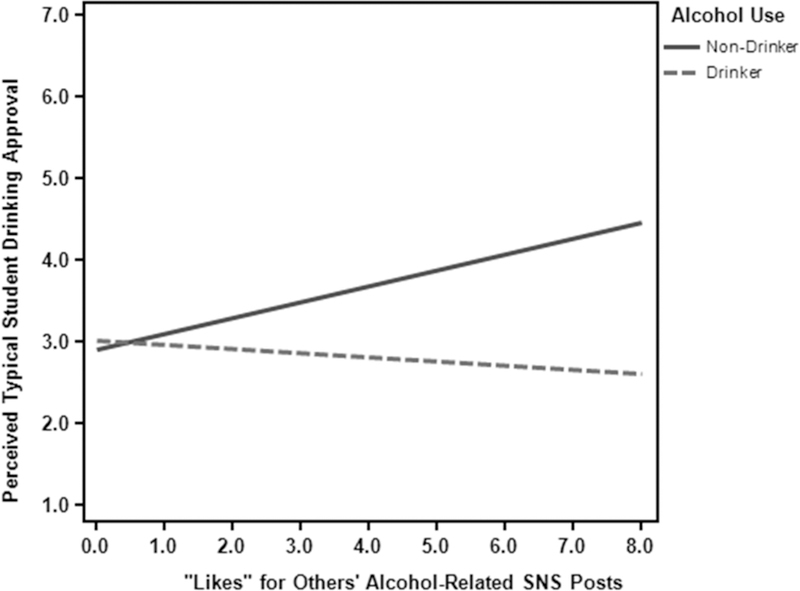
Objective: Examine 1) whether observed social reinforcements (i.e., "likes") received by peers' alcohol-related social media posts are related to first-year college students' perceptions of peer approval for risky drinking behaviors; and 2) whether associations are moderated by students' alcohol use status.
Participants: First-year university students (N = 296) completed an online survey in September, 2014.
Method: Participants reported their own alcohol use, friends' alcohol use, perceptions of the typical student's approval for risky drinking, and ranked 10 types of social media posts in terms of the relative numbers of "likes" received when posted by peers.
Results: Observed social reinforcement (i.e., "likes") for peers' alcohol-related posts predicted perceptions of peer approval for risky drinking behaviors among non-drinking students, but not drinking students.
Conclusions: For first-year college students who have not yet initiated drinking, observing peers' alcohol-related posts to receive abundant "likes" may increase perceptions of peer approval for risky drinking.
Keywords: Alcohol; college students; norms; social media.
Figures
References
-
- Foster C, Caravelis C, Kopak A. National college health assessment measuring negative alcohol-related consequences among college students. American Journal of Public Health Research 2014;2(1):1–5.
-
- Alcoholism NIoAAa. College drinking 2015; http://pubs.niaaa.nih.gov/publications/CollegeFactSheet/CollegeFact.htm. Accessed December 11, 2014.
Publication types
MeSH terms
Grants and funding
LinkOut - more resources
Full Text Sources
Other Literature Sources
Medical
