. 2018 Feb 6:5:180005.
doi: 10.1038/sdata.2018.5.

RNA-seq transcriptomic analysis of adult zebrafish inner ear hair cells

Affiliations

RNA-seq transcriptomic analysis of adult zebrafish inner ear hair cells

Cody L Barta et al. Sci Data. .

Abstract

Although hair cells are the sensory receptors of the auditory and vestibular systems in the ears of all vertebrates, hair cell properties are different between non-mammalian vertebrates and mammals. To understand the basic biological properties of hair cells from non-mammalian vertebrates, we examined the transcriptome of adult zebrafish auditory and vestibular hair cells. GFP-labeled hair cells were isolated from inner-ear sensory epithelia of a pou4f3 promoter-driven GAP-GFP line of transgenic zebrafish. One thousand hair cells and 1,000 non-sensory surrounding cells (nsSCs) were separately collected for each biological replicate, using the suction pipette technique. RNA sequencing of three biological replicates for the two cell types was performed and analyzed. Comparisons between hair cells and nsSCs allow identification of enriched genes in hair cells, which may underlie hair cell specialization. Our dataset provides an extensive resource for understanding the molecular mechanisms underlying morphology, function, and pathology of adult zebrafish hair cells. It also establishes a framework for future characterization of genes expressed in hair cells and the study of hair cell evolution.


Conflict of interest statement

The authors declare no competing financial interests.

Figures

Figure 1
Figure 1. Study design workflow for cell isolation and collection for transcriptome analysis of GFP-positive hair cells (we used HCs in all figures) and GFP-negative nsSCs isolated from adult zebrafish inner ear.
Schematic drawing of zebrafish is modified from Fig. 1 of a previous publication (with permission from Frontier in Cellular Neuroscience). (a) Workflow of experimental design for RNA-seq and transcriptome analysis for 1,000 individually collected hair cells and nsSCs. (b) GFP-expressing hair cells in saccule and lagena of zebrafish inner ear. (c) Suction pipette technique used to manually collect individual hair cells and nsSCs. (d) Examples of GFP-expressing hair cells. Only those cells that had both GFP expression and stereocilia bundles were selected. (e) Example of GFP-expressing cells without visible stereocilia bundles. The identify of these cells was unknown, so they were not collected. (f) An example of a nsSC with no GFP expression. An equal number of nsSCs was individually collected for comparison with hair cells. Bars: 20 μm (b), 10 μm (c), and 10 μm (df).
Figure 2
Figure 2. Examples of RNA-isolation quality results and Phred scores of RNA-sequencing reads.
(a) RNA quality for hair cells. (b) RNA quality for nsSCs. (c) Phred scores for one of the sequenced hair cell samples. (d) Phred scores for one of the sequenced nsSC samples.
Figure 3
Figure 3. Reproducibility of biological replicates and gene expression hierarchy of different cell populations from adult zebrafish.
(a) Correlation coefficient of biological replicates. Replicate 1 of hair cells and replicate 1 of nsSCs were separately used as reference (red lines). (b) PCA analysis of the gene expression profiles of hair cells and nsSCs compared with microglia (MGC) and liver cells, all from adult zebrafish. The top five expressed genes in PCA analysis were: s100s, mt-co2, AC024175.9, pvalb9, mt-co3 for hair cells; mt-co2, mt-co3, AC024175.9, AC024175.4, mt-cyb for nsSCs; AC024175.4, mt-co2, mt-co1, mt-co3, tmsb4x for microglial cells; and, apoa1b, apoa2, tfa, fabp10a, and apoc1l for liver cells, respectively. (c) Clustering analysis of gene expression of hair cells, nsSCs, MGC, and liver cells.
Figure 4
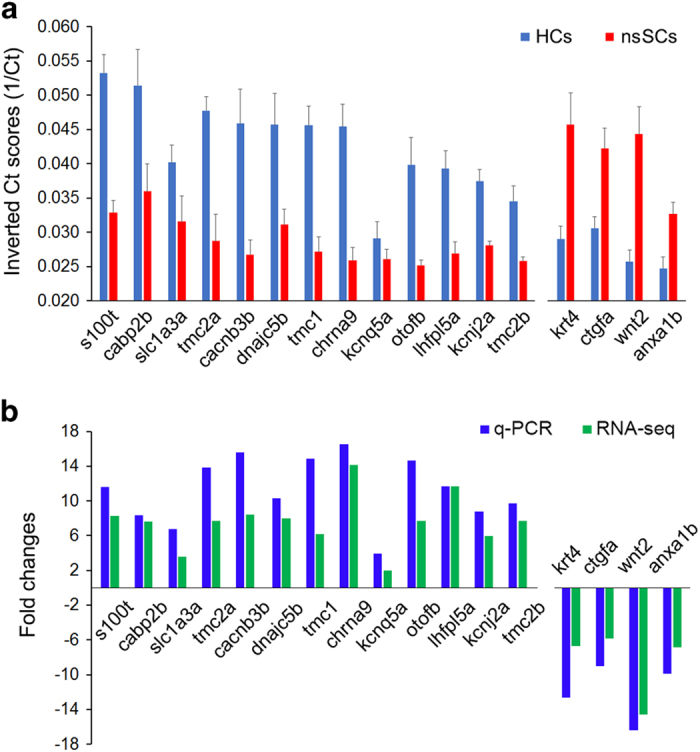
Figure 4. Q-PCR validation of differential expression of 17 genes.
(a) Comparison of the expression of 18 genes in hair cells and nsSCs using q-PCR. The difference in the inverted Ct scores for each gene between hair cells and nsSCs was statistically significant (P≤0.01, n=3). Note that the ordinate is the inverse of the number of PCR cycles necessary to reach fluorescence threshold. So even a small difference (such as 0.01) reflects a large difference between the two cell populations. (b) Fold differences in expression of these 17 genes between hair cells and nsSCs using q-PCR and RNA-seq. Positive values indicate higher gene expression in hair cells while negative values indicate higher expression values in nsSCs. Fold differences are all calculated in log2 base.

References

Data Citations

    1. Barta C. L. 2017. Figshare. http://doi.org/10.6084/m9.figshare.5625313 - DOI
    1. 2017. NCBI Sequence Read Archive. SRP113243
    1. 2017. NCBI Gene Expression Omnibus. GSE101693
    1. Barta C. L. 2017. Figshare. http://doi.org/10.6084/m9.figshare.5625403 - DOI
    1. 2016. NCBI Gene Expression Omnibus. GSM2310340

References

    1. Fettiplace R. & Kim K. X. The physiology of mechanoelectrical transduction channels in hearing. Physiol. Rev. 94, 951–986 (2014). - PMC - PubMed
    1. Kros C. J. in The Cochlea (eds Dallos P. & Fay R. R.) 318–385 (Springer, 1996).
    1. Sewell W. F. in The Cochlea (eds Dallos P. & Fay R. R.) 503–533 (Springer, 1996).
    1. Safieddine S., El-Amraoui A. & Petit C. The auditory hair cell ribbon synapse: from assembly to function. Annu. Rev. Neurosci. 35, 509–528 (2012). - PubMed
    1. Fettiplace R. & Fuchs P. A. Mechanisms of hair cell tuning. Annu. Rev. Physiol. 61, 809–834 (1999). - PubMed

Publication types