


Carboxymethyl Chitosan and Its Hydrophobically Modified Derivative as pH-Switchable Emulsifiers
- PMID: 29406746
- PMCID: PMC6150725
- DOI: 10.1021/acs.langmuir.7b03959
Carboxymethyl Chitosan and Its Hydrophobically Modified Derivative as pH-Switchable Emulsifiers
Abstract
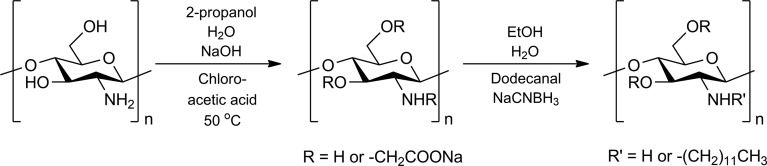
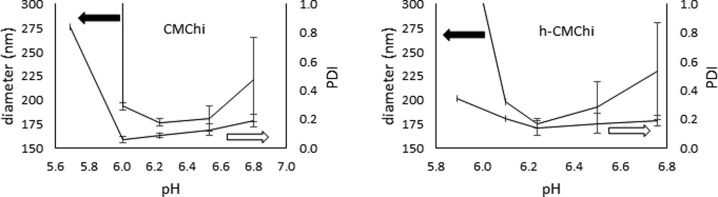
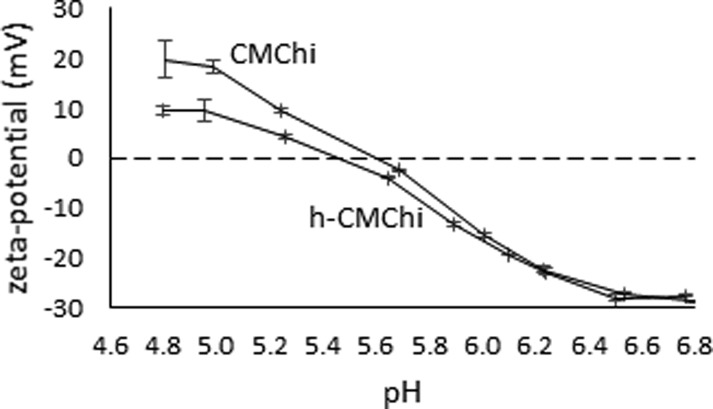
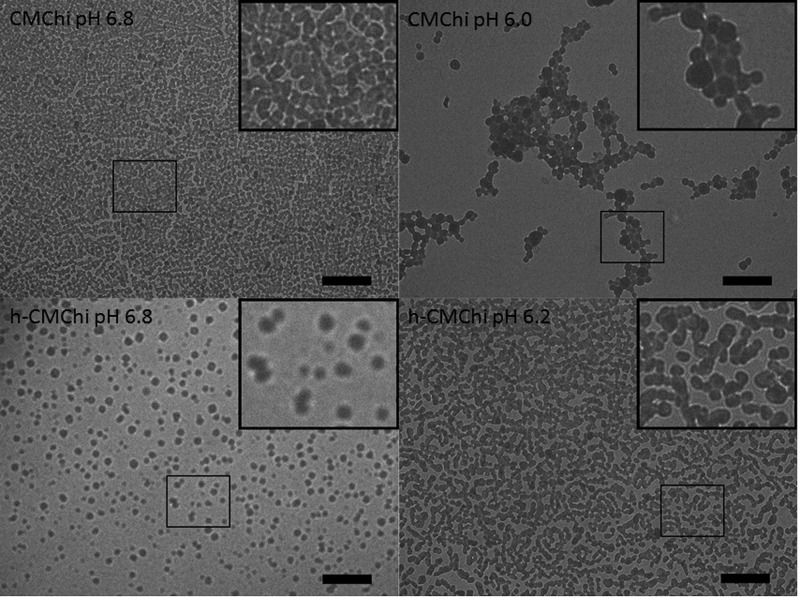
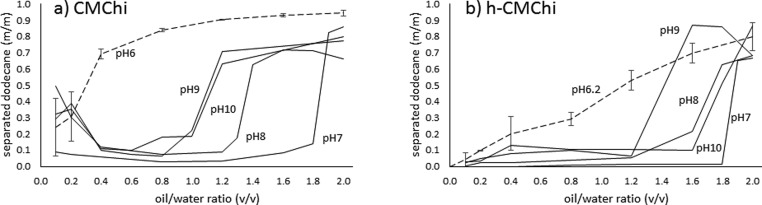
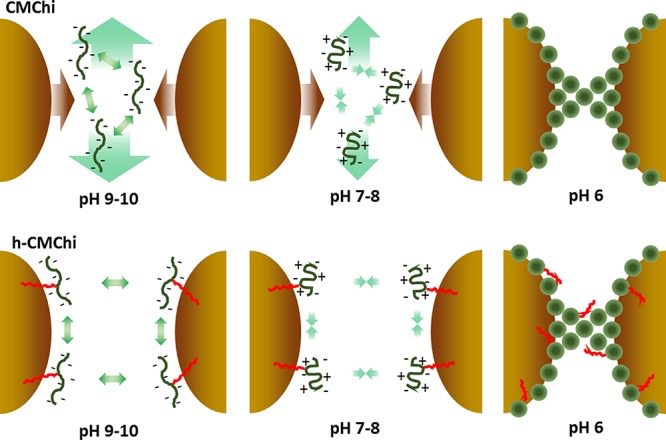
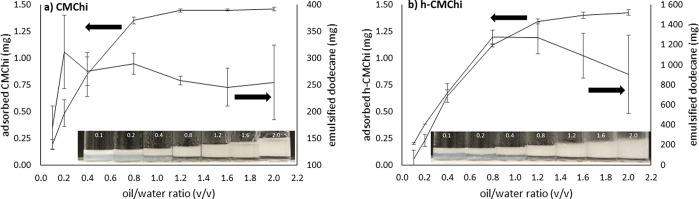
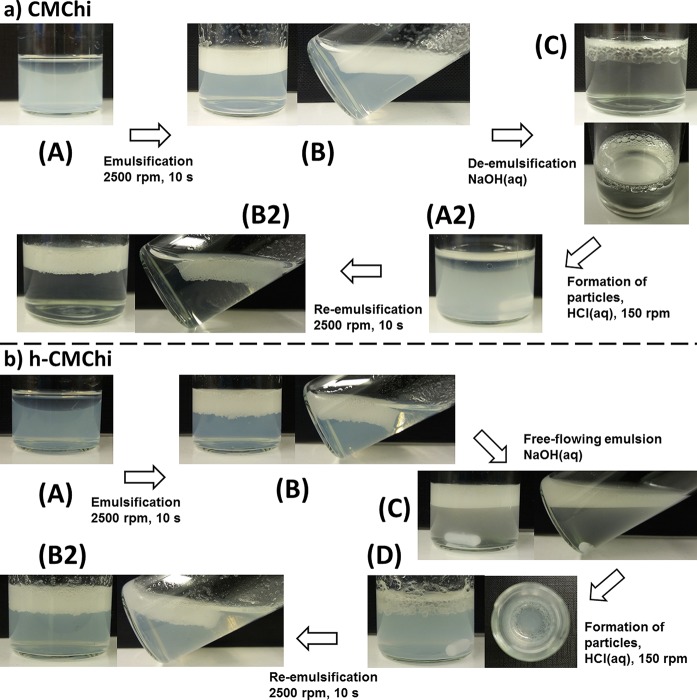
The emulsification properties of carboxymethyl chitosan (CMChi) and hydrophobically modified carboxymethyl chitosan (h-CMChi) were studied as a function of pH and dodecane/water ratio. The pH was varied between 6-10, and the oil/water ratio between 0.1-2.0. In CMChi solution, the emulsion stability increased as the pH was lowered from 10 to 7, and the phase inversion was shifted from oil/water ratio 1.0 to 1.8, respectively. The system behaved differently in pH 6 due to the aggregation of CMChi and the formation of nanoparticles (∼200-300 nm). No phase inversion was observed and the maximum amount of emulsified oil was reached at oil/water ratio 1.2. The h-CMChi showed similar behavior as a function of pH but, due to hydrophobic modification, the phase inversion was shifted to higher values in pH 7-10. In pH 6, the behavior was similar, but the maximum amount of emulsified oil was higher compared to CMChi. The amount of adsorbed particles correlated with the emulsified amount of oil. Reversible emulsification of dodecane was demonstrated by pH adjustment using CMChi and h-CMChi solutions. The formed emulsions were gel-like, suggesting particle-particle interaction.
Conflict of interest statement
The authors declare no competing financial interest.
Figures
References
-
- Liu H.; Wei Z.; Hu M.; Deng Y.; Tong Z.; Wang C. Fabrication of degradable polymer microspheres via pH-responsive chitosan-based Pickering emulsion photopolymerization. RSC Adv. 2014, 4, 29344–29351. 10.1039/C4RA01660B. - DOI
-
- Wei Z.; Wang C.; Zou S.; Liu H.; Tong Z. Chitosan nanoparticles as particular emulsifier for preparation of novel pH-responsive Pickering emulsions and PLGA microcapsules. Polymer 2012, 53, 1229–1235. 10.1016/j.polymer.2012.02.015. - DOI
-
- Mwangi W.; Ho K.-W.; Ooi C.-W.; Tey B.-T.; Chan E.-S. Facile method for forming ionically cross-linked chitosan microcapsules from Pickering emulsion templates. Food Hydrocolloids 2016, 55, 26–33. 10.1016/j.foodhyd.2015.10.022. - DOI
-
- Ho K.; Ooi C.-W.; Mwangi W.; Leong W.; Tey B.-T.; Chan E.-S. Comparison of self-aggregated chitosan particles prepared with and without ultrasonication pretreatment as Pickering emulsifier. Food Hydrocolloids 2016, 52, 827–837. 10.1016/j.foodhyd.2015.08.019. - DOI
Publication types
MeSH terms
Substances
LinkOut - more resources
Full Text Sources
Other Literature Sources
