


Description and prediction of time-to-attainment of excellent recovery for borderline patients followed prospectively for 20 years
- PMID: 29407567
- PMCID: PMC6025755
- DOI: 10.1016/j.psychres.2018.01.034
Description and prediction of time-to-attainment of excellent recovery for borderline patients followed prospectively for 20 years
Abstract
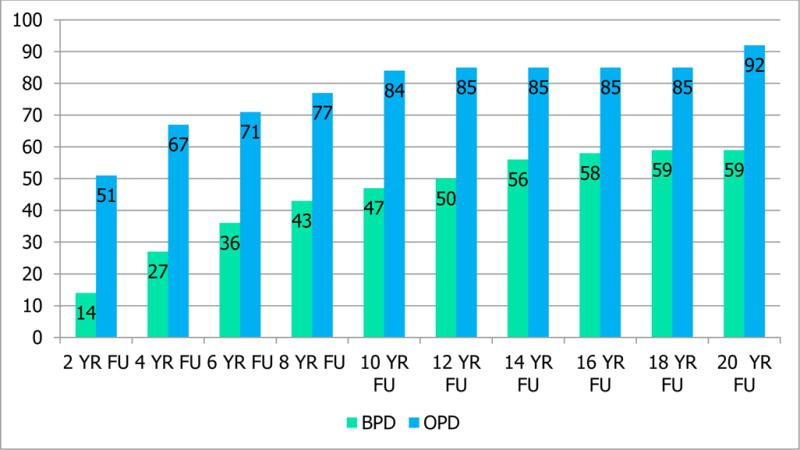
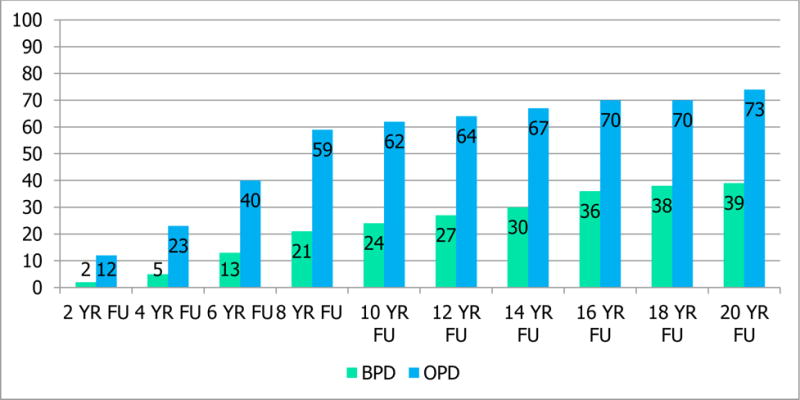
One purpose of this study was to determine the cumulative rates of excellent recovery for borderline patients and axis II comparison subjects followed prospectively for 20 years. Another purpose was to find the best set of baseline predictors of excellent recovery for borderline patients. A total of 290 inpatients meeting rigorous criteria for borderline personality disorder and 72 axis II comparison subjects completed semistructured interviews and self-report measures during their index admission. Subjects were reassessed prospectively over 10 contiguous two-year waves of follow-up. Thirty-nine percent of borderline patients and 73% of personality-disordered comparison subjects met our operationalized definition of excellent recovery (concurrent remission of borderline or another primary personality disorder, good social and full-time vocational functioning, and absence of an axis I disorder associated decreased social and/or vocational functioning). Five variables formed our multivariate predictive model of excellent recovery for borderline patients: higher IQ, good childhood work history, good adult vocational record, lower trait neuroticism, and higher trait agreeableness. The results of this study suggest that complete recovery is difficult for borderline patients to achieve even over long periods of time. They also suggest that competence displayed in both childhood and adulthood is the best predictor of this important outcome.
Copyright © 2018 Elsevier B.V. All rights reserved.
Figures
References
-
- Benjamini Y, Hochberg Y. Controlling the false discovery rate: a practical and powerful approach to multiple testing. J R Stat Soc Series B Stat Methodol. 1995;57:289–300.
-
- Costa PT, McCrae RR. Revised NEO Personality Inventory and NEO Five-Factor Inventory Professional Manual. Psychological Assessment Resources; Odessa, Florida: 1992.
-
- Distel MA, Trull TJ, Willemsen G, Vink JM, Derom CA, Lynskey M, Martin NG, Boomsma DI. The five-factor model of personality and borderline personality disorder: a genetic analysis of comorbidity. Biol Psychiatry. 2009;66:1131–1138. - PubMed
-
- Duckworth AL, Peterson C, Matthews MD, Kelly DR. Grit: perseverance and passion for long-term goals. J Pers Soc Psychol. 2007;92:1087–1101. - PubMed
-
- Endicott J, Spitzer RL, Fleiss JL, Cohen J. The Global Assessment Scale: a procedure for measuring overall severity of psychiatric disturbance. Arch Gen Psychiatry. 1976;33:766–771. - PubMed
Publication types
MeSH terms
Grants and funding
LinkOut - more resources
Full Text Sources
Other Literature Sources
Medical
Miscellaneous
