


The effects of the botanical estrogen, isoliquiritigenin on delayed spatial alternation
- PMID: 29408209
- PMCID: PMC5856646
- DOI: 10.1016/j.ntt.2018.02.001
The effects of the botanical estrogen, isoliquiritigenin on delayed spatial alternation
Abstract
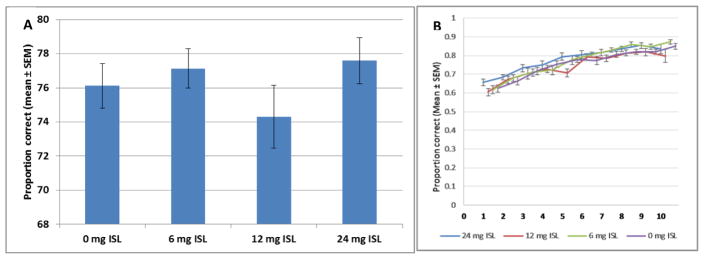
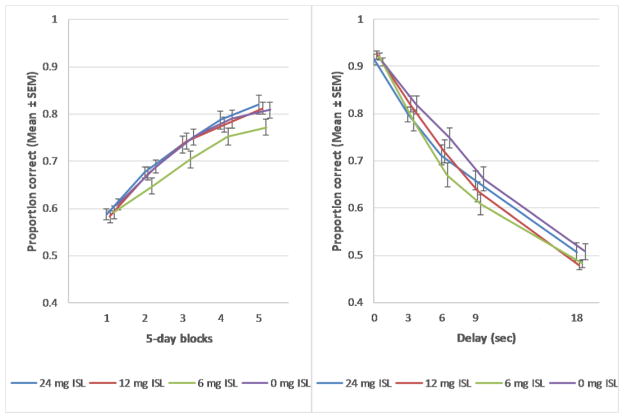
Age-related declines in cognitive function can impair working memory, reduce speed of processing, and alter attentional resources. In particular, menopausal women may show an acceleration in the rate of cognitive decline as well as an increased vulnerability to brain diseases as estrogens may play a neuroprotective and neurotrophic role in the brain. To treat menopausal symptoms, many women turn to botanical estrogens that are promoted as a safe and natural alternative to traditional hormone replacement therapy. However, the majority of these compounds have not been systematically evaluated for efficacy and safety. The current study investigated the efficacy of the commercially available botanical estrogenic compound isoliquiritigenin (ISL) to alter performance on an operant working memory task, delayed spatial alternation (DSA). ISL is a compound found in licorice root that has been shown to have a wide range of effects on different biological systems, including estrogenic properties. This botanical is currently being used in over the counter dietary supplements. Middle-aged (12-month old) Long-Evans female rats were ovariectomized and orally dosed with either 0 mg, 6 mg, 12 mg or 24 mg of ISL 60 min before testing on the DSA task. The DSA task required the rat to alternate its responses between two retractable levers in order to earn food rewards. Random delays of 0, 3, 6, 9 or 18 s were imposed between opportunities to press. ISL treatment failed to alter DSA performance. Previous work from our research group has found that estrogenic compounds, including 17β-estradiol and the botanical estrogen genistein impair performance on the DSA task. The goal of our botanical estrogens research is to find compounds that offer some of the beneficial effects of estrogen supplementation, without the harmful effects. This work suggests that ISL may not carry the cognitive risks associated with most other estrogenic compounds tested to date.
Keywords: Aging; Isoliquiritigenin; Phytoestrogens; Prefrontal; Working memory.
Copyright © 2018 Elsevier Inc. All rights reserved.
Figures
References
-
- D’Esposito M. From cognitive to neural models of working memory. Philosophical Transactions of the Royal Society B: Biological Sciences. 2007;362(1481):761–772. https://doi.org/10.1098/rstb.2007.2086. - DOI - PMC - PubMed
-
- Engler-Chiurazzi EB, Brown CM, Povroznik JM, Simpkins JW. Estrogens as neuroprotectants: Estrogenic actions in the context of cognitive aging and brain injury. Progress in neurobiology. 2016 https://doi.org/10.1016/j.pneurobio.2015.12.008. - DOI - PMC - PubMed
-
- Gasbarri A, Pompili A, Clotilde Tavares M, Tomaz C. Estrogen and cognitive functions. Expert review of endocrinology & metabolism. 2009;4(5):507–520. http://dx.doi.org/10.1586/eem.09.30. - DOI - PubMed
-
- Geller SE, Studee L. Botanical and dietary supplements for menopausal symptoms: what works, what does not. Journal of women’s health. 2005;14(7):634–649. https://doi.org/10.1089/jwh.2005.14.634. - DOI - PMC - PubMed
Publication types
MeSH terms
Substances
Grants and funding
LinkOut - more resources
Full Text Sources
Other Literature Sources
Medical
