


Inflammatory immune cells may impair the preBCR checkpoint, reduce new B cell production, and alter the antibody repertoire in old age
- PMID: 29408522
- PMCID: PMC5869160
- DOI: 10.1016/j.exger.2018.01.023
Inflammatory immune cells may impair the preBCR checkpoint, reduce new B cell production, and alter the antibody repertoire in old age
Abstract
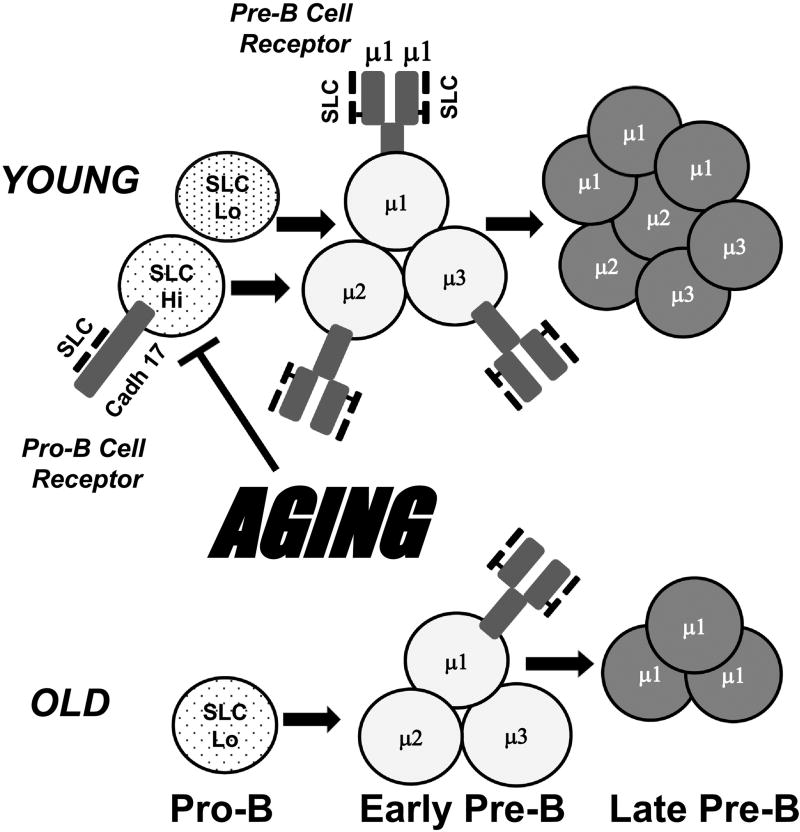
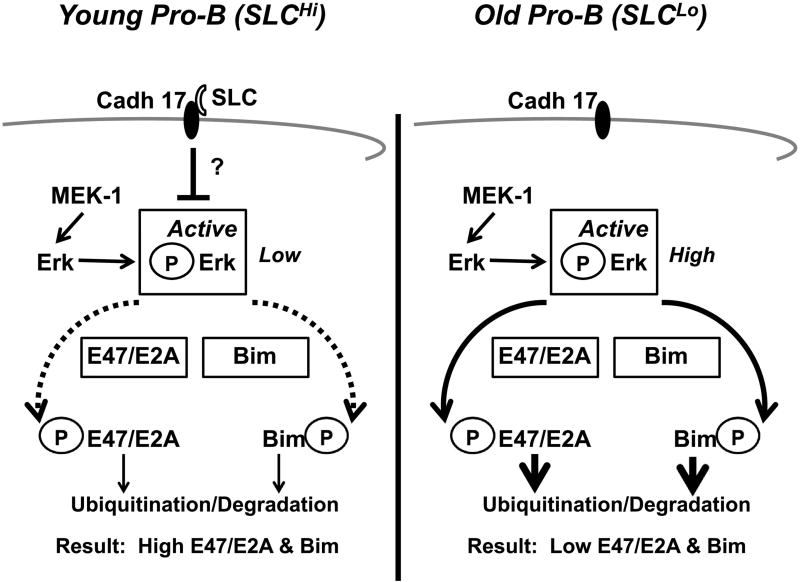
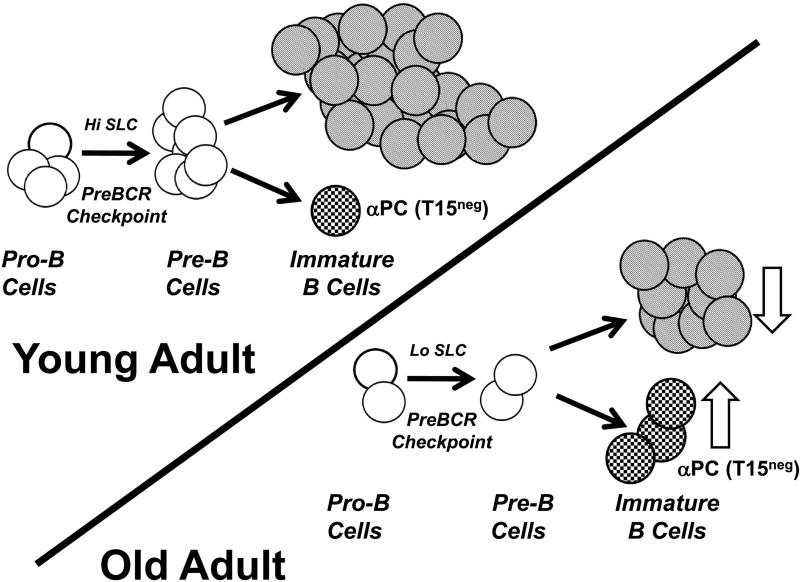
Aging impairs development of new B cells and diminishes the expression of protective antibodies. Reduced numbers of B cell precursors generally occur in old (~2 yrs.) mice. At the pro-B to pre-B cell transition, the pre-B cell receptor (preBCR) checkpoint directs pre-B cell expansion and selection of the pre-B cell immunoglobulin (Ig) μ heavy chain variable region repertoire. The preBCR is comprised of Ig μ heavy chain + surrogate light chains (SLC; λ5/VpreB). In old B cell precursors, SLC is decreased and fewer pre-B cells form the preBCR. In pro-B cells, SLC is complexed with cadherin 17 to form a "pro-B cell receptor" whose signaling is postulated to increase apoptotic sensitivity. We propose that inflammation in old mice, in part mediated by the age-associated B cells (ABC), promotes apoptosis among pro-B cells, particularly those relatively high in SLC. The remaining pro-B cells, with lower SLC, now generate pre-B cells with limited capacity to form the preBCR. Ig μ heavy chains vary in their capacity to associate with SLC and form the preBCR. We speculate that limited SLC restricts formation of the preBCR to a subset of Ig μ heavy chains. This likely impacts the composition of the antibody repertoire among B cells.
Copyright © 2018 Elsevier Inc. All rights reserved.
Figures
References
-
- Bradl H, Wittmann J, Milius D, Vettermann C, Jack HM. Interaction of murine precursor B cell receptor with stroma cells is controlled by the unique tail of lambda 5 and stroma cell-associated heparan sulfate. J Immunol. 2003;171:2338–2348. - PubMed
Publication types
MeSH terms
Substances
Grants and funding
LinkOut - more resources
Full Text Sources
Other Literature Sources
Medical
Research Materials
