


Lower Quadriceps Rate of Force Development Is Associated With Worsening Physical Function in Adults With or at Risk for Knee Osteoarthritis: 36-Month Follow-Up Data From the Osteoarthritis Initiative
- PMID: 29408538
- PMCID: PMC6019160
- DOI: 10.1016/j.apmr.2017.12.027
Lower Quadriceps Rate of Force Development Is Associated With Worsening Physical Function in Adults With or at Risk for Knee Osteoarthritis: 36-Month Follow-Up Data From the Osteoarthritis Initiative
Abstract
Objective: To determine the association between quadriceps rate of force development (RFD) and decline in self-reported physical function and objective measures of physical performance.
Design: Longitudinal cohort study.
Setting: Community-based sample from 4 urban areas.
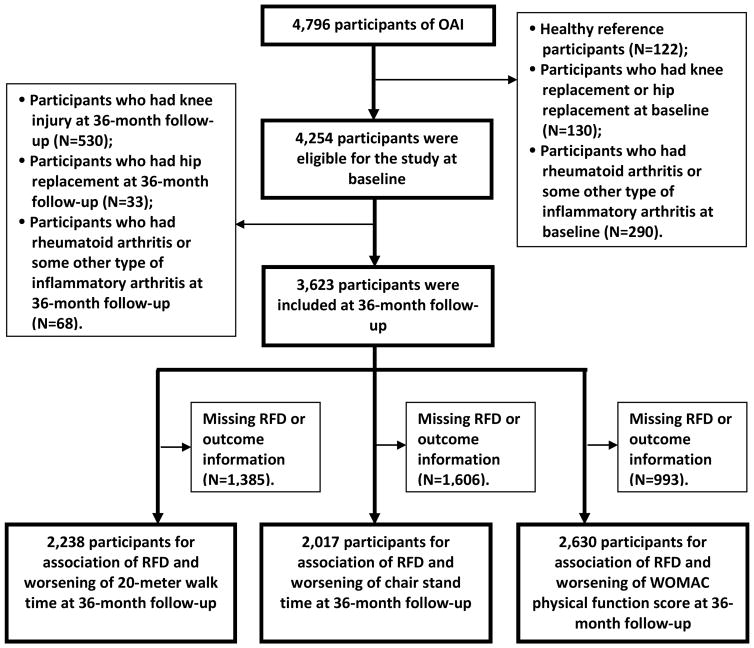
Participants: Osteoarthritis Initiative participants with or at risk for knee osteoarthritis, who had no history of knee/hip replacement, knee injury, or rheumatoid arthritis (N=2630).
Interventions: Not applicable.
Main outcome measures: Quadriceps RFD (N/s) was measured during isometric strength testing. Worsening physical function was defined as the minimal clinically important difference for worsening self-reported Western Ontario and McMaster Universities Osteoarthritis Index (WOMAC) physical function subscale score, 20-m walk time, and repeated chair stand time over 36 months.
Results: Compared with the slowest tertile of RFD, the fastest tertile had a lower risk for worsening of WOMAC physical function subscale score at 36-month follow-up, with an odds ratio (OR) of .68 (95% confidence interval [CI], .51-.92) after adjustment for age, sex, body mass index, depression, history of chronic diseases, and knee pain. In women, in comparison with the slowest tertile of RFD, the fastest tertile had a lower risk for worsening of WOMAC physical function subscale score at 36-month follow-up, with an adjusted OR of .57 (95% CI, .38-.86). This decreased risk did not reach statistical significance in men (OR, 0.81; 95% CI, 0.52-1.27). No statistically significant associations were detected between baseline RFD and walk or chair stand times.
Conclusions: Our results indicate that higher RFD is associated with decreased risk for worsening self-reported physical function but not with decreased risk for worsening of physical performance.
Trial registration: ClinicalTrials.gov NCT00080171.
Keywords: Knee; Muscle Strength; Osteoarthritis; Quadriceps muscle; Rehabilitation; Sports Medicine.
Copyright © 2018 American Congress of Rehabilitation Medicine. Published by Elsevier Inc. All rights reserved.
Figures
References
-
- van Dijk GM, Dekker J, Veenhof C, van den Ende CH, Carpa Study G. Course of functional status and pain in osteoarthritis of the hip or knee: a systematic review of the literature. Arthritis Rheum. 2006;55(5):779–85. - PubMed
-
- van Leeuwen DM, Peeters GM, de Ruiter CJ, Lips P, Twisk JW, Deeg DJ, et al. Effects of self-reported osteoarthritis on physical performance: a longitudinal study with a 10-year follow-up. Aging Clin Exp Res. 2013;25(5):561–9. - PubMed
Publication types
MeSH terms
Associated data
Grants and funding
LinkOut - more resources
Full Text Sources
Other Literature Sources
Medical
Miscellaneous
