


Impacts of estrus expression and intensity during a timed-AI protocol on variables associated with fertility and pregnancy success in Bos indicus-influenced beef cows
- PMID: 29408965
- PMCID: PMC6140899
- DOI: 10.1093/jas/skx043
Impacts of estrus expression and intensity during a timed-AI protocol on variables associated with fertility and pregnancy success in Bos indicus-influenced beef cows
Abstract
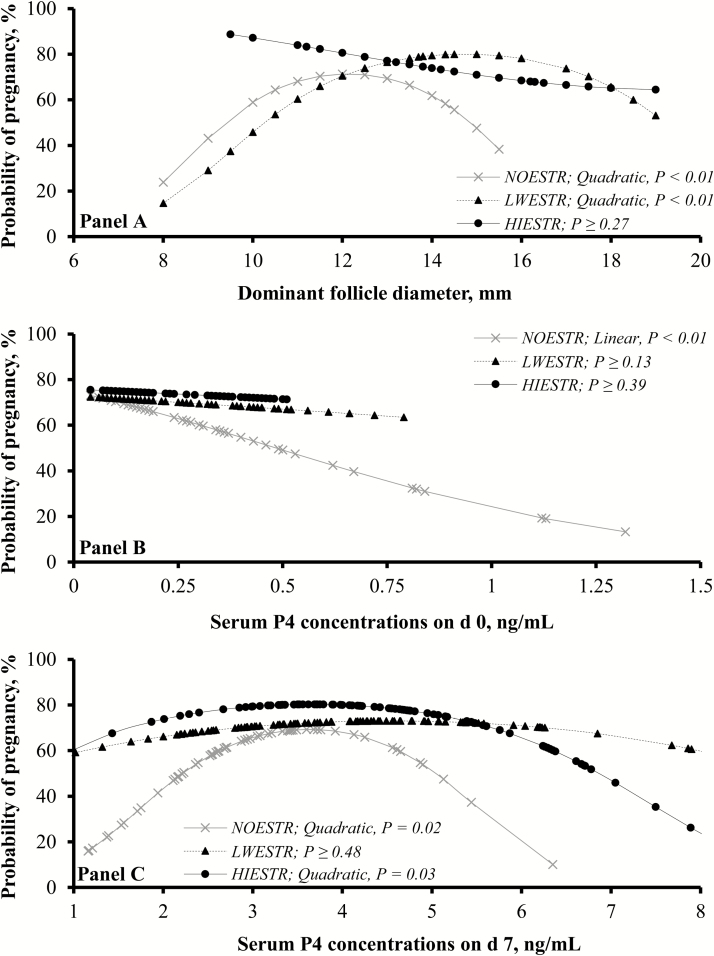
This experiment evaluated the impacts of estrus expression and intensity, estimated by physical activity during a timed-AI protocol, on reproductive performance of Bos indicus-influenced beef cows. A total of 290 lactating, primiparous, and multiparous nonpregnant Nelore × Angus cows received a 2 mg injection of estradiol benzoate and an intravaginal progesterone (P4) releasing device (CIDR) on d -11, a 12.5 mg injection of PGF2α on d -4, CIDR removal in addition to 0.6 mg injection of estradiol cypionate and 300 IU injection of eCG on d -2, and timed-AI on d 0. Cows were fitted with a pedometer behind their left shoulder on d -4. An estrus detection patch was attached to the tail-head of each cow on d -2. Pedometer results were recorded on d -2 and 0. Estrus expression was defined as removal of >50% of the rub-off coating from the patch on d 0. Net physical activity during estrus was calculated by subtracting total steps from d -4 to -2 (nonestrus basal activity) from total steps from d -2 to 0 (proestrus + estrus period) of each cow. Cows that did not express estrus were classified as NOESTR. Cows that expressed estrus were ranked by net physical activity; those above the median were classified as HIESTR and the remaining cows as LWESTR. Ovarian ultrasonography was performed on d 0 and 7. Blood was collected on d 0, 7, 20, and 30. Pregnancy status was verified by ultrasonography on d 30. Only data from cows responsive to the estrus synchronization protocol were utilized (NOESTR, n = 59; LWESTR, n = 100; HIESTR, n = 98). Diameter of dominant follicle on d 0, corpus luteum volume on d 7, and plasma P4 concentrations on d 7 were greater (P ≤ 0.05) in HIESTR vs. LWESTR and NOESTR and also greater (P ≤ 0.05) for LWESTR vs. NOESTR. Plasma P4 concentrations on d 0 were greater (P < 0.01) in NOESTR vs. HIESTR and LWESTR and similar (P = 0.93) between HIESTR and LWESTR. Whole blood mRNA expression of myxovirus resistance 2 on d 20 was greater (P ≤ 0.05) in HIESTR vs. LWESTR and NOESTR, and similar (P = 0.72) between LWESTR and NOESTR. Pregnancy rates were less (P ≤ 0.04) in NOESTR vs. HIESTR and LWESTR (52.4%, 68.9%, and 73.5%, SEM = 7.2), and similar (P = 0.57) between HIESTR and LWESTR. Hence, expression of estrus during a timed-AI protocol improved ovarian dynamics and pregnancy success, whereas estrus intensity modulated key biological markers associated with fertility but not pregnancy rates in B. indicus-influenced cows beef cows.
Figures


References
-
- Allrich R. D. 1994. Endocrine and neural control of estrus in dairy cows. J. Dairy Sci. 77:2738–2744. - PubMed
-
- Aungier S. P. M., Roche J. F., Duffy P., Scully S., and Crowe M. A.. 2015. The relationship between activity clusters detected by an automatic activity monitor and endocrine changes during the periestrous period in lactating dairy cows. J. Dairy Sci. 98:1666–1684. - PubMed
-
- Buhi W. C. 2002. Characterization and biological roles of oviduct-specific, oestrogen-dependent glycoprotein. Reproduction 123:355–362. - PubMed
-
- Carvalho E. R., Martins T., Lamb G. C., and Vasconcelos J. L. M.. 2016. Ovulation time in suckled beef cows is anticipated by use of low doses of progesterone and temporary calf removal on fixed timed AI protocol. Theriogenology 86:2238–2243. - PubMed
-
- Chenault J. R., Thatcher W. W., Kalra P. S., Abrams R. M., and Wilcox C. J.. 1975. Transitory changes in plasma progestins, estradiol, and luteinizing hormone approaching ovulation in the bovine. J. Dairy Sci. 58:709–717. - PubMed
MeSH terms
Substances
LinkOut - more resources
Full Text Sources
Other Literature Sources
