


Impact of body mass index on surgical outcomes of gastric cancer
- PMID: 29409475
- PMCID: PMC5801809
- DOI: 10.1186/s12885-018-4063-9
Impact of body mass index on surgical outcomes of gastric cancer
Abstract
Background: The association between body mass index (BMI) and clinical outcomes of gastric cancer were still under debate. The aim of the present study was to investigate the impact of BMI on intraoperative conditions, postoperative complications and prognosis of gastric cancer.
Methods: From October 2008 to March 2015, 1210 gastric cancer patients treated with D2 gastrectomy were enrolled in the present study. Patients were divided into three groups: low BMI group (BMI < 18.5 Kg/m2), normal BMI group (18.5 Kg/m2 ≤ BMI < 25.0 Kg/m2) and high BMI group (BMI ≥ 25.0 Kg/m2). Clinicopathological characteristics and prognosis of patients were recorded and analyzed. Propensity score matching was used to match patients in the three groups.
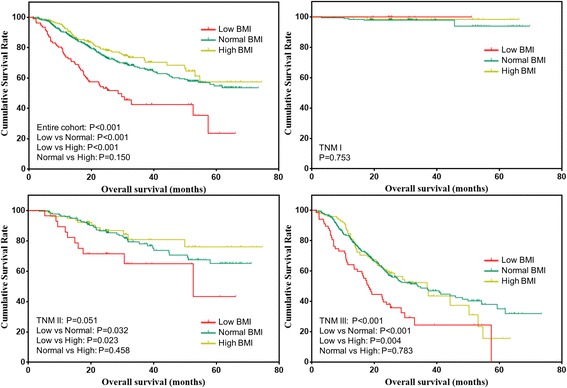
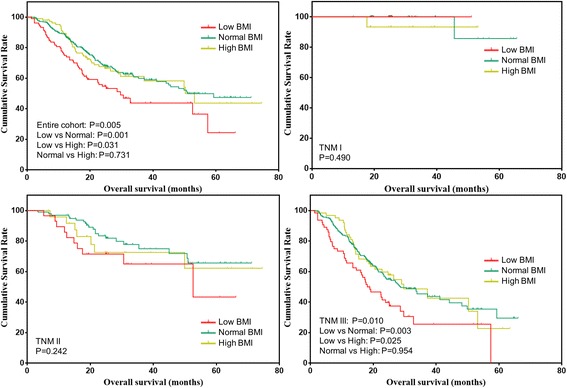
Results: There were 107 patients in low BMI group (8.9%), 862 patients in normal BMI group (71.2%) and 241 patients in high BMI group (19.95%). Before matching, BMI was inversely associated with tumor size, tumor depth, lymph node metastasis (LNM) and tumor stage (all P < 0.05). After matching, the clinicopathological features were all comparable among the three groups (all P > 0.05). High BMI was associated with increased blood loss and operation time, and deceased number of retrieved lymph nodes (all P < 0.05). For postoperative complications, low BMI was associated with decreased rate of postoperative fever (P = 0.025). Age, BMI, tumor size, Borrmann type, pathological type, type of gastrectomy, tumor depth, LNM and tumor stage were risk factors for the prognosis of gastric cancer. Multivariate analysis showed that only BMI, tumor size, tumor depth and LNM were independent prognostic factors. The overall survival of patients with low BMI was significantly worse than patients with normal (P < 0.05) or high BMI (P < 0.05). However, the overall survival was comparable between patients with normal and high BMI (P > 0.05).
Conclusions: BMI was inversely associated with tumor size, tumor depth, LNM and tumor stage. High BMI was associated with increased blood loss and operation time, and deceased number of retrieved lymph nodes. Low BMI was associated with decreased rate of postoperative fever and decreased survival.
Keywords: BMI; Complications; Gastric cancer; Prognosis.
Conflict of interest statement
Authors’ information
Not further applicable.
Ethics approval and consent to participate
This study was approved by the Ethics Committee of Xijing Hospital, and written informed consent was obtained from the patients in our center.
Consent for publication
Not applicable.
Competing interests
The authors declare that they have no competing interests.
Publisher’s Note
Springer Nature remains neutral with regard to jurisdictional claims in published maps and institutional affiliations.
Figures
References
Publication types
MeSH terms
Grants and funding
- 31100643/National Natural Scientific Foundation of China/International
- 31570907/National Natural Scientific Foundation of China/International
- 81300301/National Natural Scientific Foundation of China/International
- 81572306/National Natural Scientific Foundation of China/International
- 81502403/National Natural Scientific Foundation of China/International
LinkOut - more resources
Full Text Sources
Other Literature Sources
Medical
