


Associations between oxytocin receptor gene (OXTR) methylation, plasma oxytocin, and attachment across adulthood
- PMID: 29410310
- PMCID: PMC6072619
- DOI: 10.1016/j.ijpsycho.2018.01.008
Associations between oxytocin receptor gene (OXTR) methylation, plasma oxytocin, and attachment across adulthood
Abstract
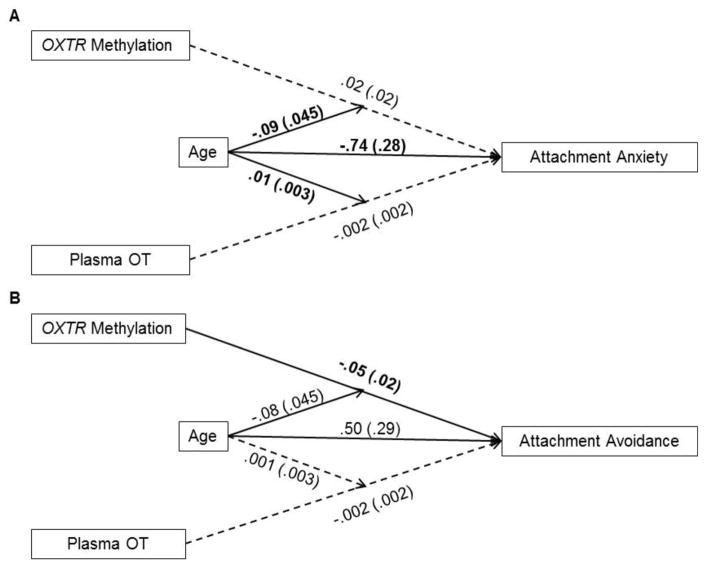
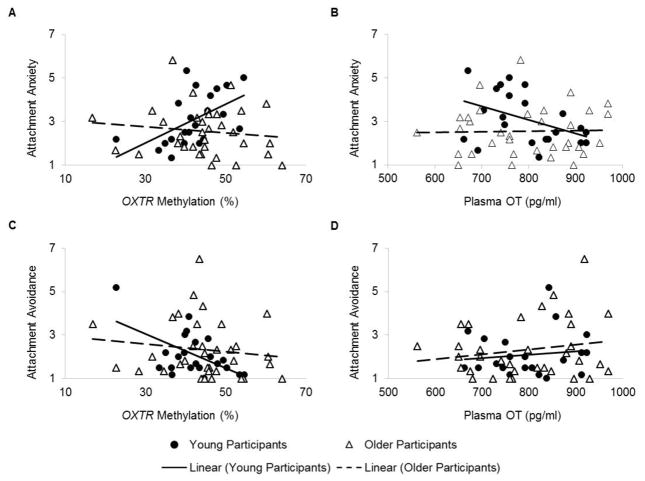
The neuropeptide oxytocin (OT) has been implicated in a wide range of affiliative processes. OT exerts its functions via OT receptors, which are encoded by the oxytocin receptor gene (OXTR). Epigenetic modification of OXTR through the process of DNA methylation has been associated with individual differences in behavioral phenotypes. Specifically, lower levels of OXTR methylation have been linked to better social and affective functioning. However, research on epigenetic mechanisms of OXTR is scarce in non-clinical populations, and even less is known about epigenetic variability across adulthood. The present study assessed methylation levels at OXTR CpG site -934 and plasma OT levels in 22 young (20-31 years, M = 23.6) and 34 older (63-80 years, M = 71.4) participants. Lower levels of OXTR methylation and higher plasma OT levels were associated with less self-reported attachment anxiety in young but not older participants, with largely independent contributions of OXTR methylation and plasma OT levels. In contrast, in the overall sample, lower levels of OXTR methylation were associated with higher self-reported attachment avoidance. Age analysis suggested that these results were largely driven by young adults. Plasma OT levels were unrelated to attachment avoidance. Taken together, these findings support the emerging notion in the literature that epigenetic properties of OXTR, in addition to endogenous OT levels, are related to adult attachment. Further, the age effects observed in the associations between OXTR methylation, plasma OT, and adult attachment emphasize the importance of adopting a developmental perspective when studying properties of the OT system and their relation to affiliative processes. Findings contribute to growing evidence suggesting that epigenetic modification of genes regulating OT pathways and endogenous OT levels are associated with the way people form and maintain intimate social relationships.
Keywords: Aging; Attachment; DNA methylation; OXTR; Plasma OT.
Copyright © 2018 Elsevier B.V. All rights reserved.
Figures
Similar articles
-
Sensitive parenting is associated with plasma oxytocin and polymorphisms in the OXTR and CD38 genes.Biol Psychiatry. 2012 Aug 1;72(3):175-81. doi: 10.1016/j.biopsych.2011.12.025. Epub 2012 Feb 14. Biol Psychiatry. 2012. PMID: 22336563
-
Epigenetic modification of the oxytocin receptor gene influences the perception of anger and fear in the human brain.Proc Natl Acad Sci U S A. 2015 Mar 17;112(11):3308-13. doi: 10.1073/pnas.1422096112. Epub 2015 Feb 9. Proc Natl Acad Sci U S A. 2015. PMID: 25675509 Free PMC article.
-
Epigenetic modification of the oxytocin and glucocorticoid receptor genes is linked to attachment avoidance in young adults.Attach Hum Dev. 2018 Aug;20(4):439-454. doi: 10.1080/14616734.2018.1446451. Epub 2018 Mar 7. Attach Hum Dev. 2018. PMID: 29513137
-
The role of oxytocin receptor gene (OXTR) DNA methylation (DNAm) in human social and emotional functioning: a systematic narrative review.BMC Psychiatry. 2018 May 29;18(1):154. doi: 10.1186/s12888-018-1740-9. BMC Psychiatry. 2018. PMID: 29843655 Free PMC article.
-
Oxytocin and Anxiety Disorders.Curr Top Behav Neurosci. 2018;35:467-498. doi: 10.1007/7854_2017_25. Curr Top Behav Neurosci. 2018. PMID: 28812274 Review.
Cited by
-
Maternal outcomes related to Genetic and epigenetic Variation in the oxytocin system: A scoping review.Compr Psychoneuroendocrinol. 2023 Sep 26;16:100209. doi: 10.1016/j.cpnec.2023.100209. eCollection 2023 Nov. Compr Psychoneuroendocrinol. 2023. PMID: 38108031 Free PMC article.
-
Elevated Oxytocin Receptor Blood Concentrations Predict Higher Risk for, More, and Earlier 24-Month Hospital Readmissions after In-Patient Detoxification in Males with Alcohol Use Disorder.Int J Mol Sci. 2022 Sep 1;23(17):9940. doi: 10.3390/ijms23179940. Int J Mol Sci. 2022. PMID: 36077337 Free PMC article.
-
Genetics of adult attachment: An updated review of the literature.World J Psychiatry. 2021 Sep 19;11(9):530-542. doi: 10.5498/wjp.v11.i9.530. eCollection 2021 Sep 19. World J Psychiatry. 2021. PMID: 34631458 Free PMC article. Review.
-
Oxytocin alters patterns of brain activity and amygdalar connectivity by age during dynamic facial emotion identification.Neurobiol Aging. 2019 Jun;78:42-51. doi: 10.1016/j.neurobiolaging.2019.01.016. Epub 2019 Jan 29. Neurobiol Aging. 2019. PMID: 30870779 Free PMC article. Clinical Trial.
-
Genetic, epigenetic, and environmental factors controlling oxytocin receptor gene expression.Clin Epigenetics. 2021 Jan 30;13(1):23. doi: 10.1186/s13148-021-01017-5. Clin Epigenetics. 2021. PMID: 33516250 Free PMC article.
References
-
- Aiken LS, West SG. Multiple regression: testing and interpreting interaction. Thousand Oaks, CA: Sage; 1991.
-
- Argiolas A, Melis MR. The role of oxytocin and the paraventricular nucleus in the sexual behaviour of male mammals. Physiol Behav. 2004;83:309–317. - PubMed
-
- Arsenijevic Y, Dreifuss JJ, Vallet P, Marguerat A, Tribollet E. Reduced binding of oxytocin in the rat brain during aging. Brain Research. 1995;698:275–279. - PubMed
-
- Bakermans-Kranenburg MJ, van Ijzendoorn MH. A sociability gene? Meta-analysis of oxytocin receptor genotype effects in humans. Psychiatric Genetics. 2014;24:45–51. - PubMed
-
- Bale TL, Dorsa DM. Cloning, novel promoter sequence, and estrogen regulation of a rat oxytocin receptor gene. Endocrinology. 1997;138:1151–1158. - PubMed
Publication types
MeSH terms
Substances
Grants and funding
LinkOut - more resources
Full Text Sources
Other Literature Sources
Medical
