


The impact of the Boko Haram insurgency in Northeast Nigeria on childhood wasting: a double-difference study
- PMID: 29410702
- PMCID: PMC5782364
- DOI: 10.1186/s13031-018-0136-2
The impact of the Boko Haram insurgency in Northeast Nigeria on childhood wasting: a double-difference study
Abstract
Background: This research examines the relationship between violent conflict and childhood wasting in Northeast Nigeria, where residents have been subjected to fighting between the Nigerian government and Boko Haram - an extremist Islamist movement - since 2009.
Methods: Using two Demographic and Health Surveys from before and after the Boko Haram insurgency started, a double-difference (difference-in-difference) approach is used to assess the impact of the conflict on mean weight-for-height z-scores and the likelihood of wasting.
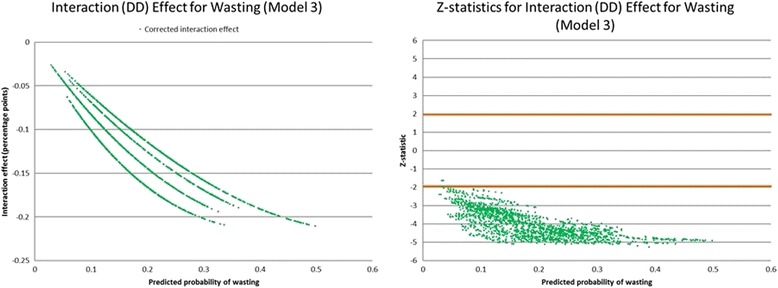
Results: Results suggest that if children exposed to the conflict had not been exposed, their mean weight-for-height z-score would be 0.49 standard deviations higher (p < 0.001) than it is, increasing from - 0.74 to - 0.25. Additionally, the likelihood of wasting would be 13 percentage points lower (mean z-statistic - 4.2), bringing the proportion down from 23% to 10%.
Conclusion: Descriptive evidence suggests that poor child health outcomes in the conflict areas of Northeast Nigeria may be due to disruptions to social services and increased food insecurity in an already resource poor area. Although other unidentified factors may contribute to both conflict and wasting, the findings underscore the importance of appropriate programs and policies to support children in conflict zones.
Keywords: Boko Haram; Conflict; Demographic and Health Surveys; Difference-in-difference; Double-difference; Malnutrition; Nigeria; Wasting; Weight-for-height.
Conflict of interest statement
This study was approved by the Baruch College (City University of New York) Human Research Protections Program. Project reference number 566615–1.Not applicableThe author declares that she has no competing interests.Springer Nature remains neutral with regard to jurisdictional claims in published maps and institutional affiliations.
Figures
References
-
- Johns Hopkins Bloomberg School of Public Health and the International Federation of Red Cross and Red Crescent Societies. The Johns Hopkins and Red Cross Red Crescent Public Health Guide in Emergencies. 2008.
-
- World Health Organization . Children: reducing mortality. 2014.
LinkOut - more resources
Full Text Sources
Other Literature Sources
