


Activity demands and instability are the most important factors for recommending to treat ACL injuries with reconstruction
- PMID: 29411079
- PMCID: PMC6061764
- DOI: 10.1007/s00167-018-4846-1
Activity demands and instability are the most important factors for recommending to treat ACL injuries with reconstruction
Abstract
Purpose: The purpose of the study was to (1) study and compare the factors that Swedish orthopaedic surgeons and physical therapists consider important for recommending ACL reconstruction and, (2) to assess how orthopaedic surgeons and physical therapists consider their own and each others, as well as patients', roles are in the treatment decision.
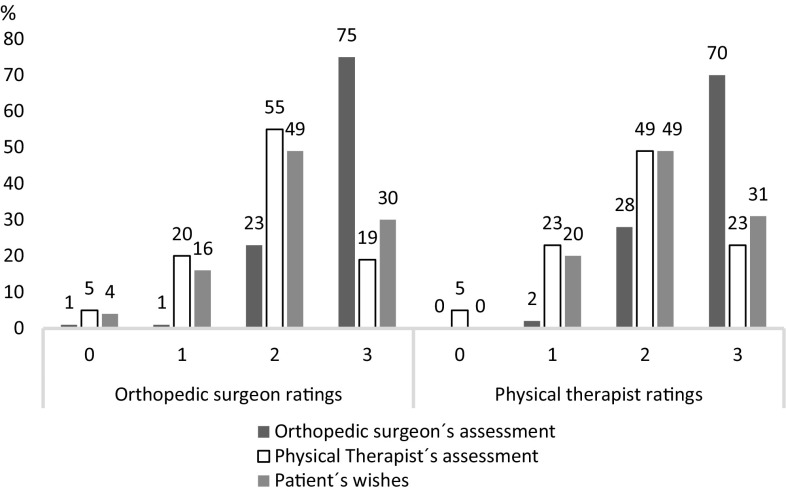
Methods: A web-based survey assessing the relevance of 21 predetermined factors, in the choice to recommend ACL reconstruction, was sent to orthopaedic surgeons and physical therapists. Respondents were also asked to rate the importance of the assessment made by themselves, the other clinician (physical therapists rated the importance of surgeons, surgeons rated the importance of physical therapists), and the patients' preferences.
Result: Orthopaedic surgeons agreed of eight, and physical therapists of seven factors as important in the choice to recommend ACL reconstruction. The factors both groups reported as important were; "patient's wishes to return to contact/pivoting sports", "instability in physical activity", "instability in activities of daily living despite adequate rehabilitation", "physically demanding occupation", and "young age". Both professions rated their own and each others assessments as well as patient's wishes as important for the decision to recommend ACL reconstruction.
Conclusion: Orthopaedic surgeons and physical therapists agree about factors that are important for their decision to recommend ACL reconstruction, showing that both professions share a common ground in perceptions of factors that are important in recommending ACL reconstruction.
Level of evidence: Diagnostic study: Level III.
Keywords: ACL reconstruction; Anterior cruciate ligament injury; Knee; Treatment decision.
Conflict of interest statement
Conflict of interest
The authors declare that they have no conflict of interest.
Ethical approval
This study had ethical approval from the Regional Ethical Review Board Dnr 2014 (71/31).
Informed consent
Informed consent was obtained from all individual participants included in the study.
Figures
References
-
- Ahldén M, Kvist J, Samuelsson K, Eriksson KO, Karlsson J. Individualiserad terapi viktigt vid främre korsbandsskada. Läkartidningen. 2014;111:1440. - PubMed
-
- Beaufils P, Hulet C, Dhenain M, Nizard R, Nourissat G, Pujol N. Clinical practice guidelines for the management of meniscal lesions and isolated lesions of the anterior cruciate ligament of the knee in adults. Orthop Traumatol Surg Res. 2009;95:437–442. doi: 10.1016/j.otsr.2009.06.002. - DOI - PubMed
MeSH terms
LinkOut - more resources
Full Text Sources
Other Literature Sources
Medical
Research Materials
