Review
. 2018 Mar;11(1):77-85.
doi: 10.1007/s12178-018-9461-8.

Natural History of Degenerative Rotator Cuff Tears

Affiliations
Review

Natural History of Degenerative Rotator Cuff Tears

Jason L Codding et al. Curr Rev Musculoskelet Med. 2018 Mar.

Abstract

Purpose of review: In the past several years, there have been significant advances in our understanding of the natural history of rotator cuff disease. Studies have continued to provide valuable insight into the clinical, radiographic, and anatomic features of these atraumatic tears. Our purpose is to summarize the findings and contributions from these recent high-quality studies.

Recent findings: Current research has continued to describe and provide understanding into the natural history of atraumatic rotator cuff disease, including symptom progression, tear enlargement, and the development of arthritis. This knowledge has allowed identification of tears with higher risk of disease progression. Additionally, studies have investigated, with long-term healing data, whether the natural history of degenerative rotator cuff tears can be altered with surgical intervention. Recent studies have shown encouraging mid to long-term healing data and clinical outcome scores for smaller tears in younger patients with minimal fatty infiltration. Future research should focus on obtaining long-term healing data, functional outcome data, and refining surgical indications for rotator cuff repair. Identifying patients with specific tear characteristics amendable to healing will allow us to provide a long-term, durable repair, thus interrupting the natural history of degenerative rotator cuff disease.

Keywords: Atraumatic; Degenerative; Natural history; Recent literature; Rotator cuff.


Conflict of interest statement

Conflict of Interest

Jason L. Codding declares that he has no conflict of interest.

Jay D. Keener reports grants from the NIH, during the conduct of study.

Human and Animal Rights and Informed Consent

This article does not contain any studies with human or animal subjects performed by any of the authors.

Figures
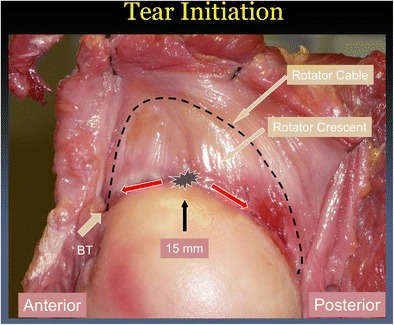
Fig. 1
Fig. 1
Anatomic description of degenerative rotator cuff tear. The common site of tear location of degenerative cuff tears is 13–17 mm posterior to the biceps tendon within the rotator crescent tissue. BT biceps tendon. Originally from Kim KH, Dahiya N, Teefey SA, Middleton WD, Stobbs G, Steger-May K, Yamaguchi K and Keener JD. Location and initiation of degenerative rotator cuff tears: an analysis of 360 shoulders. J Bone Joint Surg 2010;92:1088–96. Fig. 5, page 1094
Fig. 2
Fig. 2
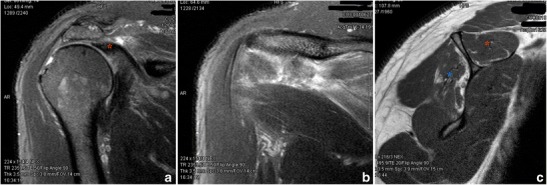
MRI sequences from traumatic rotator cuff tear. a Coronal image—retracted supraspinatus/infraspinatus tendon (red asterisk). b Coronal image—more posterior slice demonstrating edema (fluid signal) throughout infraspinatus muscle. c Sagittal image - grade 2 muscle fatty infiltration noted in the infraspinatus (blue asterisk). The supraspinatus muscle (red asterisk) is healthy.
Fig. 3
Fig. 3
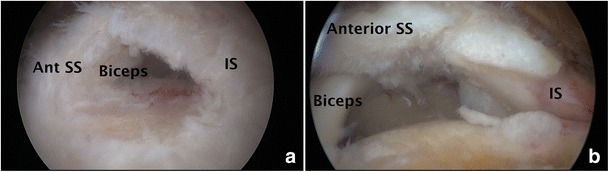
Intraoperative photos of degenerative rotator cuff tears. a Anterior supraspinatus intact tear—note intact cuff fibers posterior to the biceps tendon. SS supraspinatus, IS infraspinatus. b Anterior supraspinatus disrupted tear—uncovering of the biceps tendon due to disruption of the anterior supraspinatus insertion. SS supraspinatus, IS infraspinatus

References

    1. Milgrom C, Schaffler M, Gilbert S, van Holsbeeck M. Rotator-cuff changes in asymptomatic adults. The effect of age, hand dominance and gender. J Bone Joint Surg Br. 1995;77(2):296–298. doi: 10.1302/0301-620X.77B2.7706351. - DOI - PubMed
    1. Teunis T, Lubberts B, Reilly BT, Ring D. A systematic review and pooled analysis of the prevalence of rotator cuff disease with increasing age. J Shoulder Elb Surg. 2014;23(12):1913–1921. doi: 10.1016/j.jse.2014.08.001. - DOI - PubMed
    1. Yamaguchi K, Ditsios K, Middleton WD, Hildebolt CF, Galatz LM, Teefey SA. The demographic and morphological features of rotator cuff disease. A comparison of asymptomatic and symptomatic shoulders. J Bone Joint Surg Am. 2006;88(8):1699–1704. doi: 10.2106/JBJS.E.00835. - DOI - PubMed
    1. Kim HM, Dahiya N, Teefey SA, Middleton WD, Stobbs G, Steger-May K, Yamaguchi K, Keener JD. Location and initiation of degenerative rotator cuff tears: an analysis of three hundred and sixty shoulders. J Bone Joint Surg Am. 2010;92(5):1088–1096. doi: 10.2106/JBJS.I.00686. - DOI - PMC - PubMed
    1. Kim HM, Dahiya N, Teefey SA, Keener JD, Galatz LM, Yamaguchi K. Relationship of tear size and location to fatty degeneration of the rotator cuff. J Bone Joint Surg Am. 2010;92(4):829–839. doi: 10.2106/JBJS.H.01746. - DOI - PMC - PubMed

LinkOut - more resources