


Aspirin and clopidogrel high on-treatment platelet reactivity and genetic predictors in peripheral arterial disease
- PMID: 29411531
- PMCID: PMC5997520
- DOI: 10.1002/ccd.27453
Aspirin and clopidogrel high on-treatment platelet reactivity and genetic predictors in peripheral arterial disease
Abstract
Objectives: Our aims were to examine the prevalence and genetic predictors of aspirin and clopidogrel high on-treatment platelet reactivity (HoTPR), and associated adverse cardiovascular outcomes in patients with peripheral arterial disease (PAD).
Background: The association of aspirin and clopidogrel HoTPR with outcomes in PAD remains unclear.
Methods: This is a prospective cohort study of patients with angiographically documented PAD involving carotid and lower extremity arteries. Aspirin and clopidogrel HoTPR (using the VerifyNow Assay) and associated genetic predictors were compared to clinical outcomes. The primary end-point was a composite of major adverse cardiovascular events: all-cause mortality, myocardial infarction, stroke, target vessel revascularization (TVR) and limb-loss in patients who underwent extremity intervention.
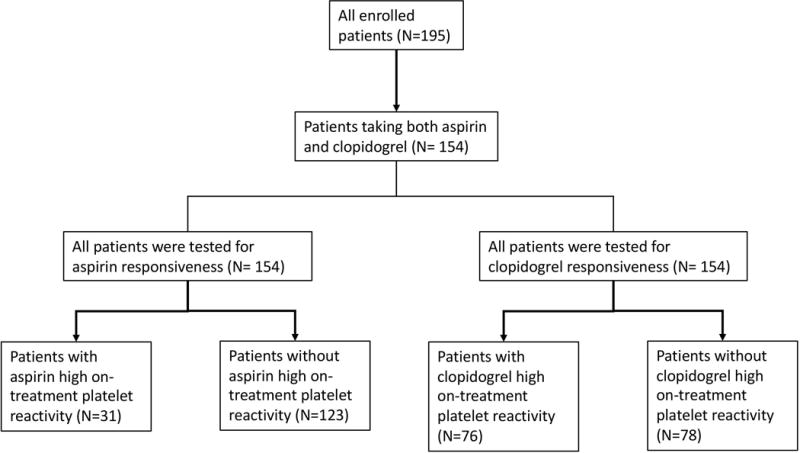
Results: The study was stopped prematurely due to slow patient enrolment. Of 195 patients enrolled, the primary analysis was performed in 154 patients taking both drugs. Aspirin HoTPR was present in 31 (20%) and clopidogrel HoTPR in 76 (49%) patients. There was a trend toward more primary composite outcome events with PRU ≥ 235 (52% freedom-from-event rate vs. 70% for PRU < 235; P = 0.09). TVR was higher in those with PRU ≥ 235 (20 vs. 6%, unadjusted P = 0.02). There was no association between aspirin HoTPR and combined outcomes. Single nucleotide polymorphisms in serum paraoxonase/arylesterase 1 (PON1) gene was associated with aspirin HoTPR (P = 0.005) while SNP in phospholipase A2, group III (PLA2G3) gene was associated with clopidogrel HoTPR (P = 0.002).
Conclusion: Clopidogrel HoTPR was significantly associated with TVR, while aspirin HoTPR was not associated with adverse clinical outcomes in patients with PAD.
Keywords: antiplatelet therapy; genetics; peripheral arterial disease.
© 2018 Wiley Periodicals, Inc.
Figures


Comment in
-
Peripheral artery disease: How do genes and pharmacology interplay?Catheter Cardiovasc Interv. 2018 Jun;91(7):1318-1319. doi: 10.1002/ccd.27649. Catheter Cardiovasc Interv. 2018. PMID: 29894588
References
-
- Rooke TW, Hirsch AT, Misra S, Sidawy AN, Beckman JA, Findeiss LK, Golzarian J, Gornik HL, Halperin JL, Jaff MR, et al. 2011 ACCF/AHA Focused Update of the Guideline for the Management of Patients With Peripheral Artery Disease (updating the 2005 guideline): a report of the American College of Cardiology Foundation/American Heart Association Task Force on Practice Guidelines. J Am Coll Cardiol. 2011;58(19):2020–45. - PMC - PubMed
-
- Anderson JL, Halperin JL, Albert NM, Bozkurt B, Brindis RG, Curtis LH, DeMets D, Guyton RA, Hochman JS, Kovacs RJ, et al. Management of patients with peripheral artery disease (compilation of 2005 and 2011 ACCF/AHA guideline recommendations): a report of the American College of Cardiology Foundation/American Heart Association Task Force on Practice Guidelines. Circulation. 2013;127(13):1425–43. - PubMed
-
- Gerhard-Herman MD, Gornik HL, Barrett C, Barshes NR, Corriere MA, Drachman DE, Fleisher LA, Fowkes FG, Hamburg NM, Kinlay S, et al. 2016 AHA/ACC Guideline on the Management of Patients With Lower Extremity Peripheral Artery Disease: A Report of the American College of Cardiology/American Heart Association Task Force on Clinical Practice Guidelines. J Am Coll Cardiol. 2017;69(11):e71–e126. - PubMed
-
- Grotemeyer KH, Scharafinski HW, Husstedt IW. Two-year follow-up of aspirin responder and aspirin non responder. A pilot-study including 180 post-stroke patients. Thromb Res. 1993;71(5):397–403. - PubMed
-
- Gum PA, Kottke-Marchant K, Welsh PA, White J, Topol EJ. A prospective, blinded determination of the natural history of aspirin resistance among stable patients with cardiovascular disease. J Am Coll Cardiol. 2003;41(6):961–5. - PubMed
Publication types
MeSH terms
Substances
Grants and funding
LinkOut - more resources
Full Text Sources
Other Literature Sources
Medical
Miscellaneous
