


Oral Anticoagulation in Atrial Fibrillation: Development and Evaluation of a Mobile Health Application to Support Shared Decision-Making
- PMID: 29412241
- PMCID: PMC5831296
- DOI: 10.5935/abc.20170181
Oral Anticoagulation in Atrial Fibrillation: Development and Evaluation of a Mobile Health Application to Support Shared Decision-Making
Abstract
Background: Atrial fibrillation is responsible for one in four strokes, which may be prevented by oral anticoagulation, an underused therapy around the world. Considering the challenges imposed by this sort of treatment, mobile health support for shared decision-making may improve patients' knowledge and optimize the decisional process.
Objective: To develop and evaluate a mobile application to support shared decision about thromboembolic prophylaxis in atrial fibrillation.
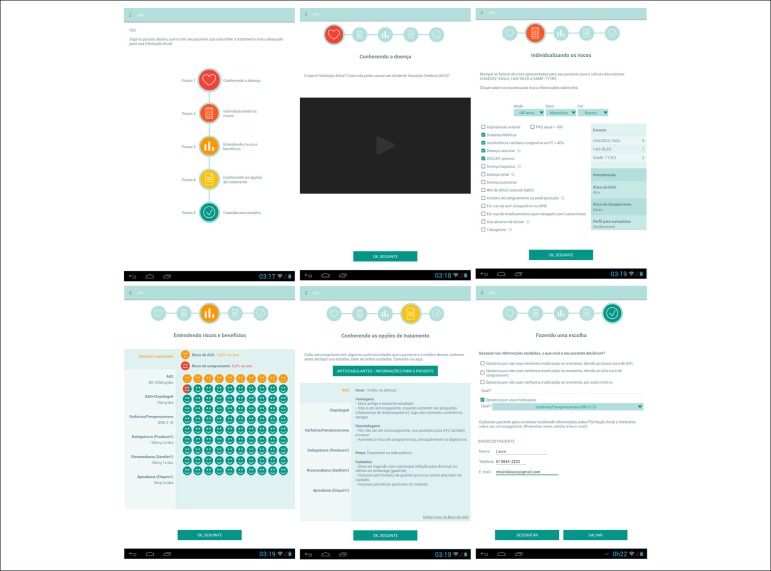
Methods: We developed an application to be used during the clinical visit, including a video about atrial fibrillation, risk calculators, explanatory graphics and information on the drugs available for treatment. In the pilot phase, 30 patients interacted with the application, which was evaluated qualitatively and by a disease knowledge questionnaire and a decisional conflict scale.
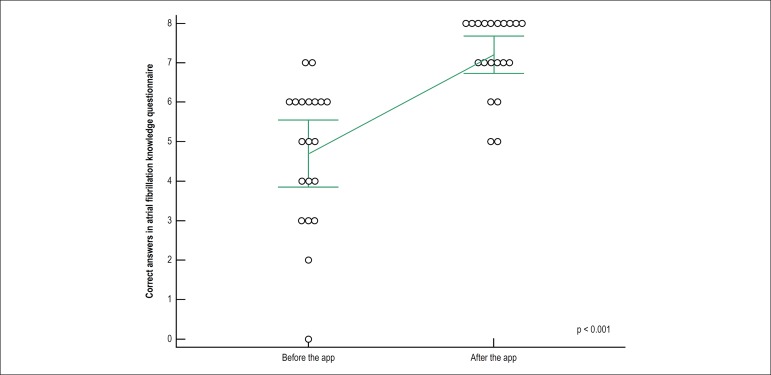
Results: The number of correct answers in the questionnaire about the disease was significantly higher after the interaction with the application (from 4.7 ± 1.8 to 7.2 ± 1.0, p < 0.001). The decisional conflict scale, administered after selecting the therapy with the app support, resulted in an average of 11 ± 16/100 points, indicating a low decisional conflict.
Conclusions: The use of a mobile application during medical visits on anticoagulation in atrial fibrillation improves disease knowledge, enabling a shared decision with low decisional conflict. Further studies are needed to confirm if this finding can be translated into clinical benefit.
Conflict of interest statement
No potential conflict of interest relevant to this article was reported.
Figures
References
-
- Perera KS, Vanassche T, Bosch J, Swaminathan B, Mundl H, Giruparajah M, et al. ESUS Global Registry Investigators Global survey of the frequency of atrial fibrillation-associated stroke embolic stroke of undetermined source global registry. Stroke. 2016;47(9):2197–2202. doi: 10.1161/STROKEAHA.116.013378. - DOI - PubMed
-
- Hart RG, Pearce LA, Aguilar MI. Meta-analysis: antithrombotic therapy to prevent stroke in patients who have nonvalvular atrial fibrillation. Ann Intern Med. 2007;146(12):857–867. - PubMed
MeSH terms
Substances
LinkOut - more resources
Full Text Sources
Other Literature Sources
Medical
