


Review
doi: 10.1016/j.anai.2017.10.037.
The atopic march: Critical evidence and clinical relevance
Affiliations
- PMID: 29413336
- PMCID: PMC5806141
- DOI: 10.1016/j.anai.2017.10.037
Item in Clipboard
Review
The atopic march: Critical evidence and clinical relevance
Ann Allergy Asthma Immunol.
2018 Feb.
Erratum in
-
Erratum.Ann Allergy Asthma Immunol. 2018 Apr;120(4):451. doi: 10.1016/j.anai.2018.02.033. Epub 2018 Mar 9. Ann Allergy Asthma Immunol. 2018. PMID: 29526604 No abstract available.
No abstract available
Conflict of interest statement
Disclosure: The authors have no financial relationships or other conflicts of interest relevant to this article to disclose
Figures
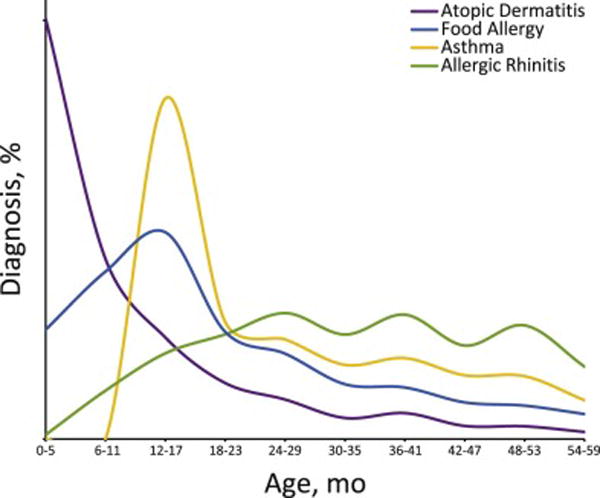
Age at diagnosis of common allergic conditions.
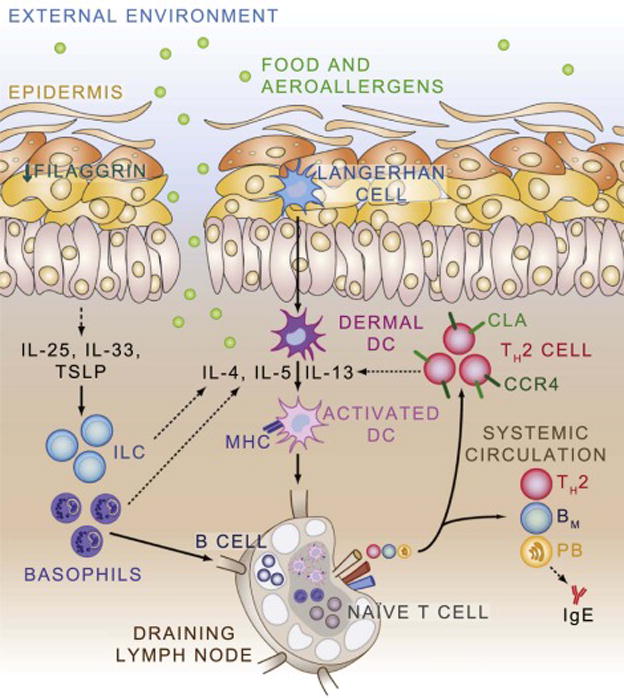
Model of the Atopic March. Deficiencies in epithelial proteins such as filaggrin, in conjunction with atopic predisposition, result in skin inflammation. Epithelial-derived cytokines such as Il-25, Il-33, and TSLP recruit and activate innate cell types including innate lymphoid cells (ILC) and basophils which produce cytokines that promote the activation of dendritic cells. Activated dendritic cells process allergen, upregulate MHC, and circulate to draining lymph nodes where they can interact with naïve T and B cells to promote the development of allergen-specific T and B cell responses. Allergen-specific T helper type 2 (TH2) cells home back to the skin through expression of C-C chemokine receptor type 4 (CCR4), cutaneous lymphocyte antigen (CLA), and other molecules. TH2 cells also enter the systemic circulation where they can exert effector response at distant tissue sites. Memory B cells (BM) recirculate in the blood and lymph, while plasmablasts (PB) home to the bone marrow where they differentiate in to plasma cells and produce allergen-specific IgE.
References
-
- Cohen S, Dworetzky M, Frick OL. Coca and Cooke on the classification of hypersensitiveness. J Allergy Clin Immunol. 2003;111:205–210. - PubMed
-
- Bloom B, Jones LI, Freeman G. Summary health statistics for U.S. children: National Health Interview Survey, 2012. Vital Health Stat. 2013;10(258):1–81. - PubMed
-
- Marenholz I, Esparza-Gordillo J, Lee YA. The genetics of the skin barrier in eczema and other allergic disorders. Curr Opin Allergy Clin Immunol. 2015;15:426–434. - PubMed
-
- Rogers AJ, Celedon JC, Lasky-Su JA, Weiss ST, Raby BA. Filaggrin mutations confer susceptibility to atopic dermatitis but not to asthma. J Allergy Clin Immunol. 2007;120:1332–1337. - PubMed
Publication types
MeSH terms
Substances
Grants and funding
LinkOut - more resources
Full Text Sources
Other Literature Sources
Medical
