. 2018 May:15:513-521.
doi: 10.1016/j.redox.2018.01.012. Epub 2018 Feb 2.

Renal protective effect of polysulfide in cisplatin-induced nephrotoxicity

Affiliations

Renal protective effect of polysulfide in cisplatin-induced nephrotoxicity

Xu Cao et al. Redox Biol. 2018 May.

Abstract

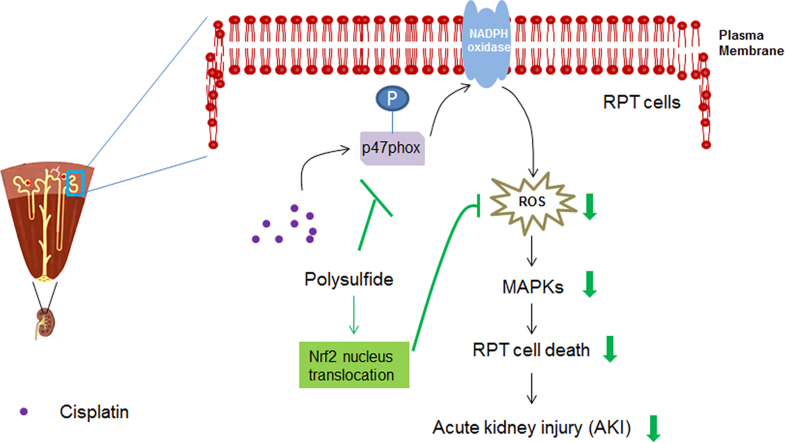
Cisplatin is a major chemotherapeutic drug for solid tumors whereas it may lead to severe nephrotoxicity. Despite decades of efforts, effective therapies remain largely lacking for this disease. In the current research, we investigated the therapeutic effect of hydrogen polysulfide, a novel hydrogen sulfide (H2S) derived signaling molecule, in cisplatin nephrotoxicity and the mechanisms involved. Our results showed that polysulfide donor Na2S4 ameliorated cisplatin-caused renal toxicity in vitro and in vivo through suppressing intracellular reactive oxygen species (ROS) generation and downstream mitogen-activated protein kinases (MAPKs) activation. Additionally, polysulfide may inhibit ROS production by simultaneously lessening the activation of NADPH oxidase and inducing nucleus translocation of nuclear factor erythroid 2-related factor 2 (Nrf2) in RPT cells. Interestingly, polysulfide possesses anti-cancer activity and is able to add on more anti-cancer effect to cisplatin in non-small cell lung cancer (NSCLC) cell lines. Moreover, we observed that the number of sulfur atoms in polysulfide well reflected the efficacy of these molecules not only in cell protection but also cancer inhibition which may serve as a guide for further development of polysulfide donors for pharmaceutical usage. Taken together, our study suggests that polysulfide may be a novel and promising therapeutic agent to prevent cisplatin-induced nephrotoxicity.

Keywords: Cisplatin nephrotoxicity; Hydrogen sulfide; NADPH oxidase; Nuclear factor erythroid 2-related factor 2; Polysulfide; Reactive oxygen species.


Figures

fx1
Graphical abstract
Fig. 1
Fig. 1
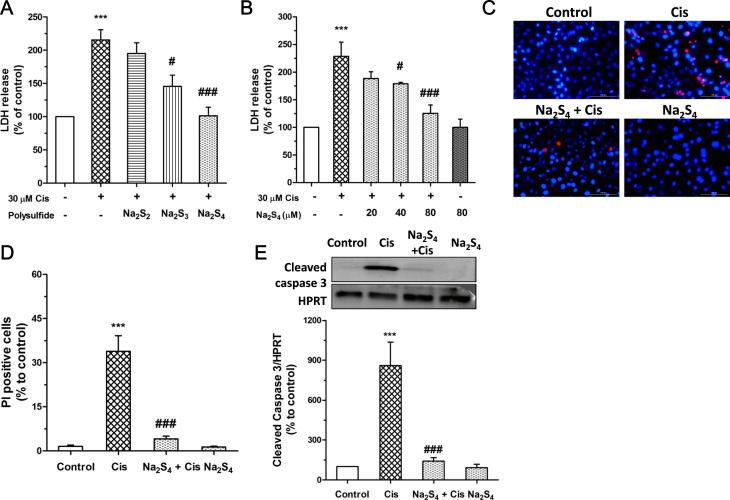
Polysulfide attenuated cisplatin-induced RPT cell death. (A) Effects of polysulfide donors (80 µM, pretreatment for 30 min) on cisplatin (30 µM, 24 h) induced LDH release (n=4).(B) Effect of Na2S4 (pretreatment for 30 min) on cisplatin (30 µM, 24 h) induced LDH release (n=4). (C-D) Hoechst/PI staining assay showed that Na2S4 (80 µM, pretreatment for 30 min) attenuated cisplatin (30 µM, 24 h) induced RPT cell death (n=6). (E) Effect of polysulfide (80 µM, pretreatment for 30 min) on cisplatin-induced cleavage of caspase 3 (30 µM, 24 h) (n=4). ***p<0.001 versus control group;#p<0.05, ###p<0.001 versuscisplatin group. HPRT: Hypoxanthine Guanine Phosphoribosyltransferase.
Fig. 2
Fig. 2
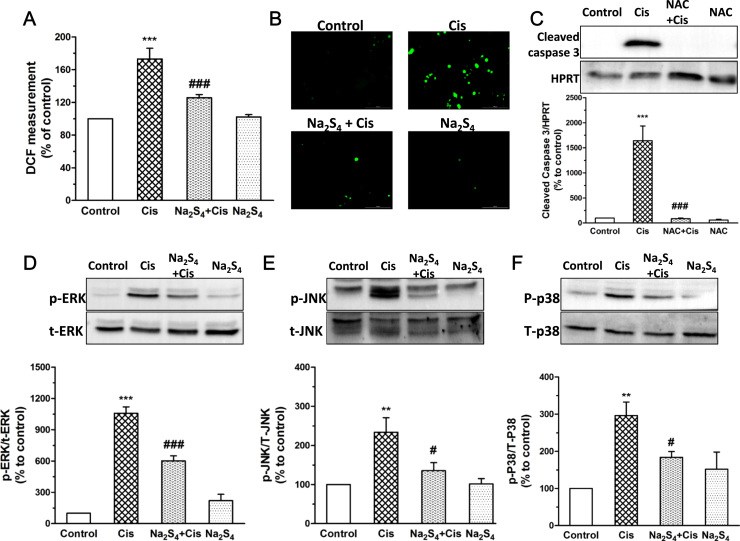
Polysulfide suppressed cisplatin-induced ROS production and MAPKs activation in RPT cells. (A)Na2S4 (80 µM, pretreatment for 30 min) on cisplatin-induced intracellular ROS generation detected by plate reader (n=4) and (B) fluorescence microscope (Representative image from three independent experiments). (C) Effect of NAC (5 mM, pretreatment for 30 min) on cisplatin-induced cleavage of caspase 3 in RPT cells (n=6). (D-F) Effects of Na2S4 (80 µM, pretreatment for 30 min) on cisplatin (30 µM, 12 h) induced phosphorylation of ERK, JNK, p38 (n=4). **p<0.01, and ***p<0.001 versus control group; #p<0.05 and ###p<0.001 versus cisplatin group.
Fig. 3
Fig. 3
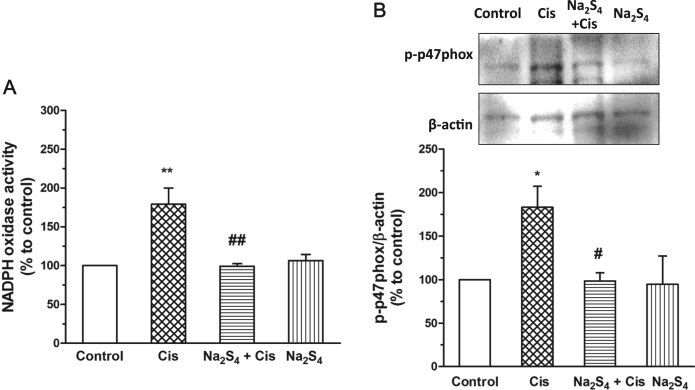
Polysulfide inhibited cisplatin-induced NADPH oxidase activation. (A) Na2S4 (80 µM, pretreatment for 30 min) suppressed cisplatin (30 µM, 12 h) induced NADPH activity (n=3). (B) Na2S4 (80 µM, pretreatment for 30 min) suppressed cisplatin (30 µM, 8 h)-induced phosphorylation of p47phox (n=4). *p<0.05, and **p<0.01 versus control group; #p<0.05 and ##p<0.01 versus cisplatin group.
Fig. 4
Fig. 4
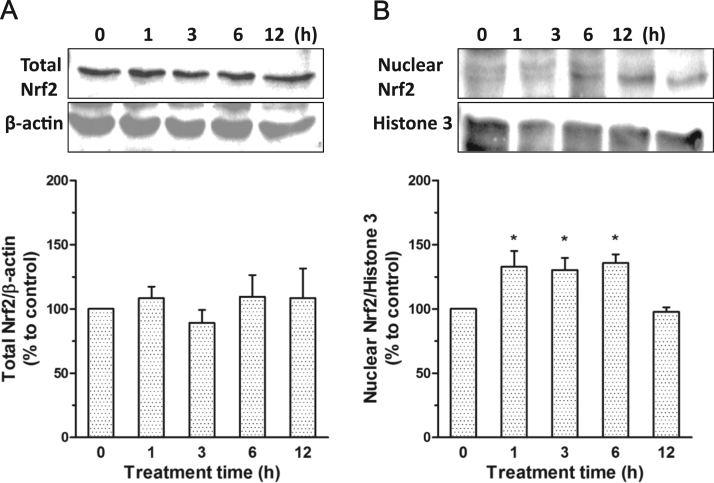
Polysulfide induced nucleus translocation of Nrf2. (A) Effect of Na2S4 (80 µM) on total expression level of Nrf2 (n=5). (B)Effect of Na2S4 (80 µM) on the nucleus level of Nrf2 (n=6).*p<0.05 versus time 0.
Fig. 5
Fig. 5
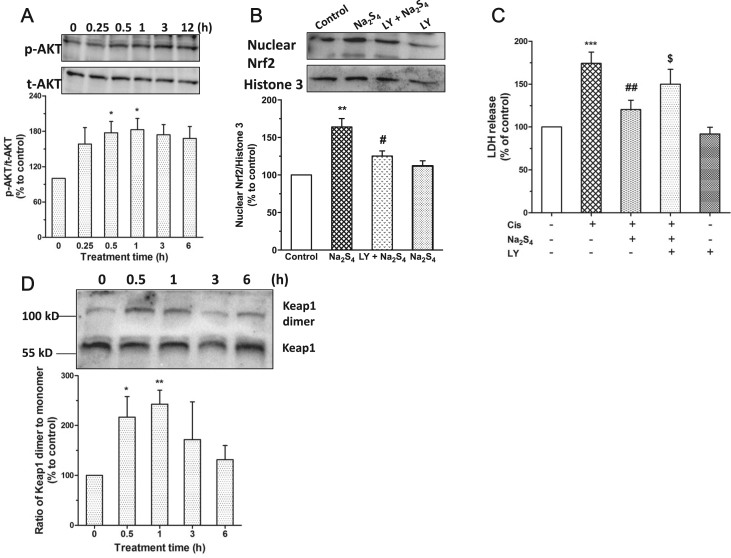
Polysulfide mediated nucleus translocation of Nrf2 involved AKT and Keap1 dimmerization. (A) Effect of Na2S4 (80 µM) on the phosphorylation of AKT (n=5). Effect of LY (AKT inhibitor LY294002, 15 µM, pretreatment for 15 min) on Na2S4 (80 µM, 1 h) mediated nucleus translocation of Nrf2 (B; n=4) and cell protection (C; n=5). (D) Effect of Na2S4 on the dimmerization of Keap1 (n=5). *p<0.05, **p<0.01 versus time 0 for A&D. **p<0.01, ***p<0.001 versus control; #p<0.05, ##p<0.01 versus cisplatin; $p<0.05 versus cisplatin + Na2S4 for B&C.
Fig. 6
Fig. 6
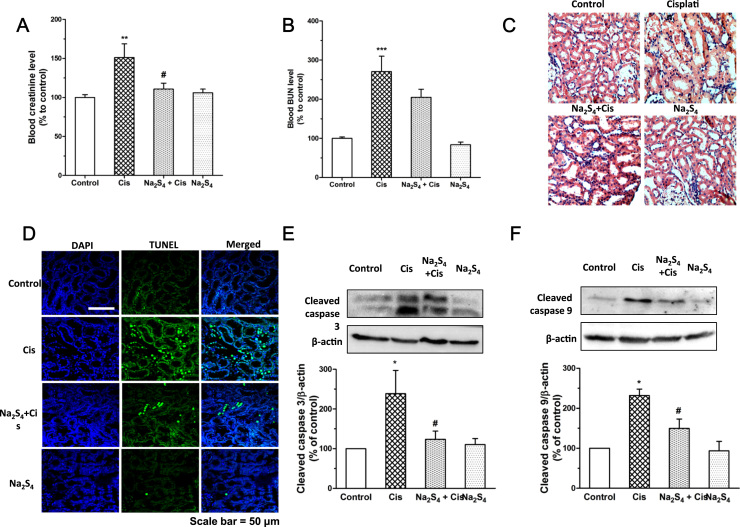
Polysulfide ameliorated cisplatin-induced renal dysfunction and apoptosis. Effects of Na2S4 on cisplatin-induced increase of plasma creatinine (A; n=6–8) and BUN (B; n=6–8). (C) Representative images of H&E staining of kidney tissues. (D) Representative images of TUNEL staining of kidney tissues. (E-F) Effects of Na2S4 on cisplatin-induced cleavage of caspase 3 (n=5) and 9 (n=5) in renal cortical tissues.*p<0.05, **p<0.01 and ***p<0.001 versus control group; #p<0.05 versus cisplatin group.
Fig. 7
Fig. 7
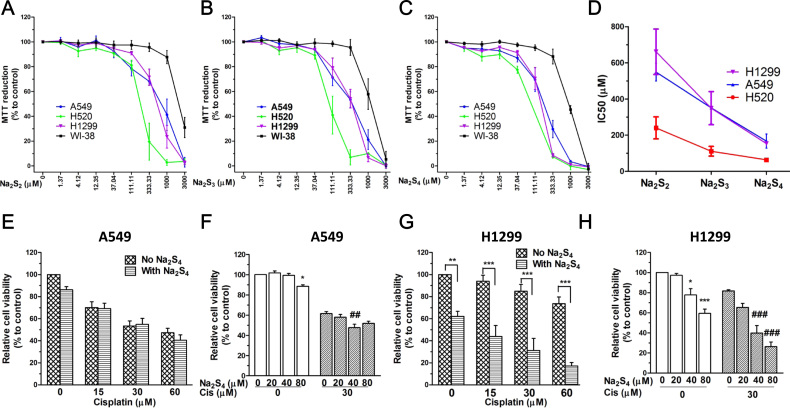
Polysulfide did not compromise the anti-cancer activity of cisplatin in NSCLC cell lines. (A-C) Effect of Na2S4 on the cell viability of NSCLC cell lines and WI-38 after treatment for 24 h (n=4). (D) IC50 value of Na2S4 for the inhibition of NSCLC cell viability (n=4). Effect of Na2S4 (80 µM, pretreatment for 30 min) on the anti-cancer activity of cisplatin (24 h) in A549 cells (E-F; n=3) and H1299 cells (G-H; n=3).**p<0.01 and ***p<.001 for G; *p<0.05 and ***p<0.001 versus non-treated group for F&H; ##p<0.01 and ###p<0.001 versus cisplatin alone group for F&H.

References

    1. Lippert B. John Wiley & Sons; 1999. Cisplatin: Chemistry and Biochemistry of A Leading Anticancer Drug.
    1. Ries F., Klastersky J. Nephrotoxicity induced by cancer chemotherapy with special emphasis on cisplatin toxicity. Am. J. Kidney Dis. 1986;8(5):368–379. - PubMed
    1. Ramesh G., Reeves W.B. TNFR2-mediated apoptosis and necrosis in cisplatin-induced acute renal failure. Am. J. Physiol. Ren. Physiol. 2003;285(4):F610–F618. - PubMed
    1. Miller R.P. Mechanisms of cisplatin nephrotoxicity. Toxins. 2010;2(11):2490–2518. - PMC - PubMed
    1. Baliga R. Oxidant mechanisms in toxic acute renal failure. Drug Metab. Rev. 1999;31(4):971–997. - PubMed

Publication types

MeSH terms