. 2018 Mar 16;293(11):4014-4025.
doi: 10.1074/jbc.RA117.001575. Epub 2018 Feb 2.

High-throughput screen for inhibitors of protein-protein interactions in a reconstituted heat shock protein 70 (Hsp70) complex

Affiliations

High-throughput screen for inhibitors of protein-protein interactions in a reconstituted heat shock protein 70 (Hsp70) complex

Isabelle R Taylor et al. J Biol Chem. .

Abstract

Protein-protein interactions (PPIs) are an important category of putative drug targets. Improvements in high-throughput screening (HTS) have significantly accelerated the discovery of inhibitors for some categories of PPIs. However, methods suitable for screening multiprotein complexes (e.g. those composed of three or more different components) have been slower to emerge. Here, we explored an approach that uses reconstituted multiprotein complexes (RMPCs). As a model system, we chose heat shock protein 70 (Hsp70), which is an ATP-dependent molecular chaperone that interacts with co-chaperones, including DnaJA2 and BAG2. The PPIs between Hsp70 and its co-chaperones stimulate nucleotide cycling. Thus, to re-create this ternary protein system, we combined purified human Hsp70 with DnaJA2 and BAG2 and then screened 100,000 diverse compounds for those that inhibited co-chaperone-stimulated ATPase activity. This HTS campaign yielded two compounds with promising inhibitory activity. Interestingly, one inhibited the PPI between Hsp70 and DnaJA2, whereas the other seemed to inhibit the Hsp70-BAG2 complex. Using secondary assays, we found that both compounds inhibited the PPIs through binding to allosteric sites on Hsp70, but neither affected Hsp70's intrinsic ATPase activity. Our RMPC approach expands the toolbox of biochemical HTS methods available for studying difficult-to-target PPIs in multiprotein complexes. The results may also provide a starting point for new chemical probes of the Hsp70 system.

Keywords: Hsp70, heat shock protein; chemical biology; high-throughput screening (HTS); inhibition mechanism; inhibitor; molecular chaperone; protein complex; protein–protein interaction.


Conflict of interest statement

The authors declare that they have no conflicts of interest with the contents of this article

Figures
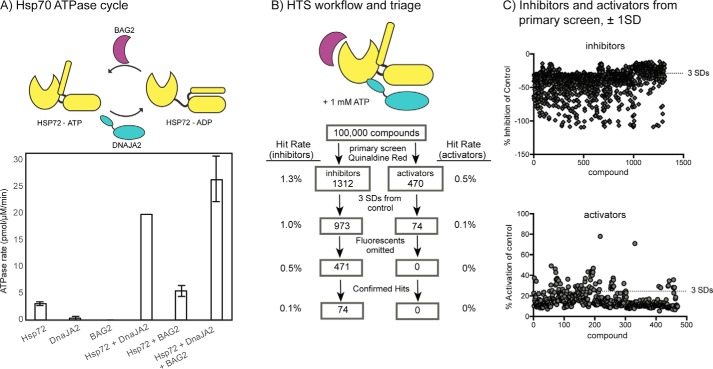
Figure 1.
Figure 1.
High-throughput ATPase screen identifies inhibitors and activators of the Hsp72/DnaJA2/BAG2 system. A, schematic of the Hsp72 ATPase cycle, highlighting the role of the DnaJA2 and BAG2 co-chaperones. Hsp72 (0.5 μm) has a slow hydrolysis rate in the absence of DnaJA2 (0.1 μm) or BAG2 (0.25 μm). Results are the average of triplicates, and the error bars represent standard error of the mean (S.E.). B, overview of the HTS campaign. A total of 100,000 molecules were screened against the Hsp72/DnaJA2/BAG2 combination. Approximately 1.8% of the molecules had inhibitor or activator activity at ±1 S.D., and 1.1% were inhibitors or activators at ±3 S.D. After triage for fluorescent artifacts and dose-response curves (EC50 <50 μm), 74 molecules were predicted to be inhibitors. See the text and under “Materials and methods” for details. C, overview of the compounds with activity at ±1 S.D. and ±3 S.D. from the controls, highlighting the distribution of the top active molecules.
Figure 2.
Figure 2.
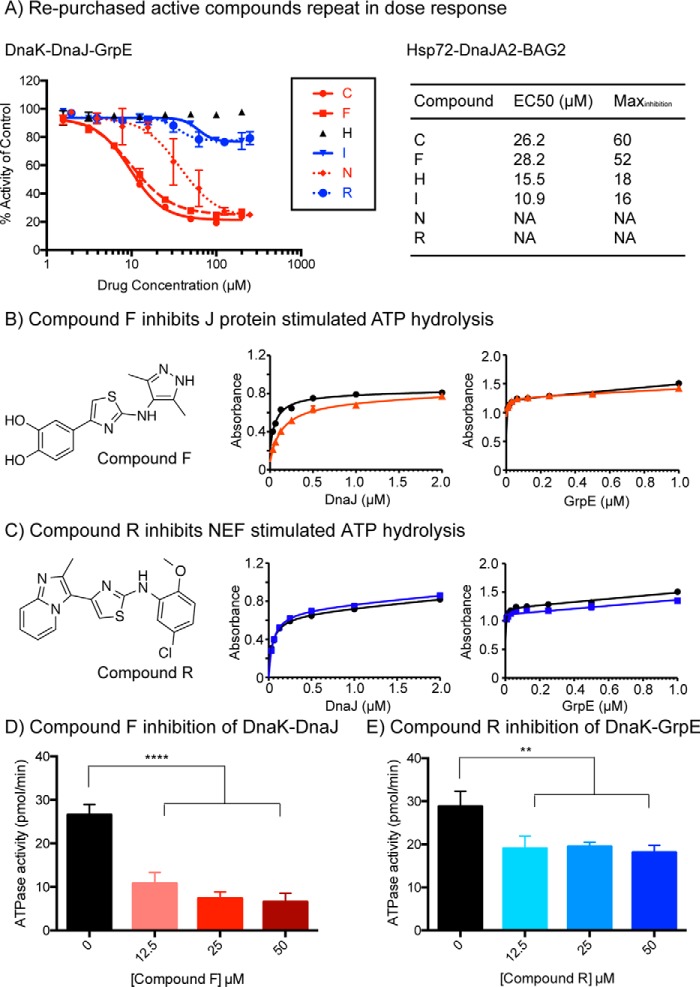
Confirmation of active molecules reveals that they are either inhibitors of J protein or NEF co-chaperones. A, top 18 active molecules were re-purchased and subject to DRCs in the prokaryotic and human Hsp70 systems. Compounds not shown were inactive or not sufficiently soluble for testing. B, compound F inhibits DnaJ-mediated stimulation but has little effect on GrpE-mediated stimulation in ATPase assay. Absorbance is measured at 620 nm. C, compound R has no activity against DnaK–DnaJ but modestly inhibits DnaK–GrpE. Results in B and C are the average of at least three experiments performed in triplicate each, and the error bars represent S.E. D, compound F inhibits a combination of DnaK and DnaJ dose-dependently at low micromolar concentrations (****, p < 0.0001). E, compound R showed significant inhibition of a combination of DnaK, DnaJ, and GrpE at low micromolar concentrations (**, p = 0.005). Results are the average of triplicate values and error bars represent S.E.
Figure 3.
Figure 3.
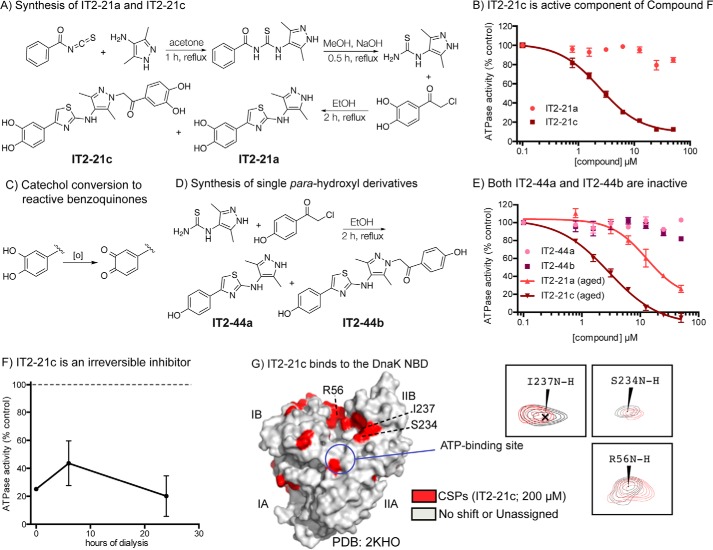
Side product of compound F synthesis is an irreversible inhibitor of Hsp70 systems. A, synthesis of IT2-21a and IT2-21c by Hantzsch thiazole condensation. Compounds IT2-21c and IT2-21a were separated by HPLC. B, IT2-21c, not IT2-21a, is an inhibitor of DnaK/DnaJ/GrpE ATPase activity. Results are the average of triplicates, and error bars represent S.E. C, known oxidation of catechol rings to yield reactive benzoquinones. D, synthesis of IT2-44a and IT2-44b. Compounds were separated by HPLC. E, neither of the para-phenolic analogs were active in the ATPase assay using DnaK/DnaJ/GrpE. Results are the average of triplicates, and error bars represent S.E. “Aging” DMSO stocks of IT2-21a and IT2-21c by overnight incubation at room temperature improved their activity, consistent with an oxidative mechanism. F, IT2-21c (100 μm) was incubated with DnaK (2.5 μm) and then subjected to dialysis. Samples were removed from dialysis after 6 and 24 h, and the ATPase assay was performed with added DnaJ. Even 24 h of dialysis was not able to reverse compound activity. G, a potential binding site of IT2-21c was revealed by HSQC experiments with 15N-labeled DnaK NBD. CSPs (>0.01 ppm in 1H and/or >0.1 ppm in 15N) in the presence of IT2-21c were localized to the IB and IIB subdomains (red). See under “Materials and methods” for details. Peaks shifting for select residues are highlighted with NBD + 2% DMSO in gray and NBD + 200 μm IT2-21c in red.
Figure 4.
Figure 4.
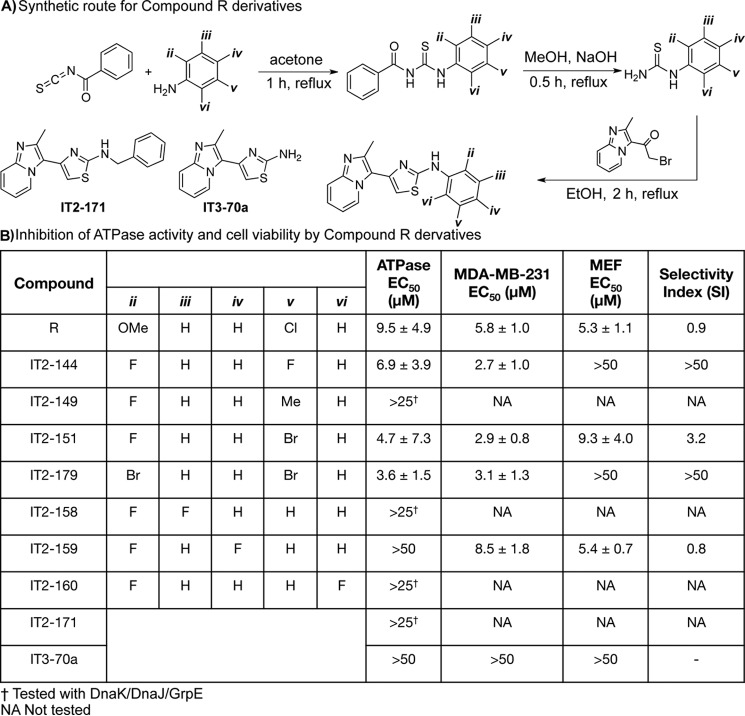
Synthesis and activity of compound R derivatives. A, synthesis of compound R analogs. Structures of IT2-171 and IT3-70a are shown here. B, activity of analogs in ATPase assays (Hsp72, DnaJA2, and BAG2 at 0.5, 0.1, and 0.25 μm, respectively). Results are the average of three independent experiments, each performed in triplicate ± S.D. In addition, compounds were tested for membrane permeability using cell growth assays in MDA-MB-231 breast cancer cells and normal MEFs. EC50 values in cell experiments are the result of two independent experiments, each in triplicate ± S.D. The selectivity index is the EC50 in MDA-MB-231 cells divided by the EC50 in MEF cells.
Figure 5.
Figure 5.
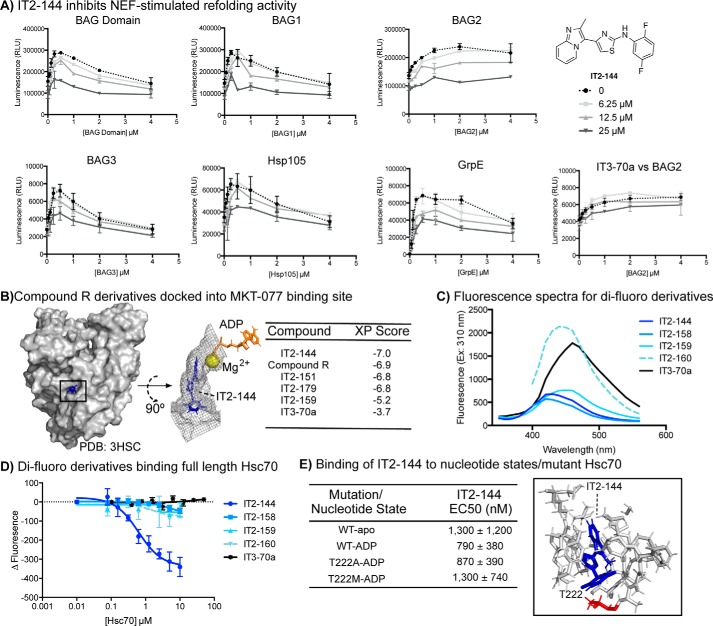
IT2-144 inhibits NEF-mediated activity and potentially binds in the MKT-077 binding pocket. A, IT2-144 inhibits a wide range of Hsp70–NEF combinations in luciferase refolding assays. Hsp72 (1 μm) was used with all of the NEFs except for GrpE, which used DnaK (1 μm). Likewise, DnaJA2 (0.5 μm) was used for all of the NEFs except for GrpE, which used DnaJ (0.5 μm). Denatured luciferase (0.1 μm) and potassium phosphate (10 mm) were also added. Results are the average of triplicate values, and the error bars represent S.E. B, IT2-144 docked to the MKT-077-binding site of Hsc70 (3HSC). Top view of the binding pocket (residues within 5 Å of IT2-144) highlights IT2-144 as well as ADP and magnesium in the adjacent nucleotide-binding cassette. C, scanning fluorescence spectra for all di-fluoro derivatives and the negative compound IT3-70a, with excitation wavelength set at 310 nm. D, change in fluorescence intensity with increasing Hsc70 concentration. Compounds were held at 50 μm, and fluorescence emission was read at optimal wavelengths, determined in spectral scans (see C). E, full-length Hsc70 was incubated with or without ADP and then tested for ability to bind IT2-144 (excitation 310 nm and emission 430 nm). EC50 was determined from two independent experiments in triplicate. Full-length Hsc70 with mutations at position Thr-222 was also tested for ability to bind IT2-144. Thr-222 is highlighted in the structure of IT2-144 docked to Hsc70.

References

    1. Arkin M. R., Tang Y., and Wells J. A. (2014) Small-molecule inhibitors of protein–protein interactions: progressing toward the reality. Chem. Biol. 21, 1102–1114 10.1016/j.chembiol.2014.09.001 - DOI - PMC - PubMed
    1. Cesa L. C., Mapp A. K., and Gestwicki J. E. (2015) Direct and propagated effects of small molecules on protein–protein interaction networks. Front. Bioeng. Biotechnol. 3, 119 - PMC - PubMed
    1. Thompson A. D., Dugan A., Gestwicki J. E., and Mapp A. K. (2012) Fine-tuning multiprotein complexes using small molecules. ACS Chem. Biol. 7, 1311–1320 10.1021/cb300255p - DOI - PMC - PubMed
    1. Scott D. E., Bayly A. R., Abell C., and Skidmore J. (2016) Small molecules, big targets: drug discovery faces the protein–protein interaction challenge. Nat. Rev. Drug Discov. 15, 533–550 10.1038/nrd.2016.29 - DOI - PubMed
    1. Chiappori F., Merelli I., Milanesi L., Colombo G., and Morra G. (2016) An atomistic view of Hsp70 allosteric crosstalk: from the nucleotide to the substrate binding domain and back. Sci. Rep. 6, 23474 10.1038/srep23474 - DOI - PMC - PubMed

Publication types

MeSH terms

Substances

Associated data