


Who is where at risk for Chronic Obstructive Pulmonary Disease? A spatial epidemiological analysis of health insurance claims for COPD in Northeastern Germany
- PMID: 29414997
- PMCID: PMC5802453
- DOI: 10.1371/journal.pone.0190865
Who is where at risk for Chronic Obstructive Pulmonary Disease? A spatial epidemiological analysis of health insurance claims for COPD in Northeastern Germany
Abstract
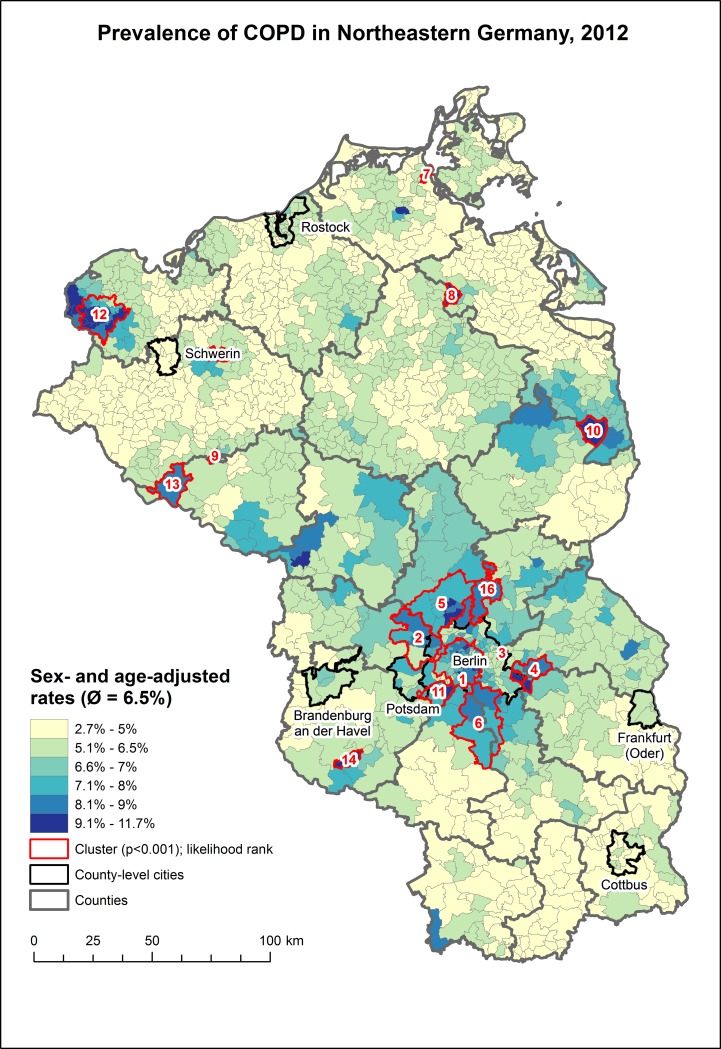
Background: Chronic obstructive pulmonary disease (COPD) has a high prevalence rate in Germany and a further increase is expected within the next years. Although risk factors on an individual level are widely understood, only little is known about the spatial heterogeneity and population-based risk factors of COPD. Background knowledge about broader, population-based processes could help to plan the future provision of healthcare and prevention strategies more aligned to the expected demand. The aim of this study is to analyze how the prevalence of COPD varies across northeastern Germany on the smallest spatial-scale possible and to identify the location-specific population-based risk factors using health insurance claims of the AOK Nordost.
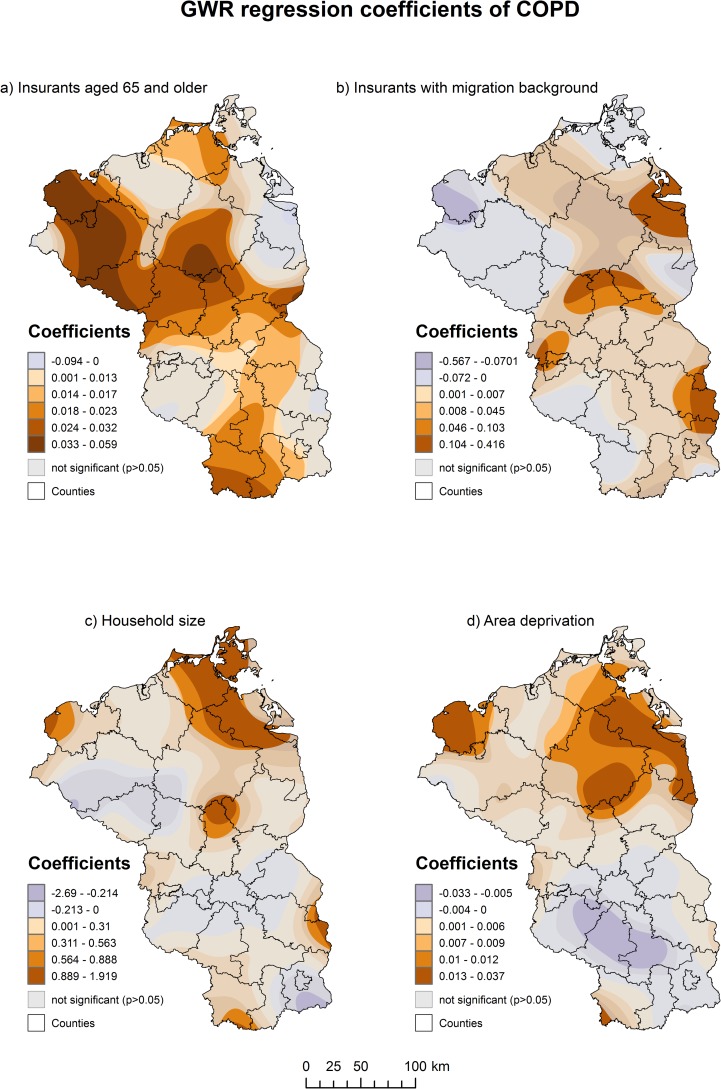
Methods: To visualize the spatial distribution of COPD prevalence at the level of municipalities and urban districts, we used the conditional autoregressive Besag-York-Mollié (BYM) model. Geographically weighted regression modelling (GWR) was applied to analyze the location-specific ecological risk factors for COPD.
Results: The sex- and age-adjusted prevalence of COPD was 6.5% in 2012 and varied widely across northeastern Germany. Population-based risk factors consist of the proportions of insurants aged 65 and older, insurants with migration background, household size and area deprivation. The results of the GWR model revealed that the population at risk for COPD varies considerably across northeastern Germany.
Conclusion: Area deprivation has a direct and an indirect influence on the prevalence of COPD. Persons ageing in socially disadvantaged areas have a higher chance of developing COPD, even when they are not necessarily directly affected by deprivation on an individual level. This underlines the importance of considering the impact of area deprivation on health for planning of healthcare. Additionally, our results reveal that in some parts of the study area, insurants with migration background and persons living in multi-persons households are at elevated risk of COPD.
Conflict of interest statement
Figures
References
-
- Kitaguchi Y, Fujimoto K, Kubo K, Honda T. Characteristics of COPD phenotypes classified according to the findings of HRCT. Respiratory medicine. 2006;100(10):1742–52. doi: 10.1016/j.rmed.2006.02.003 - DOI - PubMed
-
- Mathers C, Fat DM, Boerma JT. The global burden of disease: 2004 update: World Health Organization; 2008.
-
- Lopez A, Shibuya K, Rao C, Mathers C, Hansell A, Held L, et al. Chronic obstructive pulmonary disease: current burden and future projections. European Respiratory Journal. 2006;27(2):397–412. doi: 10.1183/09031936.06.00025805 - DOI - PubMed
-
- Mannino DM, Buist AS. Global burden of COPD: risk factors, prevalence, and future trends. The Lancet. 2007;370(9589):765–73. - PubMed
-
- Pritzkuleit R, Beske F, Katalinic A. Erkrankungszahlen in der Pneumologie–eine Projektion bis 2060. Pneumologie. 2010;64(09):535–40. - PubMed
Publication types
MeSH terms
LinkOut - more resources
Full Text Sources
Other Literature Sources
Medical
