. 2018 Feb 6;19(2):480.
doi: 10.3390/ijms19020480.

CircSMARCA5 Inhibits Migration of Glioblastoma Multiforme Cells by Regulating a Molecular Axis Involving Splicing Factors SRSF1/SRSF3/PTB

Affiliations

CircSMARCA5 Inhibits Migration of Glioblastoma Multiforme Cells by Regulating a Molecular Axis Involving Splicing Factors SRSF1/SRSF3/PTB

Davide Barbagallo et al. Int J Mol Sci. .

Abstract

Circular RNAs (circRNAs) have recently emerged as a new class of RNAs, highly enriched in the brain and very stable within cells, exosomes and body fluids. To analyze their involvement in glioblastoma multiforme (GBM) pathogenesis, we assayed the expression of twelve circRNAs, physiologically enriched in several regions of the brain, through real-time PCR in a cohort of fifty-six GBM patient biopsies and seven normal brain parenchymas. We focused on hsa_circ_0001445 (circSMARCA5): it was significantly downregulated in GBM biopsies as compared to normal brain tissues (p-value < 0.00001, student's t-test), contrary to its linear isoform counterpart that did not show any differential expression (p-value = 0.694, student's t-test). Analysis of a public dataset revealed a negative correlation between the expression of circSMARCA5 and glioma's histological grade, suggesting its potential negative role in the progression to malignancy. Overexpressing circSMARCA5 in U87MG cells significantly decreased their migration, but not their proliferation rate. In silico scanning of circSMARCA5 sequence revealed an enrichment in binding motifs for several RNA binding proteins (RBPs), specifically involved in splicing. Among them, serine and arginine rich splicing factor 1 (SRSF1), a splicing factor known to be a positive controller of cell migration and known to be overexpressed in GBM, was predicted to bind circSMARCA5 by three different prediction tools. Direct interaction between circSMARCA5 and SRSF1 is supported by enhanced UV crosslinking and immunoprecipitation (eCLIP) data for SRSF1 in K562 cells from Encyclopedia of DNA Elements (ENCODE). Consistently, U87MG overexpressing circSMARCA5 showed an increased expression of serine and arginine rich splicing factor 3 (SRSF3) RNA isoform containing exon 4, normally skipped in a SRSF1-dependent manner, resulting in a non-productive non-sense mediated decay (NMD) substrate. Interestingly, SRSF3 is known to interplay with two other splicing factors, polypyrimidine tract binding protein 1 (PTBP1) and polypyrimidine tract binding protein 2 (PTBP2), that positively regulate glioma cells migration. Collectively, our data show circSMARCA5 as a promising druggable tumor suppressor in GBM and suggest that it may exert its function by tethering the RBP SRSF1.

Keywords: RNA binding proteins; cell migration; circRNAs; glioblastoma multiforme; splicing.


Conflict of interest statement

The authors declare no conflict of interest.

Figures
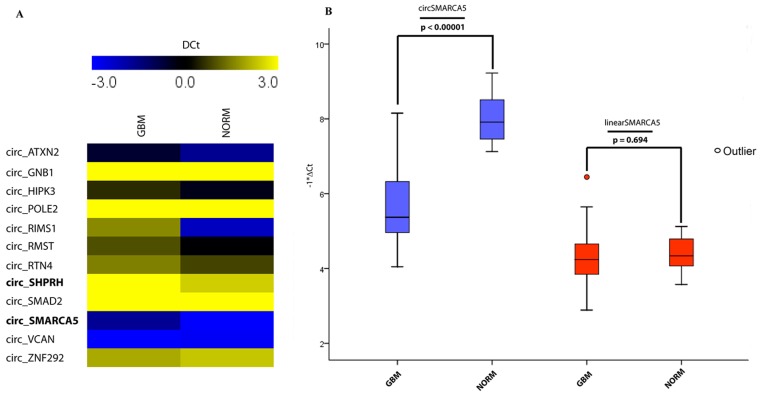
Figure 1
Figure 1
Expression of candidate circRNAs in GBM and control (NORM) samples. (A) Heat map representing the expression profile of twelve candidate circRNAs in GBM and control samples. Expression values (reported as DCt) higher and lower than those of the control are shown in yellow and blue, respectively. circSHPRH and circSMARCA5 are in bold, due to their significant downregulation (p-value circSHPRH = 0.015, p-value circSMARCA5 = 0.017, n = 5, Student’s t-test). (B) Box-plots representing the expression of circSMARCA5 and linearSMARCA5 in GBM and control samples. Expression values are reported as −DCt relative to (mRNA) TBP (p-values are shown in the figure, nGBM = 56, nNORM = 7, Student’s t-test).
Figure 2
Figure 2
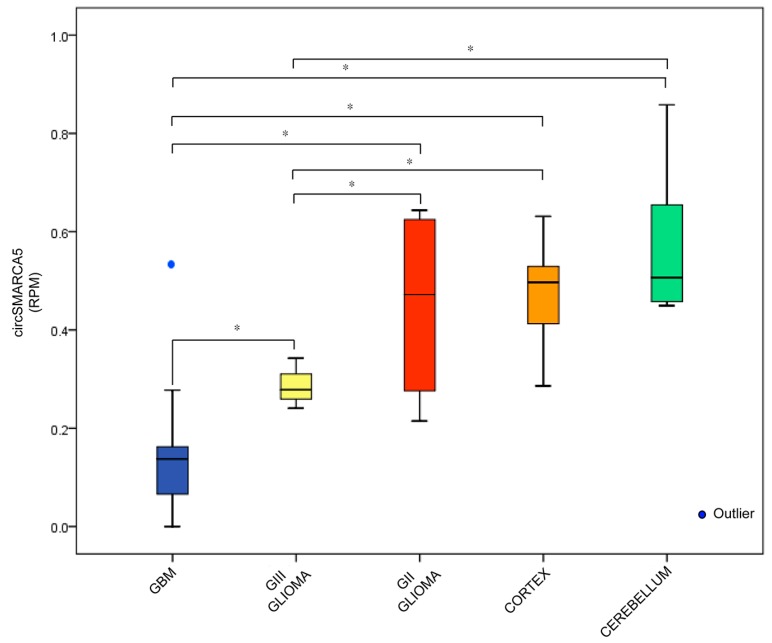
Correlation between circSMARCA5 expression and glioma grade malignancy. Box-plot representing circSMARCA5 expression in three grade tumor groups (GBM, Grade III—GIII- and Grade II—GII-gliomas) and two different control groups (Cortex and Cerebellum). Expression values are reported as reads per million mapped reads (RPM) (* p-value < 0.05, ANOVA test).
Figure 3
Figure 3
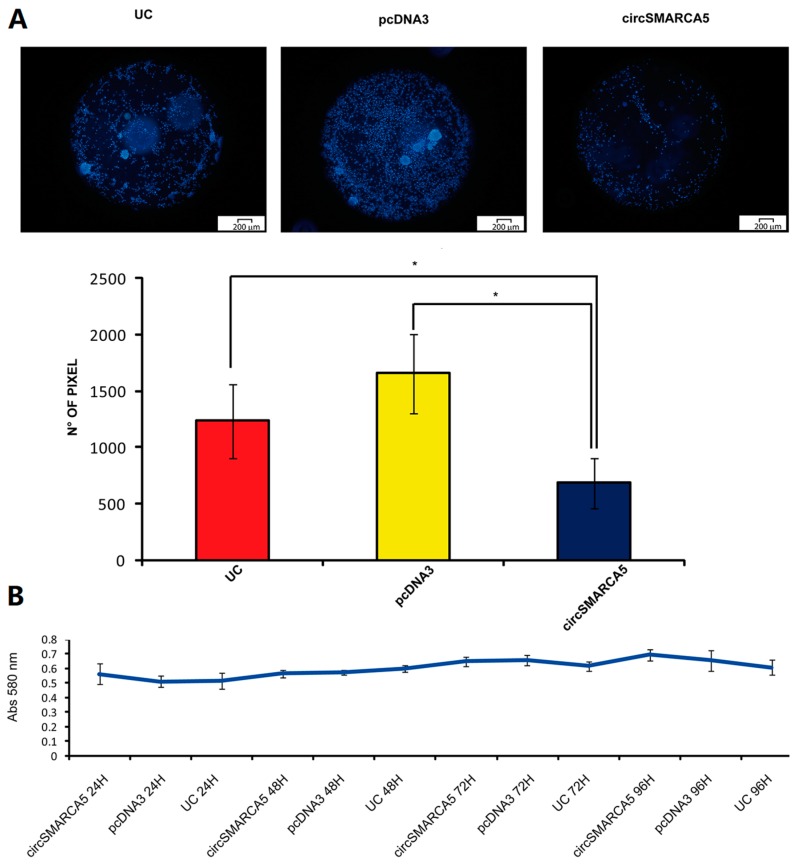
Effects of circSMARCA5 overexpression on migration and viability of U87MG cells. (A) Migration of untransfected (UC), pcDNA3 and pcDNA3_circSMARCA5 (circSMARCA5) transfected U87MG cells. Cells were stained with Hoechst® 33342 at a final concentration of 5 µg/mL (upper panel). Quantitative data are reported as the number of pixel within the detection area (lower panel, * p-value < 0.05, n = 3, Student’s t-test). (B) Viability of untransfected (UC), pcDNA3 and pcDNA3_circSMARCA5 (circSMARCA5) transfected U87MG cells. Data are reported as baseline-corrected absorbance at 580 nm (n = 6).
Figure 4
Figure 4
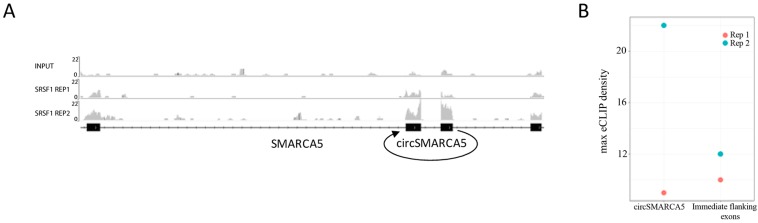
SRFS1 eCLIP data from ENCODE on K562 cells. (A) eCLIP read density within the SMARCA5 gene locus (chr4:144461450-144466050, hg19), containing the circSMARCA5 and the immediate flanking exons, visualized by the Integrative Genomics Viewer (IGV). (B) Max read density obtained on circSMARCA5 and in the immediate flanking exons (as shown in a) from SRSF1 eCLIP replicates 1 and 2.
Figure 5
Figure 5
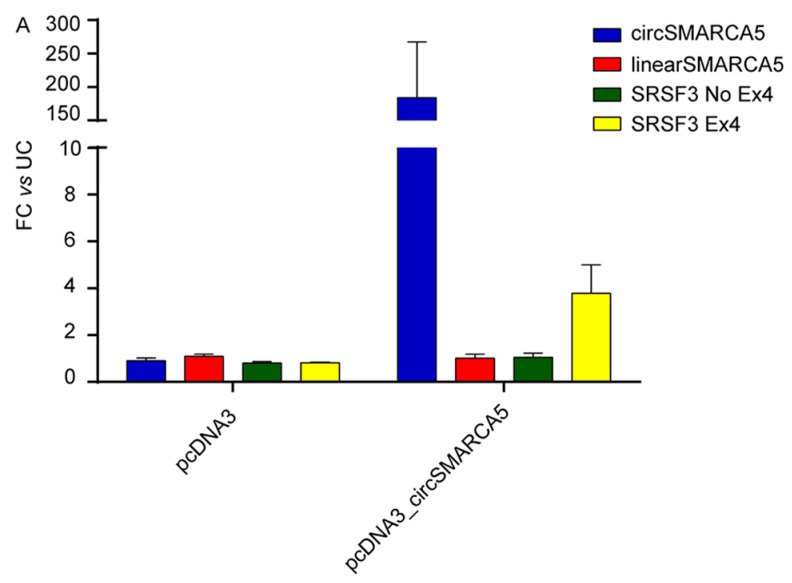
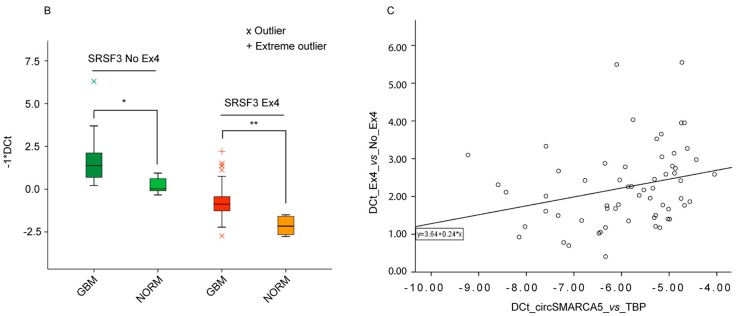
circSMARCA5 stimulates inclusion of exon 4 within SRSF3 mRNA. Graphs representing the expression of the mRNA of the splicing factor SRFS3 in: (A) U87MG overexpressing circSMARCA5; and (B,C) GBM biopsies. (A) U87MG overexpressing circSMARCA5 show a significant increased expression of SRSF3 containing exon 4 (SRSF3 Ex4) (** p-value < 0.01, n = 3, Student’s t-test). Data are reported as fold-change (FC) versus untransfected cells (UC). (B) Both SRSF3 No Ex4 and SRSF3 Ex4 are significantly overexpressed in GBM biopsies (GBM) with respect to normal brain parenchyma (NORM) (* p-value < 0.05; ** p-value < 0.01, nGBM = 56, nNORM = 7, Student’s t-test). Expression values are reported as −DCt relative to (mRNA) TBP.(C) Correlation between SRSF3 Ex4/SRSF3 No Ex4 ratio and circSMARCA5 (r-value = 0.36, p-value = 0.004, Spearman’s correlation test). Data are represented as DCt relative to (mRNA) TBP in a scatter plot.
Figure 5
Figure 5
circSMARCA5 stimulates inclusion of exon 4 within SRSF3 mRNA. Graphs representing the expression of the mRNA of the splicing factor SRFS3 in: (A) U87MG overexpressing circSMARCA5; and (B,C) GBM biopsies. (A) U87MG overexpressing circSMARCA5 show a significant increased expression of SRSF3 containing exon 4 (SRSF3 Ex4) (** p-value < 0.01, n = 3, Student’s t-test). Data are reported as fold-change (FC) versus untransfected cells (UC). (B) Both SRSF3 No Ex4 and SRSF3 Ex4 are significantly overexpressed in GBM biopsies (GBM) with respect to normal brain parenchyma (NORM) (* p-value < 0.05; ** p-value < 0.01, nGBM = 56, nNORM = 7, Student’s t-test). Expression values are reported as −DCt relative to (mRNA) TBP.(C) Correlation between SRSF3 Ex4/SRSF3 No Ex4 ratio and circSMARCA5 (r-value = 0.36, p-value = 0.004, Spearman’s correlation test). Data are represented as DCt relative to (mRNA) TBP in a scatter plot.

References

    1. Memczak S., Jens M., Elefsinioti A., Torti F., Krueger J., Rybak A., Maier L., Mackowiak S.D., Gregersen L.H., Munschauer M., et al. Circular RNAs are a large class of animal RNAs with regulatory potency. Nature. 2013;495:333–338. doi: 10.1038/nature11928. - DOI - PubMed
    1. Chen I., Chen C.Y., Chuang T.J. Biogenesis, identification, and function of exonic circular RNAs. Wiley Interdiscip. Rev. RNA. 2015;6:563–579. doi: 10.1002/wrna.1294. - DOI - PMC - PubMed
    1. Zhang Y., Zhang X.O., Chen T., Xiang J.F., Yin Q.F., Xing Y.H., Zhu S., Yang L., Chen L.L. Circular intronic long noncoding RNAs. Mol. Cell. 2013;51:792–806. doi: 10.1016/j.molcel.2013.08.017. - DOI - PubMed
    1. Li Z., Huang C., Bao C., Chen L., Lin M., Wang X., Zhong G., Yu B., Hu W., Dai L., et al. Exon-intron circular RNAs regulate transcription in the nucleus. Nat. Struct. Mol. Biol. 2015;22:256–264. doi: 10.1038/nsmb.2959. - DOI - PubMed
    1. Vicens Q., Westhof E. Biogenesis of Circular RNAs. Cell. 2014;159:13–14. doi: 10.1016/j.cell.2014.09.005. - DOI - PubMed

MeSH terms

LinkOut - more resources