


The demographic impact and development benefits of meeting demand for family planning with modern contraceptive methods
- PMID: 29415632
- PMCID: PMC5814765
- DOI: 10.1080/16549716.2018.1423861
The demographic impact and development benefits of meeting demand for family planning with modern contraceptive methods
Abstract
Background: Meeting demand for family planning can facilitate progress towards all major themes of the United Nations Sustainable Development Goals (SDGs): people, planet, prosperity, peace, and partnership. Many policymakers have embraced a benchmark goal that at least 75% of the demand for family planning in all countries be satisfied with modern contraceptive methods by the year 2030.
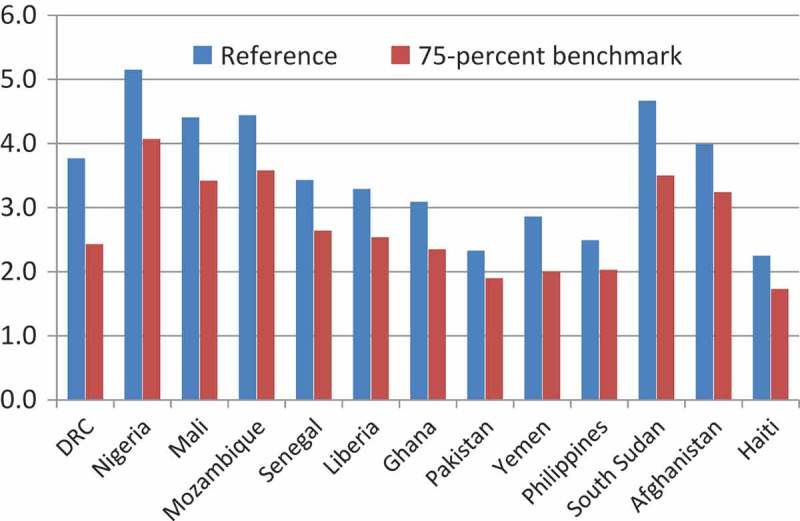
Objective: This study examines the demographic impact (and development implications) of achieving the 75% benchmark in 13 developing countries that are expected to be the furthest from achieving that benchmark.
Methods: Estimation of the demographic impact of achieving the 75% benchmark requires three steps in each country: 1) translate contraceptive prevalence assumptions (with and without intervention) into future fertility levels based on biometric models, 2) incorporate each pair of fertility assumptions into separate population projections, and 3) compare the demographic differences between the two population projections. Data are drawn from the United Nations, the US Census Bureau, and Demographic and Health Surveys.
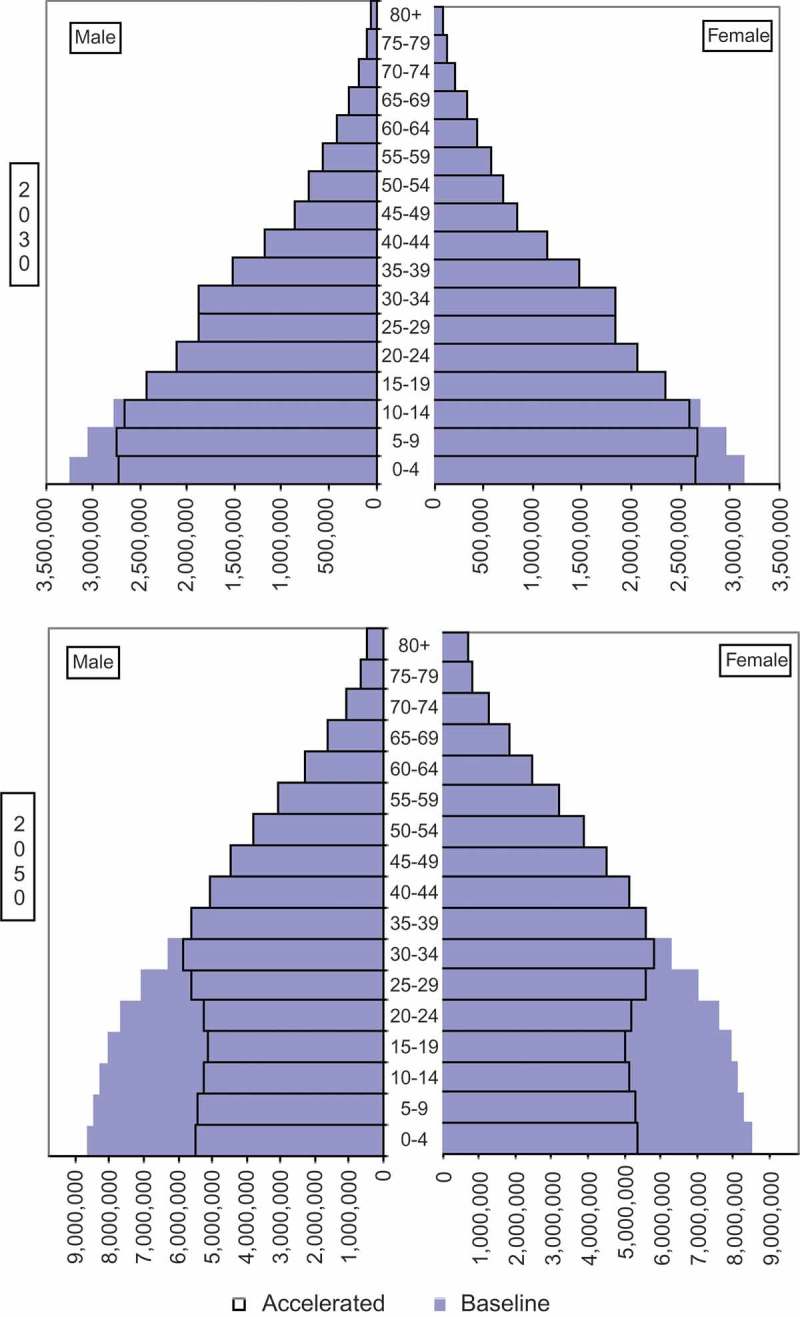
Results: The demographic impact of meeting the 75% benchmark is examined via projected differences in fertility rates (average expected births per woman's reproductive lifetime), total population, growth rates, age structure, and youth dependency. On average, meeting the benchmark would imply a 16 percentage point increase in modern contraceptive prevalence by 2030 and a 20% decline in youth dependency, which portends a potential demographic dividend to spur economic growth.
Conclusions: Improvements in meeting the demand for family planning with modern contraceptive methods can bring substantial benefits to developing countries. To our knowledge, this is the first study to show formally how such improvements can alter population size and age structure. Declines in youth dependency portend a demographic dividend, an added bonus to the already well-known benefits of meeting existing demands for family planning.
Keywords: Demographic dividend; United Nations SDGs (sustainable development goals); biometric models; population projections; reproductive health; sub-Saharan Africa.
Figures
References
-
- United Nations General Assembly Resolution adopted by the General Assembly on 25 September 2015. 70/1. Transforming our world: the 2030 Agenda for Sustainable Development. New York: United Nations; 2015. Available from: http://www.un.org/ga/search/view_doc.asp?symbol=A/RES/70/1&referer=/engl...
-
- Ahmed S, Li Q, Liu L, et al. Maternal deaths averted by contraceptive use: an analysis of 172 countries. Lancet. 2012;380:111–125. - PubMed
-
- Hobcraft J, McDonald JW, Rutstein S. Child-spacing effects on infant and early child-mortality. Popul Index. 1983;49:585–618.
-
- World Health Organization Report of a WHO Technical Consultation on Birth Spacing. Geneva. 13-15 June 2005. Geneva: World Health Organization; 2007.
Publication types
MeSH terms
LinkOut - more resources
Full Text Sources
Other Literature Sources
Medical
