


Disparities in severe shigellosis among adults - Foodborne diseases active surveillance network, 2002-2014
- PMID: 29415691
- PMCID: PMC5803893
- DOI: 10.1186/s12889-018-5115-4
Disparities in severe shigellosis among adults - Foodborne diseases active surveillance network, 2002-2014
Abstract
Background: Shigella causes approximately 500,000 illnesses, 6000 hospitalizations, and 40 deaths in the United States annually, but incidence and populations at risk for severe shigellosis among adults are unclear. This study describes severe shigellosis among US adults.
Methods: We analyzed Foodborne Diseases Active Surveillance Network data for infections caused by Shigella among adults ≥18 years old during 2002-2014. Criteria to define severe shigellosis included hospitalization, bacteremia, or death. We estimated annual incidence of shigellosis per 100,000 among adult populations, and conducted multivariable mixed-effects logistic regression to assess associations between severe shigellosis, demographic factors and Shigella species among adults with shigellosis.
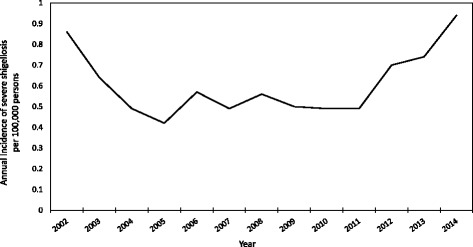
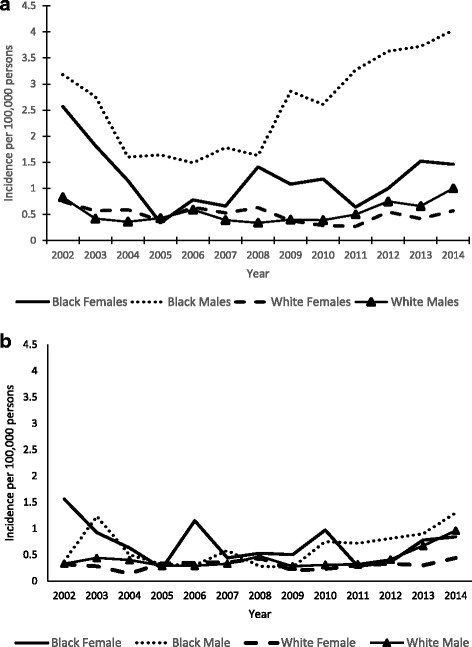
Results: Among 9968 shigellosis cases, 2764 (28%) were severe. Restricting to cases due to S. sonnei and S. flexneri, median annual incidence of severe shigellosis among adults was 0.56 and highest overall incidence was among black males 18-49 years old (1.58). Among adults with shigellosis, odds of severe disease were higher among males than females aged 18-49 years old (OR [95% CI] = 1.32 [1.15-1.52], p < 0.001) and among males than females with S. flexneri infections (OR [95% CI] =1.39 [1.10-1.75], p = 0.005). The odds of severe shigellosis were higher among blacks than whites (OR [95% CI] = 1.36 [1.22-1.52], p < 0.001).
Conclusions: Among adults, men 18-49 years old, particularly blacks, have the highest incidence of severe shigellosis. Among adults with shigellosis, severe shigellosis was associated with being male in age group 18-49 years, with infections caused by S. flexneri, and with black race. Future research should assess associations between severe shigellosis and sexual practices, antimicrobial resistance, comorbidities, and access to care.
Keywords: Adult; Epidemiology; MSM; Shigellosis.
Conflict of interest statement
Ethics approval and consent to participate
The data used for this analysis was de-identified under a protocol reviewed and approved by CDC’s IRB.
Consent for publication
Not applicable.
Competing interests
The authors declare that they have no competing interests.
Publisher’s Note
Springer Nature remains neutral with regard to jurisdictional claims in published maps and institutional affiliations.
Figures
References
-
- Centers for Disease Control and Prevention. Shigella - Shigellosis [https://www.cdc.gov/shigella/index.html]. Accessed 3 Nov 2016.
-
- Centers for Disease Control and Prevention. Yellow Book [http://wwwnc.cdc.gov/travel/yellowbook/2016/infectious-diseases-related-...] Accessed 9 Nov 2016.
-
- Cordell RL. The risk of infectious diseases among child care providers. J Am Med Womens Assoc. 2001;56(3):109–112. - PubMed
-
- Barton Behravesh C, Jones TF, Vugia DJ, Long C, Marcus R, Smith K, Thomas S, Zansky S, Fullerton KE, Henao OL, et al. Deaths associated with bacterial pathogens transmitted commonly through food: foodborne diseases active surveillance network (FoodNet), 1996-2005. J Infect Dis. 2011;204(2):263–267. doi: 10.1093/infdis/jir263. - DOI - PubMed
MeSH terms
LinkOut - more resources
Full Text Sources
Other Literature Sources
Medical
