Meta-Analysis
. 2018 Feb 7;19(1):26.
doi: 10.1186/s12931-018-0731-1.

Characterizing undiagnosed chronic obstructive pulmonary disease: a systematic review and meta-analysis

Affiliations
Meta-Analysis

Characterizing undiagnosed chronic obstructive pulmonary disease: a systematic review and meta-analysis

Kate M Johnson et al. Respir Res. .

Abstract

Background: A significant proportion of patients with chronic obstructive pulmonary disease (COPD) remain undiagnosed. Characterizing these patients can increase our understanding of the 'hidden' burden of COPD and the effectiveness of case detection interventions.

Methods: We conducted a systematic review and meta-analysis to compare patient and disease factors between patients with undiagnosed persistent airflow limitation and those with diagnosed COPD. We searched MEDLINE and EMBASE for observational studies of adult patients meeting accepted spirometric definitions of COPD. We extracted and pooled summary data on the proportion or mean of each risk factor among diagnosed and undiagnosed patients (unadjusted analysis), and coefficients for the adjusted association between risk factors and diagnosis status (adjusted analysis).

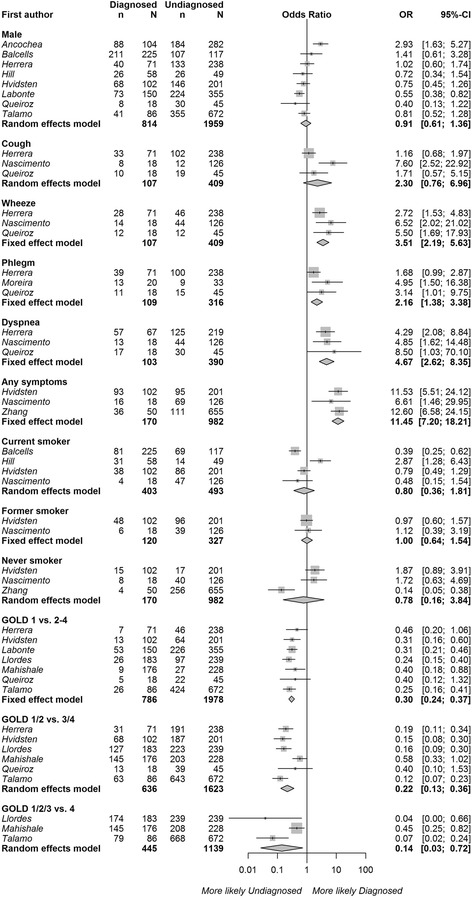
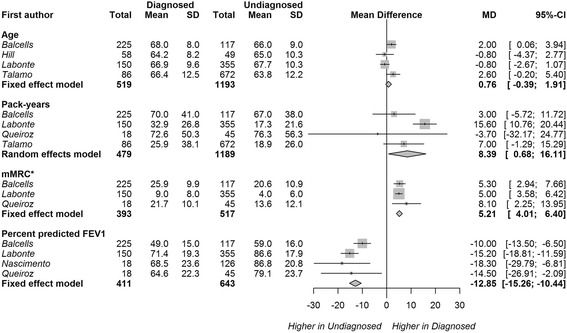
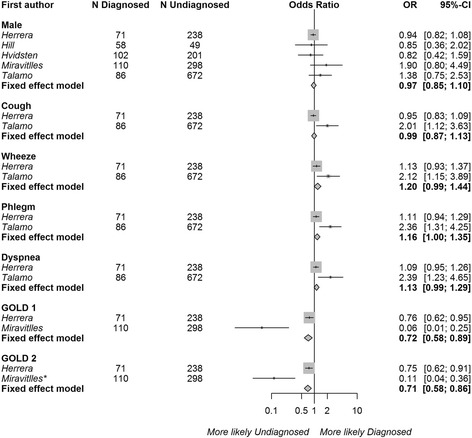
Results: Two thousand eighty-three records were identified through database searching and 16 articles were used in the meta-analyses. Diagnosed patients were less likely to have mild (v. moderate to very severe) COPD (odds ratio [OR] 0.30, 95%CI 0.24-0.37, 6 studies) in unadjusted analysis. This association remained significant but its strength was attenuated in the adjusted analysis (OR 0.72, 95%CI 0.58-0.89, 2 studies). Diagnosed patients were more likely to report respiratory symptoms such as wheezing (OR 3.51, 95%CI 2.19-5.63, 3 studies) and phlegm (OR 2.16, 95% CI 1.38-3.38, 3 studies), had more severe dyspnea (mean difference in modified Medical Research Council scale 0.52, 95%CI 0.40-0.64, 3 studies), and slightly greater smoking history than undiagnosed patients. Patient age, sex, current smoking status, and the presence of coughing were not associated with a previous diagnosis.

Conclusions: Undiagnosed patients had less severe airflow obstruction and fewer respiratory symptoms than diagnosed patients. The lower disease burden in undiagnosed patients may significantly delay the diagnosis of COPD.

Keywords: Chronic Obstructive Pulmonary Disease; Delayed diagnosis; Diagnostic errors; Differential diagnosis; Meta-analysis; Risk factors; Systematic review.


Conflict of interest statement

Ethics approval and consent to participate

Is not required because this study does not include analysis of individual data.

Consent for publication

Not applicable.

Competing interests

The authors declare that they have no competing interests.

Publisher’s Note

Springer Nature remains neutral with regard to jurisdictional claims in published maps and institutional affiliations.

Figures
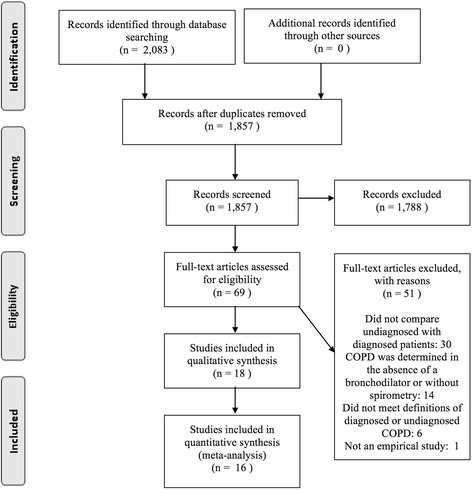
Fig. 1
Fig. 1
Preferred Reporting Items for Systematic Reviews and Meta-Analyses flow diagram
Fig. 2
Fig. 2
Associations between diagnosed (v. ‘undiagnosed’) COPD and sex, the presence of cough, wheeze, phlegm, dyspnea, any respiratory symptoms, smoking status, smoking history, and COPD severity based on contingency tables (‘unadjusted analysis’). Persistent airflow limitation was defined as post-bronchodilator FEV1/FVC < 0.7. Squares represent individual study estimates with the size of the square corresponding to their weight in the pooled estimate (represented with diamonds)
Fig. 3
Fig. 3
Mean difference (MD) in age, pack-years of smoking, mMRC dyspnea score, and percent of predicted FEV1 between diagnosed and undiagnosed categories. Persistent airflow limitation was defined as post-bronchodilator FEV1/FVC < 0.7. Squares represent individual study estimates with the size of the square corresponding to their weight in the pooled estimate (represented with diamonds). * modified Medical Research Council (mMRC) Dyspnea scale [26] means and standard errors (SE) for the diagnosed and undiagnosed categories are multiplied by a factor of 10
Fig. 4
Fig. 4
Associations between risk factors and the odds of receiving a COPD diagnosis using the regression coefficients from studies with multivariable regression modeling† (‘adjusted analysis’) and persistent airflow limitation defined as post-bronchodilator FEV1/FVC < 0.7. The reference categories were female, the absence of cough, wheeze, dyspnea, phlegm, and GOLD grades 3 and 4, respectively. Squares represent individual study estimates with the size of the square corresponding to their weight in the pooled estimate (represented with diamonds). †Herrera et al. [25] reported prevalence ratios from Poisson regression models. *The reference category was changed from GOLD grade 1 to GOLD grades 3 and 4 by assuming a covariance of 0 between the dummy variables representing GOLD grades 1 and 2.1 Regression models were adjusted for age (Herrera, Hill, Hvidsten, Miravitlles, Talamo), sex (Herrera, Hill, Hvidsten, Miravitlles, Talamo), ethnicity (Herrera, Talamo), body mass index (Herrera, Hvidsten), education (Herrera, Hvidsten, Miravitlles, Talamo), income (Hvidsten), employment (Talamo), risk factor to dust (Herrera), smoking (Herrera, Hill, Hvidsten, Miravitlles, Talamo), respiratory symptoms, (Herrera, Hill, Hvidsten, Talamo), self-rated health (Hvidsten, Miravitlles), COPD severity (Herrera, Miravitlles, Talamo), comorbidities (Herrera, Hvidsten), prior health-care use (Herrera, Hill), and exacerbations (Herrera)
Fig. 5
Fig. 5
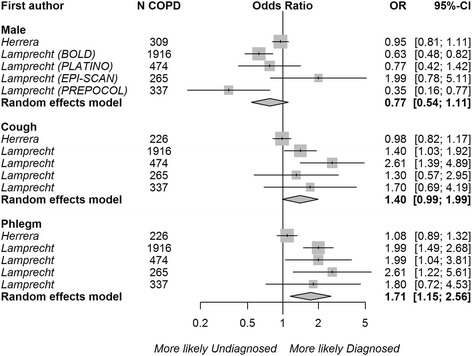
Associations between risk factors and the odds of receiving a COPD diagnosis using the regression coefficients from studies with multivariable regression modeling (‘adjusted analysis’) and persistent airflow limitation defined as post-bronchodilator FEV1/FVC < LLN. The reference categories were female, and the absence of cough and phlegm, respectively. The results for each dataset (BOLD, PLATINO, EPI-SCAN, PREPOCOL) analyzed in Lamprecht et al. [4] were pooled separately. Squares represent individual study estimates with the size of the square corresponding to their weight in the pooled estimate (represented with diamonds).1 Regression models were adjusted for age (Herrera, Lamprecht), sex (Herrera, Lamprecht), ethnicity (Herrera), body mass index (Herrera), education (Herrera, Lamprecht), risk factors to dust (Herrera), smoking (Herrera, Lamprecht), respiratory symptoms (Herrera, Lamprecht), COPD severity (Herrera, Lamprecht), comorbidities (Herrera), and prior health-care use (Herrera, Lamprecht)

References

    1. From the Global Strategy for the Diagnosis, Management and Prevention of COPD . Global Initiative for Chronic Obstructive Lung Disease (GOLD) 2017.
    1. Vestbo J, Edwards LD, Scanlon PD, Yates JC, Agusti A, Bakke P, et al. Changes in forced expiratory volume in 1 second over time in COPD. N Engl J Med. 2011;365:1184–1192. doi: 10.1056/NEJMoa1105482. - DOI - PubMed
    1. Balcells E, Gimeno-Santos E, de Batlle J, Ramon MA, Rodriguez E, Benet M, et al. Characterisation and prognosis of undiagnosed chronic obstructive pulmonary disease patients at their first hospitalisation. BMC Pulm Med. 2015;15 - PMC - PubMed
    1. Lamprecht B, Soriano JB, Studnicka M, Kaiser B, Vanfleteren LE, Gnatiuc L, et al. Determinants of underdiagnosis of COPD in national and international surveys. Chest. 2015;148:971–985. doi: 10.1378/chest.14-2535. - DOI - PubMed
    1. Haroon SM, Jordan RE, O’Beirne-Elliman J, Adab P. Effectiveness of case finding strategies for COPD in primary care: a systematic review and meta-analysis. NPJ Prim Care Respir Med. 2015;25:15056. doi: 10.1038/npjpcrm.2015.56. - DOI - PMC - PubMed

Publication types

MeSH terms

Grants and funding