


Design and first baseline data of the DZNE multicenter observational study on predementia Alzheimer's disease (DELCODE)
- PMID: 29415768
- PMCID: PMC5802096
- DOI: 10.1186/s13195-017-0314-2
Design and first baseline data of the DZNE multicenter observational study on predementia Alzheimer's disease (DELCODE)
Abstract
Background: Deep phenotyping and longitudinal assessment of predementia at-risk states of Alzheimer's disease (AD) are required to define populations and outcomes for dementia prevention trials. Subjective cognitive decline (SCD) is a pre-mild cognitive impairment (pre-MCI) at-risk state of dementia, which emerges as a highly promising target for AD prevention.
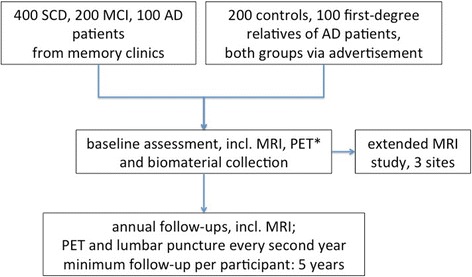
Methods: The German Center for Neurodegenerative Diseases (DZNE) is conducting the multicenter DZNE-Longitudinal Cognitive Impairment and Dementia Study (DELCODE), which focuses on the characterization of SCD in patients recruited from memory clinics. In addition, individuals with amnestic MCI, mild Alzheimer's dementia patients, first-degree relatives of patients with Alzheimer's dementia, and cognitively unimpaired control subjects are studied. The total number of subjects to be enrolled is 1000. Participants receive extensive clinical and neuropsychological assessments, magnetic resonance imaging, positron emission tomography, and biomaterial collection is perfomed. In this publication, we report cognitive and clinical data as well as apolipoprotein E (APOE) genotype and cerebrospinal fluid (CSF) biomarker results of the first 394 baseline data sets.
Results: In comparison with the control group, patients with SCD showed slightly poorer performance on cognitive and functional measures (Alzheimer's Disease Assessment Scale-cognitive part, Clinical Dementia Rating, Functional Activities Questionnaire), with all mean scores in a range which would be considered unimpaired. APOE4 genotype was enriched in the SCD group in comparison to what would be expected in the population and the frequency was significantly higher in comparison to the control group. CSF Aβ42 was lower in the SCD group in comparison to the control group at a statistical trend with age as a covariate. There were no group differences in Tau or pTau concentrations between the SCD and the control groups. The differences in all measures between the MCI group and the AD group were as expected.
Conclusions: The initial baseline data for DELCODE support the approach of using SCD in patients recruited through memory clinics as an enrichment strategy for late-stage preclinical AD. This is indicated by slightly lower performance in a range of measures in SCD in comparison to the control subjects as well as by enriched APOE4 frequency and lower CSF Aβ42 concentration.
Trial registration: German Clinical Trials Register DRKS00007966 . Registered 4 May 2015.
Keywords: Alzheimer’s disease; Apolipoprotein E; Beta-amyloid 42; Cerebrospinal fluid; Longitudinal; Magnetic resonance imaging; Mild cognitive impairment; Positron emission tomography; Subjective cognitive decline; Tau.
Conflict of interest statement
Ethics approval and consent to participate
The study protocol was approved by the ethical committees of the medical faculties of all participating sites: the ethical committees of Berlin (Charité, University Medicine), Bonn, Cologne, Göttingen, Magdeburg, Munich (Ludwig-Maximilians-University), Rostock, and Tübingen. The process was led and coordinated by the ethical committee of the medical faculty of the University of Bonn. The registration number of the trial at the ethical committee in Bonn is 117/13.
Consent for publication
Not applicable.
Competing interests
The authors declare that they have no competing interests with regard to the content of the manuscript.
Publisher’s Note
Springer Nature remains neutral with regard to jurisdictional claims in published maps and institutional affiliations.
Figures
References
-
- Vellas B, Carrillo MC, Sampaio C, Brashear HR, Siemers E, Hampel H, et al. Designing drug trials for Alzheimer’s disease: what we have learned from the release of the phase III antibody trials: a report from the EU/US/CTAD Task Force. Alzheimers Dement. 2013;9:438–44. doi: 10.1016/j.jalz.2013.03.007. - DOI - PubMed
Publication types
MeSH terms
Substances
Grants and funding
LinkOut - more resources
Full Text Sources
Other Literature Sources
Medical
Miscellaneous
