


Sputum bacteriology conversion and treatment outcome of patients with multidrug-resistant tuberculosis
- PMID: 29416359
- PMCID: PMC5790105
- DOI: 10.2147/IDR.S153499
Sputum bacteriology conversion and treatment outcome of patients with multidrug-resistant tuberculosis
Abstract
Purpose: Multidrug-resistant tuberculosis (MDR-TB) requires long-term treatment, has a high fatality rate, and constitutes a global threat. Earlier detection of treatment failure is required to predict therapeutic efficacy.
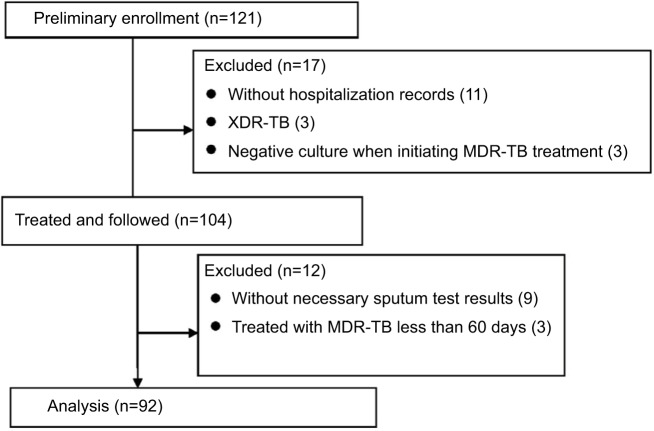
Patients and methods: We enrolled MDR-TB patients consecutively from January 2011 through December 2012 in Lianyungang, China. Sputum smear microscopy tests and sputum cultures were performed once a month for the first 6 months following initiation of antituberculosis treatment and once every 2 months thereafter until the end of therapy. The sensitivity, specificity and area under the receiver operating characteristic curve (AUC) were used with a 95% CI to estimate the role of sputum bacteriology conversion in predicting treatment outcomes.
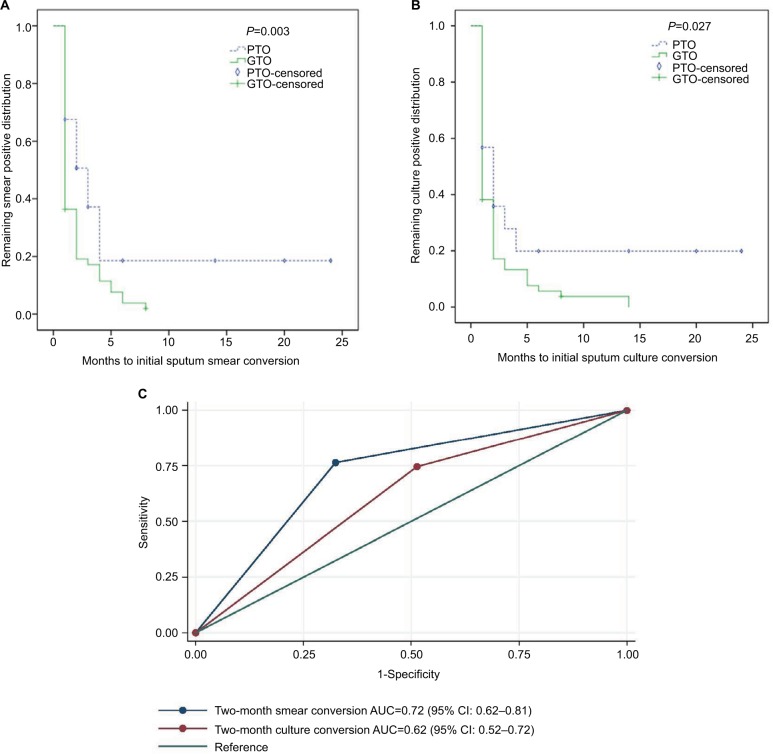
Results: Among the 92 MDR-TB patients enrolled in this study, 40.2% had poor treatment outcomes. The median initial sputum bacteriology conversion time was 1 month. Patients having 2-month sputum smear conversions (adjusted odds ratio [OR]: 7.19, 95% CI: 2.60-19.84) or culture conversions (adjusted OR: 2.88, 95% CI: 1.11-7.45) were more likely to experience good outcomes. The sensitivity and specificity obtained when using two-month sputum smear conversions to predict treatment outcomes were 67.6% (95% CI: 50.2-82.0) and 76.4% (95% CI: 63.0-86.8), respectively. The sensitivity and specificity obtained when using 2-month culture conversions to predict treatment outcomes were 48.6% (95% CI: 32.0-65.6) and 74.5% (95% CI: 61.0-85.3), respectively. The AUC for two-month smear conversions was 0.72 (95% CI: 0.62-0.81), significantly higher than that obtained for 2-month culture conversions (0.62, 95% CI: 0.52-0.72) (χ2 = 4.18, P = 0.041).
Conclusion: The prognoses of MDR-TB patients displaying persistent sputum positivity were inferior to those for whom sputum bacteriology conversion was observed. Thus, sputum smear conversion results obtained 2 months after treatment initiation may provide a potential means for predicting MDR-TB treatment outcomes.
Keywords: multidrug-resistant tuberculosis; prognosis; sputum culture conversion; sputum smear conversion; treatment outcome.
Conflict of interest statement
Disclosure The authors report no conflicts of interest in this work.
Figures
References
-
- Marais BJ. The global tuberculosis situation and the inexorable rise of drug-resistant disease. Adv Drug Deliv Rev. 2016;102:3–9. - PubMed
-
- World Health Organization Global tuberculosis report 2015. 2016. [Accessed Aug 8, 2017]. Available from: http://www.who.int/tb/publications/2016/en/
-
- Zhang J, Gou H, Hu X, et al. Status of drug-resistant tuberculosis in China: a systematic review and meta-analysis. Am J Infect Control. 2016;44(6):671–676. - PubMed
LinkOut - more resources
Full Text Sources
Other Literature Sources
