


Comparison of clinical and survival characteristics between prostate cancer patients of PSA-based screening and clinical diagnosis in China
- PMID: 29416625
- PMCID: PMC5787478
- DOI: 10.18632/oncotarget.20787
Comparison of clinical and survival characteristics between prostate cancer patients of PSA-based screening and clinical diagnosis in China
Abstract
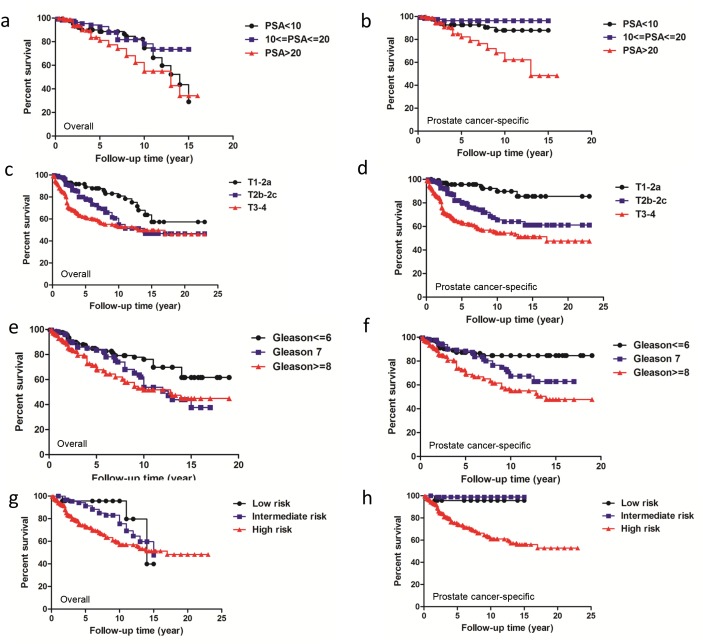
Prostate-specific antigen (PSA)-based mass screening remains the most controversial topic in prostate cancer. PSA-based mass screening has not been widely used in China yet. The aim of our study was to evaluate the effect of the PSA-based screening in China. The cohort consisted of 1,012 prostate cancer patients. Data were retrospectively collected and clinical characteristics of the cohorts were investigated. Survival was analyzed for prostatic carcinoma of both PSA screened and clinically diagnosed patients according to clinical characteristics and the National Comprehensive Cancer Network (NCCN) risk classification. Cox Proportional Hazards Model analysis was done for risk predictor identification. The median age was 71 years old. Five-year overall and prostate-cancer-specific survival in prostatic adenocarcinoma patients were 77.52% and 79.65%; 10-year survivals were 62.57% and 68.60%, respectively. Survival was significantly poorer in patients with metastases and non-curative management. T staging and Gleason score by NCCN classification effectively stratified prostatic adenocarcinoma patients into different risk groups. T staging was a significant predictor of survival by COX Proportional Hazard Model. PSA screened patients had a significantly higher percentage diagnosed in early stage. PSA screened prostatic adenocarcinoma patients had a better prognosis in both overall and prostate cancer-specific survivals. This Chinese cohort had a lower overall and prostate cancer survival rate than it is reported in western countries. The incidence of early-stage prostate cancer found in PSA-based mass screening was high and there were significant differences in both overall and prostate cancer-specific survival between the PSA-screened and clinically diagnosed patients.
Keywords: PSA-based mass screening; metastases; overall survival; prostate cancer; prostate-cancer specific mortality.
Conflict of interest statement
CONFLICTS OF INTEREST The authors have no conflicts of interest to declare regarding the manuscript.
Figures



References
-
- Fitzmaurice C, Dicker D, Pain A, Hamavid H, Moradi-Lakeh M, MacIntyre MF, Allen C, Hansen G, Woodbrook R, Wolfe C, Hamadeh RR, Moore A, Werdecker A, et al. The global burden of cancer 2013. JAMA Oncol. 2015;1:505–27. https://doi.org/10.1001/jamaoncol.2015.0735. - DOI - PMC - PubMed
-
- Hoffman RM, Meisner AL, Arap W, Barry M, Shah SK, Zeliadt SB, Wiggins CL. Trends in United States prostate cancer incidence rates by ge and stage, 1995-2012. Cancer Epidemiol Biomarkers Prev. 2016;25:259–63. https://doi.org/10.1158/1055-9965.EPI-15-0723. - DOI - PubMed
-
- Schröder FH, Hugosson J, Roobol MJ, Tammela TL, Zappa M, Nelen V, Kwiatkowski M, Lujan M, Määttänen L, Lilja H, Denis LJ, Recker F, Paez A, et al. Screening and prostate cancer mortality: results of the European Randomised Study of Screening for Prostate Cancer (ERSPC) at 13 years of follow-up. Lancet. 2014;384:2027–35. https://doi.org/10.1016/s0140-6736(14)60525-0. - DOI - PMC - PubMed
-
- Deng J, Gao JT, Xie T. Clinical epidemiological study on prostate cancer. Tumor. 1995;15:340–3.
LinkOut - more resources
Full Text Sources
Other Literature Sources
Research Materials
Miscellaneous
