Review
. 2018 Jan 24:5:3.
doi: 10.3389/fcvm.2018.00003. eCollection 2018.

Inflammation in Vein Graft Disease

Affiliations
Review

Inflammation in Vein Graft Disease

Margreet R de Vries et al. Front Cardiovasc Med. .

Abstract

Bypass surgery is one of the most frequently used strategies to revascularize tissues downstream occlusive atherosclerotic lesions. For venous bypass surgery the great saphenous vein is the most commonly used vessel. Unfortunately, graft efficacy is low due to the development of vascular inflammation, intimal hyperplasia and accelerated atherosclerosis. Moreover, failure of grafts leads to significant adverse outcomes and even mortality. The last couple of decades not much has changed in the treatment of vein graft disease (VGD). However, insight is the cellular and molecular mechanisms of VGD has increased. In this review, we discuss the latest insights on VGD and the role of inflammation in this. We discuss vein graft pathophysiology including hemodynamic changes, the role of vessel wall constitutions and vascular remodeling. We show that profound systemic and local inflammatory responses, including inflammation of the perivascular fat, involve both the innate and adaptive immune system.

Keywords: atherosclerosis; bypass graft; cardiovascular disease; inflammation; innate immunity; saphenous vein; vein graft disease.


Figures
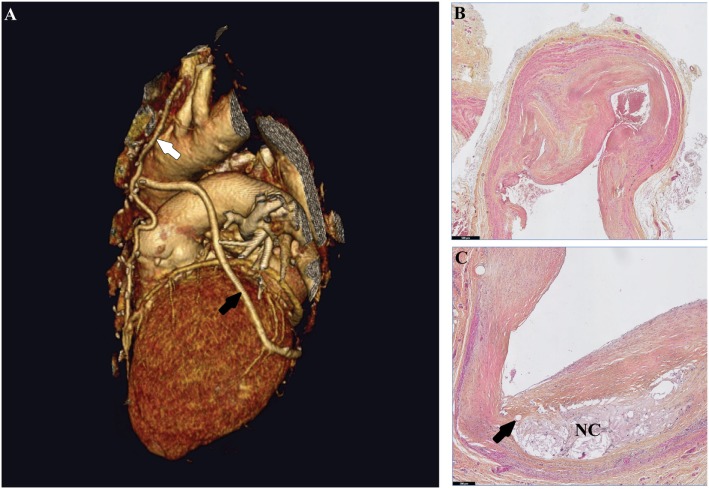
Figure 1
Figure 1
Human vein grafts in macroscopic and microscopic views. (A) 3D reconstruction of a heart. In this CT scan, a saphenous vein segment (black arrow) is grafted from the aorta to the ramus circumflexus. The left internal mammarian artery graft (white arrow) is connected to the left anterior descending coronary artery. (B) A failed human saphenous vein graft displaying in the intimal hyperplasia, extensive smooth muscle cell accumulation, and extracellular matrix deposition. (C) Accelerated atherosclerosis in a human vein graft lesion is characterized by a decellularized necrotic core with cholesterol crystals and calcification (NC) and neovessels (arrow).
Figure 2
Figure 2
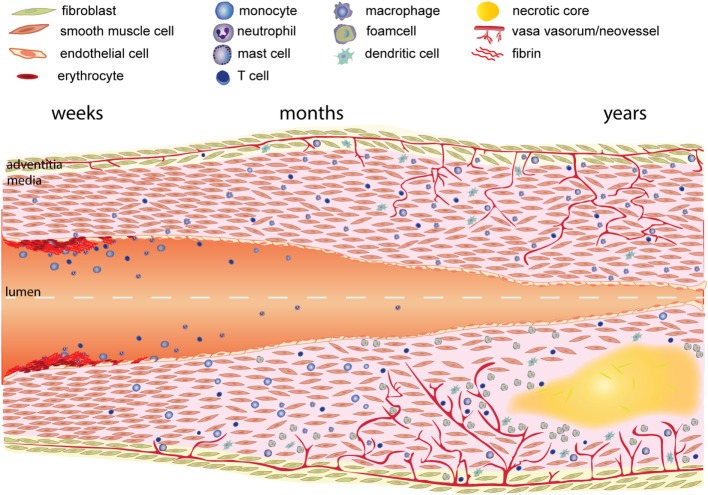
Time course of vein graft development. As a result of the vein graft procedure the endothelial layer is damaged resulting in coverage of the luminal surface by fibrin. White blood cells (neutrophils, monocytes, and lymphocytes) attach and infiltrate the fibrin layer and intima. Next activated smooth muscle cells in the media and fibroblasts in the adventitia are and start migrating toward the intima, forming the intimal hyperplasia. Migration and proliferation of smooth muscle cells is enhanced by growth factors and cytokines released by cells in the vessel wall, and especially inflammatory cells. Growth factors and cytokines also induce extracellular matrix deposition, resulting in further growth of the intimal hyperplasia. The lower part of the figure describes the process of vein graft remodeling as it occurs under atherosclerotic conditions (lower part). Typically macrophages in the vessel wall engulf lipids and become foam cells. Subsequently a necrotic core is formed by dying cells and cholesterol depositions. Hypoxia in the vessel wall induces the growth of plaque neovessels.
Figure 3
Figure 3
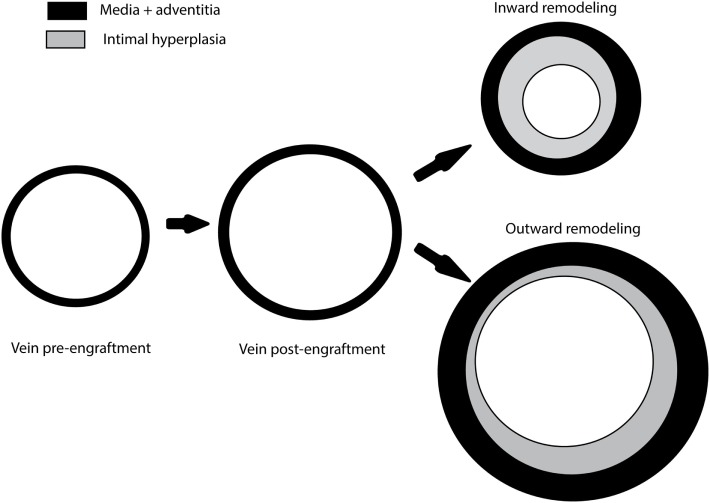
Vein graft remodeling. Damage caused by graft handling and distension during the high-pressure check for leakage as well as implantation in the high blood pressure surrounding of the arterial circulation results in distention of the venous graft. Depending on local and systemic influences like inflammatory factors, this can result in inward remodeling characterized by intimal hyperplasia and a reduced lumen or outward remodeling characterized by moderate intimal hyperplasia and an increased lumen.

References

    1. de Vries MR, Simons KH, Jukema JW, Braun J, Quax PH. Vein graft failure: from pathophysiology to clinical outcomes. Nat Rev Cardiol (2016) 13(8):451–70.10.1038/nrcardio.2016.76 - DOI - PubMed
    1. Weintraub WS, Grau-Sepulveda MV, Weiss JM, O’Brien SM, Peterson ED, Kolm P, et al. Comparative effectiveness of revascularization strategies. N Engl J Med (2012) 366(16):1467–76.10.1056/NEJMoa1110717 - DOI - PMC - PubMed
    1. Deb S, Wijeysundera HC, Ko DT, Tsubota H, Hill S, Fremes SE. Coronary artery bypass graft surgery vs percutaneous interventions in coronary revascularization: a systematic review. JAMA (2013) 310(19):2086–95.10.1001/jama.2013.281718 - DOI - PubMed
    1. Windecker S, Kolh P, Alfonso F, Collet JP, Cremer J, Falk V, et al. 2014 ESC/EACTS Guidelines on myocardial revascularization: the Task Force on Myocardial Revascularization of the European Society of Cardiology (ESC) and the European Association for Cardio-Thoracic Surgery (EACTS) developed with the special contribution of the European Association of Percutaneous Cardiovascular Interventions (EAPCI). Eur Heart J (2014) 35(37):2541–619.10.1093/eurheartj/ehu278 - DOI - PubMed
    1. Goldman S, Zadina K, Moritz T, Ovitt T, Sethi G, Copeland JG, et al. Long-term patency of saphenous vein and left internal mammary artery grafts after coronary artery bypass surgery: results from a Department of Veterans Affairs Cooperative Study. J Am Coll Cardiol (2004) 44(11):2149–56.10.1016/j.jacc.2004.08.064 - DOI - PubMed

LinkOut - more resources