. 2018 Jan 24:4:240.
doi: 10.3389/fvets.2017.00240. eCollection 2017.

Highly Pathogenic Avian Influenza H5N8 Clade 2.3.4.4b in Germany in 2016/2017

Affiliations

Highly Pathogenic Avian Influenza H5N8 Clade 2.3.4.4b in Germany in 2016/2017

Anja Globig et al. Front Vet Sci. .

Abstract

Here, we report on the occurrence of highly pathogenic avian influenza (HPAI) H5Nx clade 2.3.4.4b in Germany. Between November 8, 2016, and September 30, 2017, more than 1,150 cases of HPAI H5Nx clade 2.3.4.4b in wild birds and 107 outbreaks in birds kept in captivity (92 poultry holdings and 15 zoos/animal parks) were reported in Germany. This HPAI epidemic is the most severe recorded in Germany so far. The viruses were apparently introduced by migratory birds, sparking an epidemic among wild birds across Germany with occasional incursions into poultry holdings, zoos and animal parks, which were usually rapidly detected and controlled by stamping out. HPAI viruses (mainly subtype H5N8, in a few cases also H5N5) were found in dead wild birds of at least 53 species. The affected wild birds were water birds (including gulls, storks, herons, and cormorants) and scavenging birds (birds of prey, owls, and crows). In a number of cases, substantial gaps in farm biosecurity may have eased virus entry into the holdings. In a second wave of the epidemic starting from February 2017, there was epidemiological and molecular evidence for virus transmission of the infections between commercial turkey holdings in an area of high poultry density, which caused approximately 25% of the total number of outbreaks in poultry. Biosecurity measures in poultry holdings should be adapted. This includes, inter alia, wearing of stable-specific protective clothing and footwear, cleaning, and disinfection of equipment that has been in contact with birds and prevention of contacts between poultry and wild water birds.

Keywords: Germany; H5N8; clade 2.3.4.4b; farm-to-farm spread; highly pathogenic avian influenza; outbreak investigations; primary incursion; wild water birds.


Figures
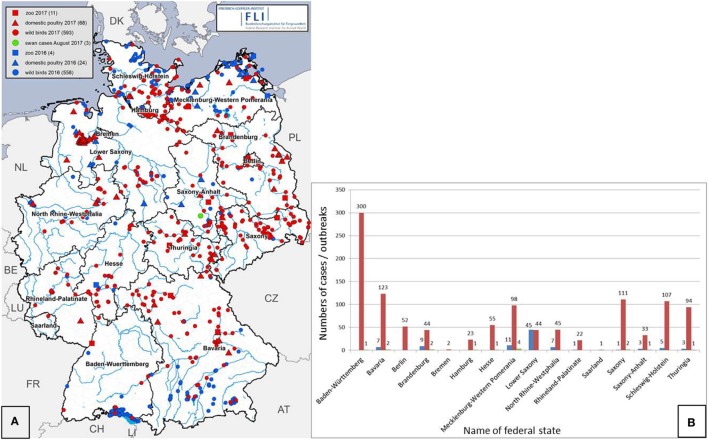
Figure 1
Figure 1
Reported highly pathogenic avian influenza (HPAI) clade 2.3.4.4b H5Nx cases in wild birds (points) and outbreaks in poultry holdings (triangles) and zoos (squares) in the German federal states in 2016 (blue) and 2017 (red). Green points refer to mute swans found HPAIV H5N8 infected in August 2017 (A). Number of cases in wild birds (red) and outbreaks in poultry holdings (blue) and zoos (green) in each German federal state (B).
Figure 2
Figure 2
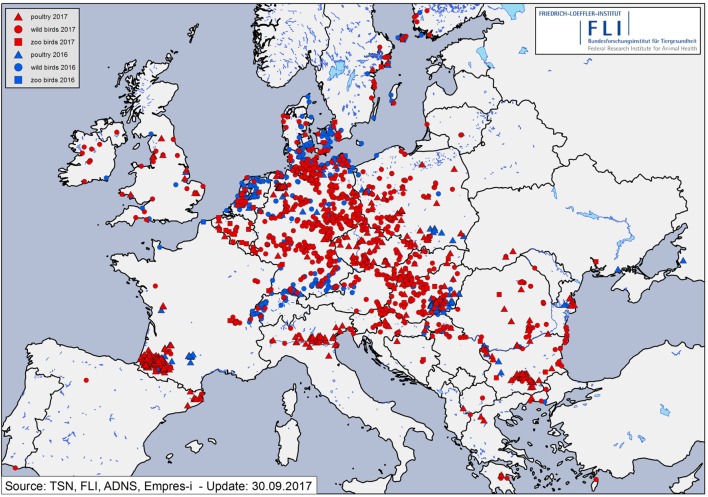
Distribution of reported highly pathogenic avian influenza clade 2.3.4.4b H5Nx cases in wild birds (points) and outbreaks in poultry holdings (triangles) and captive birds in zoos (squares) in 2016 (blue) and 2017 (red) in Europe.
Figure 3
Figure 3
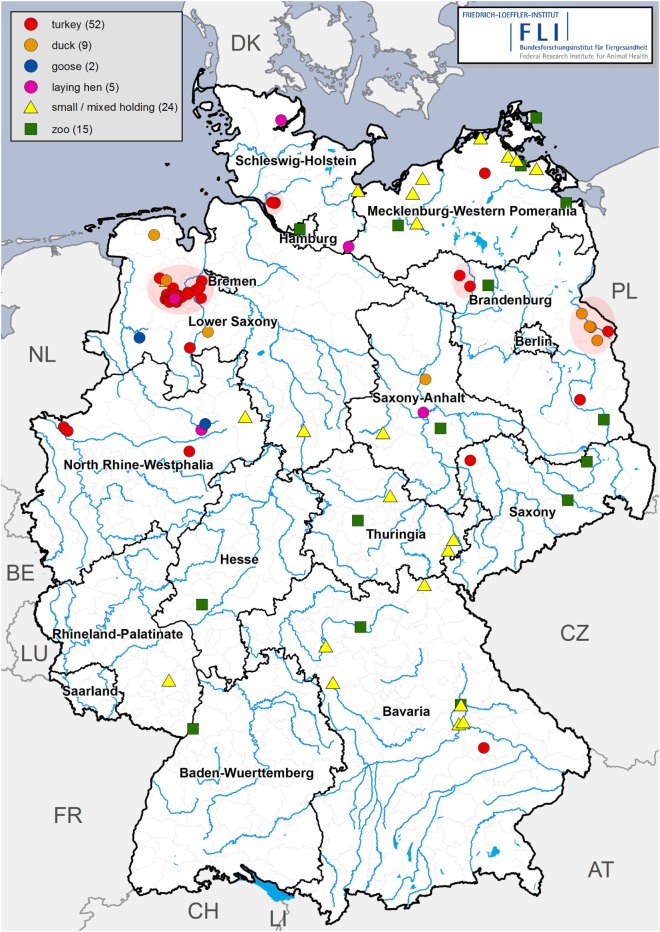
Highly pathogenic avian influenza in holdings of captive birds in Germany since November 2016. Red points: turkeys (52), orange points: ducks (9), blue points: geese (2), pink points: laying hens (5), yellow triangles: small scale, mixed holdings (24), and green squares: zoos (15). Red circles indicate outbreaks where farm-to-farm spread most likely occurred.
Figure 4
Figure 4
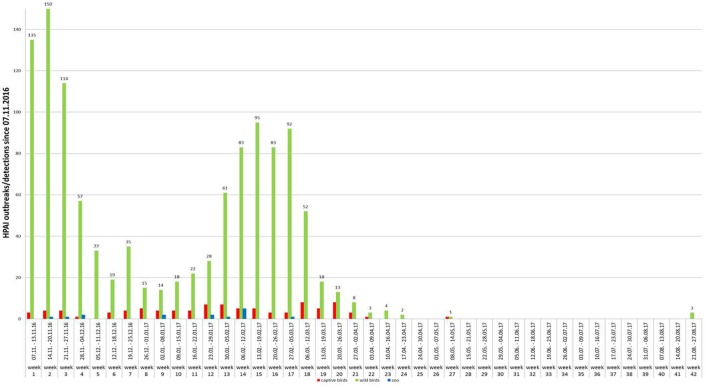
Weekly number of outbreaks of highly pathogenic avian influenza in poultry (red columns), zoos (blue columns) and cases in wild birds (green columns) in Germany (November 2016–August 2017).

References

    1. Jones BA, Grace D, Kock R, Alonso S, Rushton J, Said MY, et al. Zoonosis emergence linked to agricultural intensification and environmental change. Proc Natl Acad Sci U S A (2012) 21:8399–404. 10.1073/pnas.1208059110 - DOI - PMC - PubMed
    1. Swayne DE, Suarez DL. Highly pathogenic avian influenza. Rev Sci Tech (2000) 19:463–8. 10.20506/rst.19.2.1230 - DOI - PubMed
    1. Lam TT, Hon C, Tang JW. Use of phylogenetics in the molecular epidemiology and evolutionary studies of viral infections. Crit Rev Clin Lab Sci (2010) 47:5–49. 10.3109/10408361003633318 - DOI - PubMed
    1. Guan Y, Smith GJD. The emergence and diversification of panzootic H5N1 influenza viruses. Virus Res (2013) 178:35–43. 10.1016/j.virusres.2013.05.012 - DOI - PMC - PubMed
    1. Lee DH, Sharshov K, Swayne DE, Kurskaya O, Sobolev I, Kabilov M, et al. Novel reassortant clade 2.3.4.4 avian influenza A(H5N8) virus in wild aquatic birds, Russia, 2016. Emerg Infect Dis (2017) 23:358–60. 10.3201/eid2302.161616 - DOI - PMC - PubMed

LinkOut - more resources