


Macronutrient Composition and Food Form Affect Glucose and Insulin Responses in Humans
- PMID: 29419785
- PMCID: PMC5852764
- DOI: 10.3390/nu10020188
Macronutrient Composition and Food Form Affect Glucose and Insulin Responses in Humans
Abstract
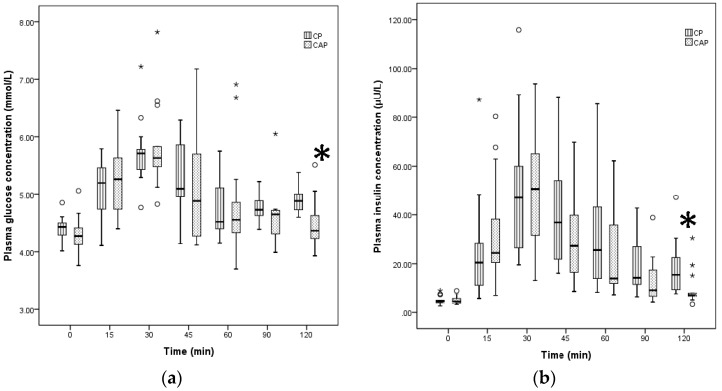
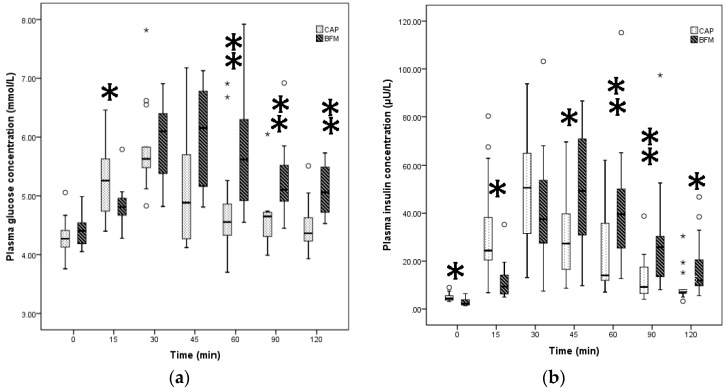
Glycaemic index (GI) is used as an indicator to guide consumers in making healthier food choices. We compared the GI, insulin index (II), and the area under the curve for blood glucose and insulin as glucose (GR) and insulin responses (IR) of a newly developed liquid nutritional formula with one commercially available liquid product with different types of carbohydrates. We then evaluated the glucose and insulin responses of two test foods with comparable energy density and protein percentage but presented in different food forms (liquid vs. solid). Fourteen healthy women participated in the study. GI, II, GR, and IR were assessed after (independent) consumption of two liquid products and a solid breakfast meal. The two liquid foods showed comparable GI, whilst the liquid form appeared to produce lower median GI (25 vs. 54), and II (52 vs. 98) values compared to the solid breakfast (p < 0.02). The median GR and IR for solid breakfast were respectively 44% and 45% higher compared to the liquid product (p < 0.02). Liquid formulas with different carbohydrate qualities produced comparable glucose responses, while foods with comparable energy density and protein percentage but different food form elicited differential effects on GI, II, GR, and IR. Nutrient quality and food form need to be taken into consideration when developing low GI products to manage glycaemic responses.
Keywords: carbohydrate quality; glycaemic and insulin responses; glycaemic index; insulinemic index; nutritional formula; protein quality.
Conflict of interest statement
Shila Shafaeizadeh, Leilani Muhardi, Bert J. M. van de Heijning, and Eline M. van der Beek are full time employees of Nutricia Research, the research and development organization for Danone Nutricia Early Life Nutrition. The concept product (CP) investigated in this study was produced in The Netherlands and shipped to Singapore, and the commercially available product was provided from a Singapore market.
Figures
References
-
- Food and Agriculture Organization (FAO) World Health Organisation (WHO) Carbohydrates in Human Nutrition: Report of a Joint FAO/WHO Expert Consultation. FAO Food Nutr. Pap. 1998;66:1–140. - PubMed
-
- Sentko A. Innovative low-glycaemic carbohydrates: An update. Nutrafoods. 2013;12:127–135. doi: 10.1007/s13749-013-0062-2. - DOI
-
- Howard B.V., Wylie-Rosett J. Sugar and cardiovascular disease: A statement for healthcare professionals from the committee on nutrition of the council on nutrition, physical activity, and metabolism of the American Heart Association. Circulation. 2002;106:523–527. doi: 10.1161/01.CIR.0000019552.77778.04. - DOI - PubMed
-
- Johnson R.K., Appel L.J., Brands M., Howard B.V., Lefevre M., Lustig R.H., Sacks F., Steffen L.M., Wylie-Rosett J. Dietary sugars intake and cardiovascular health: A scientific statement from the American Heart Association. Circulation. 2009;120:1011–1020. doi: 10.1161/CIRCULATIONAHA.109.192627. - DOI - PubMed
Publication types
MeSH terms
Substances
LinkOut - more resources
Full Text Sources
Other Literature Sources
Medical
