


Convergent pathways of the hyperferritinemic syndromes
- PMID: 29420734
- PMCID: PMC7189979
- DOI: 10.1093/intimm/dxy012
Convergent pathways of the hyperferritinemic syndromes
Abstract
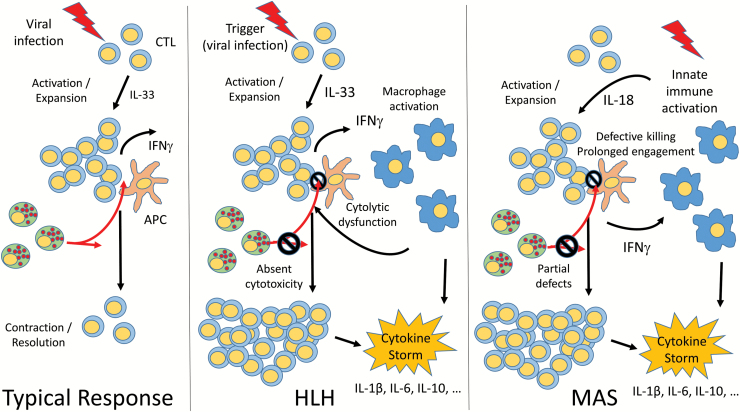
Hyperferritinemia and pronounced hemophagocytosis help distinguish a subset of patients with a particularly inflammatory and deadly systemic inflammatory response syndrome. Two clinically similar disorders typify these hyperferritinemic syndromes: hemophagocytic lymphohistiocytosis (HLH) and macrophage activation syndrome (MAS). HLH is canonically associated with a complete disturbance of perforin/granzyme-mediated cytotoxicity, whereas MAS occurs in the context of the related rheumatic diseases systemic juvenile idiopathic arthritis and adult-onset Still's disease, with associated IL-1 family cytokine activation. In practice, however, there are accumulating lines of evidence for innate immune dysregulation in HLH as well as partial impairments of cytotoxicity in MAS, and these mechanisms likely represent only a fraction of the host and environmental factors driving hyperferritinemic inflammation. Herein, we present new findings that highlight the pathogenic differences between HLH and MAS, two conditions that present with life-threatening hyperinflammation, hyperferritinemia and hemophagocytosis.
Figures
References
-
- Goldstein B., Giroir B., Randolph A., et al. 2005. International pediatric sepsis consensus conference: definitions for sepsis and organ dysfunction in pediatrics. Pediatr Crit Care Med. 6(1):2 http://www.ncbi.nlm.nih.gov/pubmed/15636651 - PubMed
-
- Ravelli A., Minoia F., Davì S. et al. ; Paediatric Rheumatology International Trials Organisation; Childhood Arthritis and Rheumatology Research Alliance; Pediatric Rheumatology Collaborative Study Group; Histiocyte Society. 2016. 2016 classification criteria for macrophage activation syndrome complicating systemic juvenile idiopathic arthritis: a European League against Rheumatism/American College of Rheumatology/Paediatric Rheumatology International Trials Organisation Collaborative Initiative. Arthritis Rheumatol. 68:566. - PubMed
-
- Broz P. and Dixit V. M. 2016. Inflammasomes: mechanism of assembly, regulation and signalling. Nat. Rev. Immunol. 16:407. - PubMed
Publication types
MeSH terms
Substances
Grants and funding
LinkOut - more resources
Full Text Sources
Other Literature Sources
Molecular Biology Databases
