


Review
doi: 10.1016/j.neuron.2018.01.015.
SPARK: A US Cohort of 50,000 Families to Accelerate Autism Research
Collaborators
- PMID: 29420931
- PMCID: PMC7444276
- DOI: 10.1016/j.neuron.2018.01.015
Item in Clipboard
Review
SPARK: A US Cohort of 50,000 Families to Accelerate Autism Research
Neuron.
.
Abstract
The Simons Foundation Autism Research Initiative (SFARI) has launched SPARKForAutism.org, a dynamic platform that is engaging thousands of individuals with autism spectrum disorder (ASD) and connecting them to researchers. By making all data accessible, SPARK seeks to increase our understanding of ASD and accelerate new supports and treatments for ASD.
Copyright © 2018 Elsevier Inc. All rights reserved.
Figures
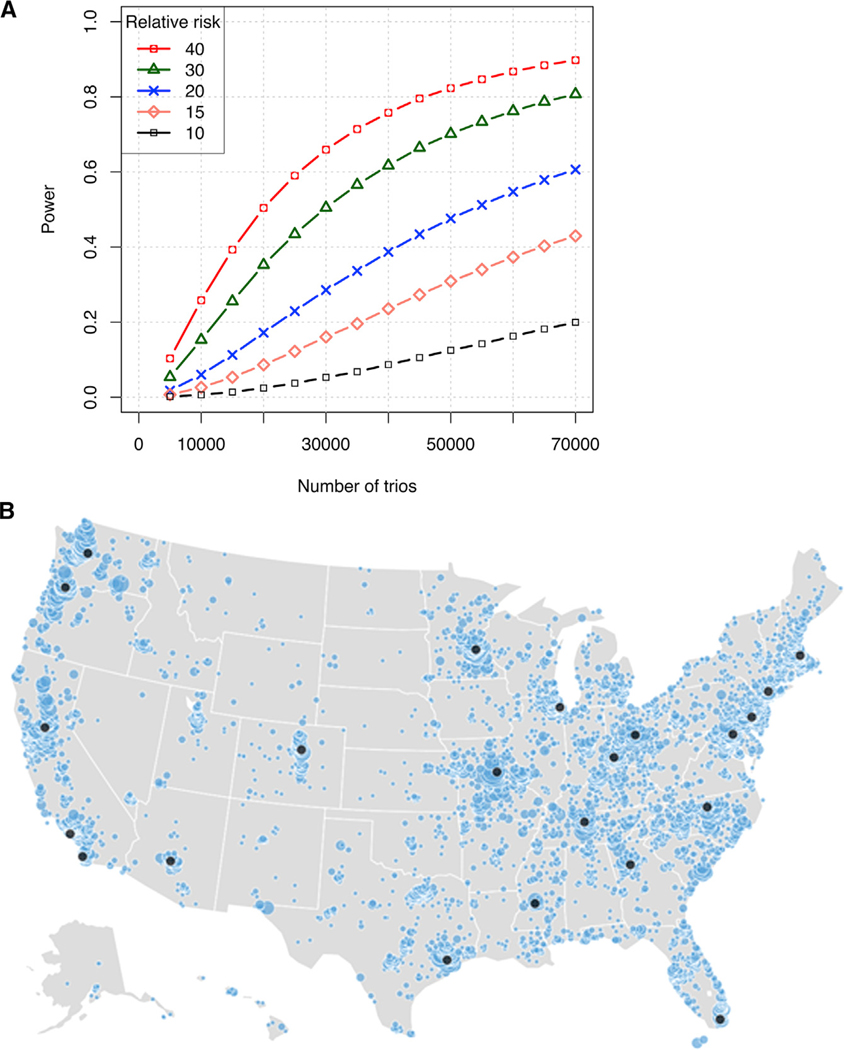
(A) Statistical power to detect individual ASD risk genes based on excess of de novo variants. For a given sample size (number of trios), we calculate the expected number of de novo likely gene disrupting (LGD) (M1) or D-mis (damaging missense defined by meta-SVM) (Dong et al., 2015) (M2) for each gene by gene-specific background mutation rate calibrated in previous publications (Ware et al., 2015; Homsy et al., 2015). We assume that the observed number of such variants in a risk gene follows a Poisson distribution with mean of M1*R + M2*R/2, in which R is the relative risk of a de novo LGD variant in a risk gene. We then calculate the power of detecting the excess of de novo LGD and D-mis variants at a significance threshold of 2.6 × 3 10−6 to account for ~19,000 protein-coding genes captured by WES and with the available background mutation rate data. The figure shows the average power of all genes given the sample size and R. With WES of 50,000 trios, we achieve greater than 70% power to detect an association based on de novo LGD and D-mis variants if R (relative risk) is 30 or above. (B) In the first year of recruitment, 18,809 individuals with ASD (higher density indicated by larger circles) and 27,794 of their first-degree relatives consented to participate in SPARK, 81% of whom were recruited through the clinical sites (indicated by black dots). 15,302 of the individuals with ASD are children (<18 years) and 2,787 are adults. 7,610 unaffected full biological siblings were enrolled. The cohort includes 6,309 trios (proband, biological mother, and biological father), 682 sets of multi-gestational pregnancies with individuals with ASD (664 twin, 15 triplet, and three quadruplet sets that included 1,371 individuals with ASD), and 1,944 multiplex families in which at least one first-degree relative of the ASD proband also has ASD.
References
Publication types
MeSH terms
Grants and funding
LinkOut - more resources
Full Text Sources
Other Literature Sources
Medical
