Review
. 2018 Apr:49:106-113.
doi: 10.1016/j.yfrne.2018.02.002. Epub 2018 Feb 5.

Behavioral and structural adaptations to stress

Affiliations
Review

Behavioral and structural adaptations to stress

Heather A Cameron et al. Front Neuroendocrinol. 2018 Apr.

Abstract

Unpredictable aversive experiences, or stressors, lead to changes in depression- and anxiety-related behavior and to changes in hippocampal structure including decreases in adult neurogenesis, granule cell and pyramidal cell dendritic morphology, and volume. Here we review the relationship between these behavioral and structural changes and discuss the possibility that these changes may be largely adaptive. Specifically, we suggest that new neurons in the dentate gyrus enhance behavioral adaptability to changes in the environment, biasing behavior in novel situations based on previous experience with stress. Conversely, atrophy-like changes in the hippocampus and decreased adult neurogenesis following chronic stress may serve to limit stress responses and stabilize behavior during chronic stress.

Keywords: Adult neurogenesis; Behavioral adaptation; Dendrites; Dentate gyrus; Hippocampus; Morphology; Stress; Volume.


Figures

Figure 1
Figure 1
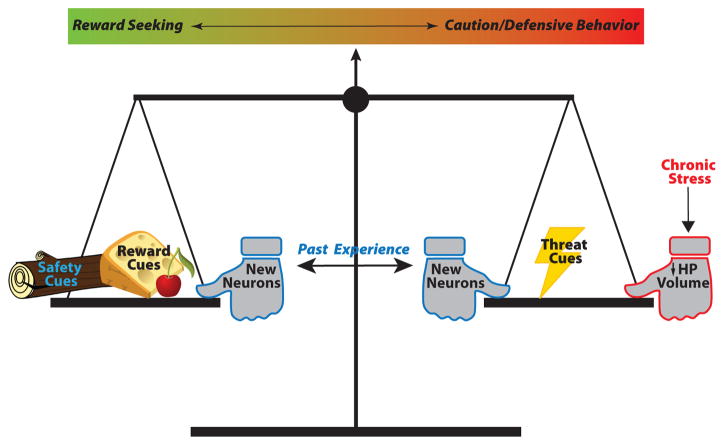
Reward seeking and cautious or anxiety-like behavior must be balanced to appropriately respond in new or unpredictable situations. Safety and reward cues drive behavior toward reward seeking, while cues signaling actual or potential threats tip the balance toward defensive or cautious behaviors such as freezing or approach-avoidance investigation. New neurons generated in the adult dentate gyrus can bias this balance in either direction based on the predictability of prior threats. Stress and the resulting structural changes in the hippocampus bias the system toward caution.
Figure 2
Figure 2
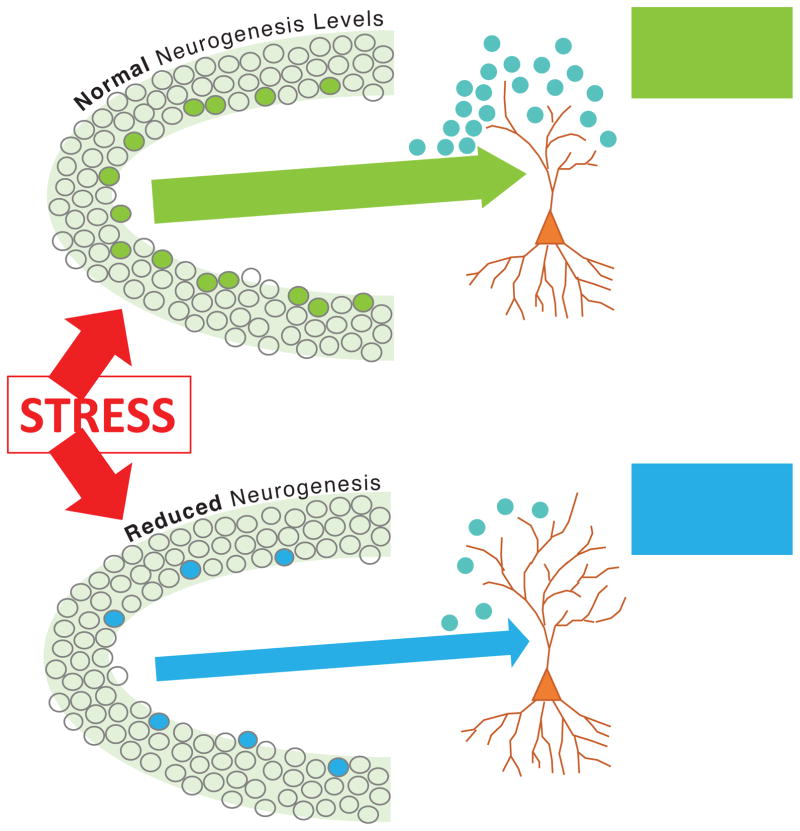
With adult neurogenesis intact, stress increases activation of the dentate gyrus, leading to increased excitation and glutamate release onto downstream CA3 pyramidal cells, causing excitotoxic dendritic atrophy. When neurogenesis is reduced, due to ongoing stress or other factors, the dentate gyrus may be less activated by stress, causing mossy fiber input to the CA3 pyramidal cells to be buffered, limiting dendritic atrophy.

References

    1. Abbott CC, Jones T, Lemke NT, Gallegos P, McClintock SM, Mayer AR, Bustillo J, Calhoun VD. Hippocampal structural and functional changes associated with electroconvulsive therapy response. Transl Psychiatry. 2014;4:e483. doi: 10.1038/tp.2014.124. - DOI - PMC - PubMed
    1. Airan RD, Meltzer LA, Roy M, Gong Y, Chen H, Deisseroth K. High-speed imaging reveals neurophysiological links to behavior in an animal model of depression. Science. 2007;317:819–823. doi: 10.1126/science.1144400. - DOI - PubMed
    1. Alves ND, Correia JS, Patrício P, Mateus-Pinheiro A, Machado-Santos AR, Loureiro-Campos E, Morais M, Bessa JM, Sousa N, Pinto L. Adult hippocampal neuroplasticity triggers susceptibility to recurrent depression. Transl Psychiatry. 2017;7:e1058. doi: 10.1038/tp.2017.29. - DOI - PMC - PubMed
    1. Antoniadis EA, McDonald RJ. Discriminative fear conditioning to context expressed by multiple measures of fear in the rat. Behav Brain Res. 1999;101:1–13. - PubMed
    1. Bannerman DM, Sprengel R, Sanderson DJ, Mchugh SB, Rawlins JNP, Monyer H, Seeburg PH. Hippocampal synaptic plasticity, spatial memory and anxiety. Nat Rev Neurosci. 2014;15:181–192. doi: 10.1038/nrn3677. - DOI - PubMed

Publication types

MeSH terms