


Porphyromonas gingivalis, a periodontitis causing bacterium, induces memory impairment and age-dependent neuroinflammation in mice
- PMID: 29422938
- PMCID: PMC5791180
- DOI: 10.1186/s12979-017-0110-7
Porphyromonas gingivalis, a periodontitis causing bacterium, induces memory impairment and age-dependent neuroinflammation in mice
Abstract
Background: A possible relationship between periodontitis and Alzheimer's disease (AD) has been reported. However, there is limited information on the association between the Porphyromonas gingivalis (P. gingivalis) periodontal infection and the pathological features of AD. The hypothesis that P. gingivalis periodontal infection may cause cognitive impairment via age-dependent neuroinflammation was tested.
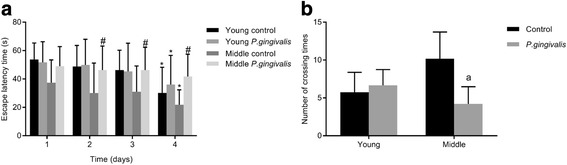
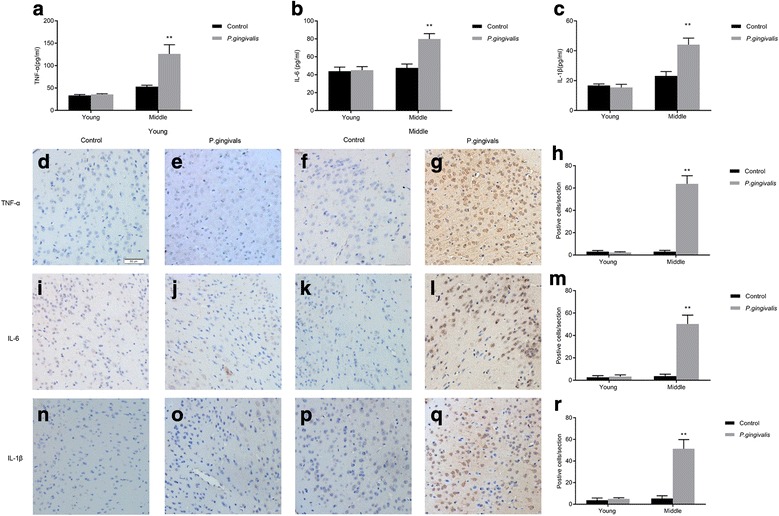
Results: Thirty 4-week-old (young) female C57BL/6 J mice were randomly divided into two groups, the control group and the experimental group. Thirty 12-month-old (middle-aged) were grouped as above. The mouth of the mice in the experimental group was infected with P. gingivalis. Morris water maze(MWM) was performed to assess the learning and memory ability of mice after 6 weeks. Moreover, the expression levels of the pro-inflammatory cytokines TNF-α, IL-6, and IL-1β in the mice brain tissues were determined by Quantitative real-time polymerase chain reaction (qRT-PCR), Enzyme Linked Immunosorbent Assay(ELISA) and immunohistochemistry. Our results showed that the learning and memory abilities of the middle-aged P. gingivalis infected mice were impaired. Moreover, the expression levels of the pro-inflammatory cytokines TNF-α, IL-6, and IL-1β in the brain tissues of the middle-aged P. gingivalis infected mice were increased.
Conclusions: These results suggest that P. gingivalis periodontal infection may cause cognitive impairment via the release of the pro-inflammatory cytokines TNF-α, IL-6, and IL-1β in the brain tissues of middle-aged mice.
Keywords: Alzheimer’s disease(AD); Cognition; Neuroinflammation; Periodontitis; Porphyromonas gingivalis (P. gingivalis).
Conflict of interest statement
The present study was performed in accordance with the guidelines of the National Institutes of Health Guide for the Care and Use of Laboratory Animals (NIH Pub. No. 85–23, revised 1996) and was approved by Animal Care and Use Committee of the Jilin University Medical Centre (Jilin, China).Not applicable.The authors declare that they have no competing interests.Springer Nature remains neutral with regard to jurisdictional claims in published maps and institutional affiliations.
Figures

References
-
- Kamer AR, Morse DE, Holm-Pedersen P, Mortensen EL, Avlund K. Periodontal inflammation in relation to cognitive function in an older adult Danish population. J Alzheimers Dis. 2012;28:613–624. - PubMed
LinkOut - more resources
Full Text Sources
Other Literature Sources
