Decrease in PSCA expression caused by Helicobacter pylori infection may promote progression to severe gastritis
- PMID: 29423095
- PMCID: PMC5790512
- DOI: 10.18632/oncotarget.23278
Decrease in PSCA expression caused by Helicobacter pylori infection may promote progression to severe gastritis
Abstract
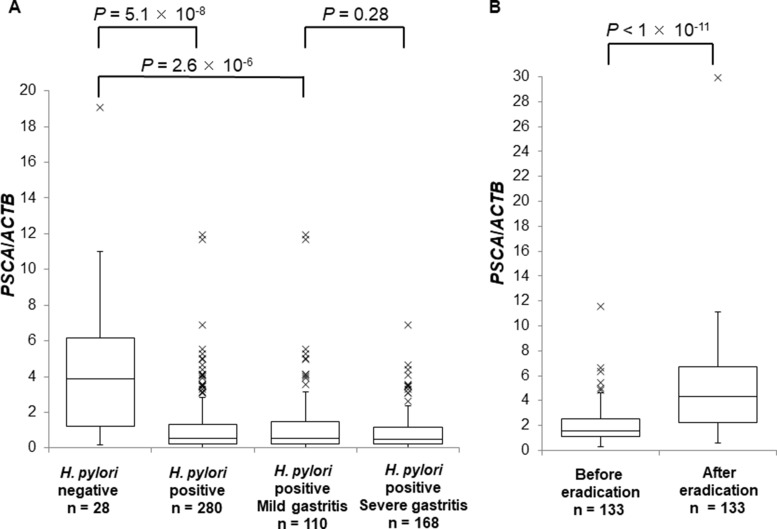
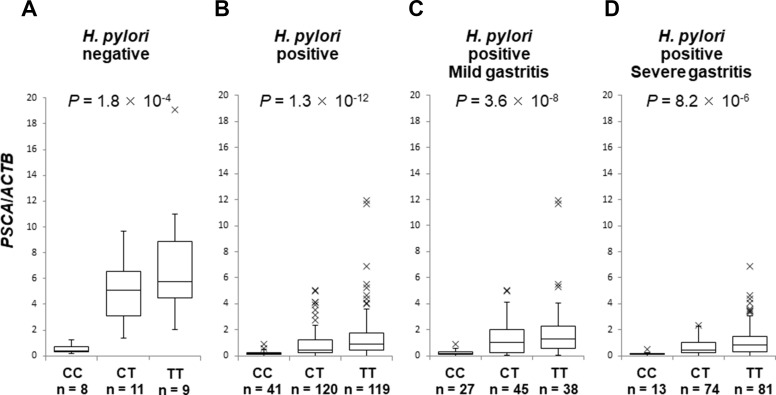
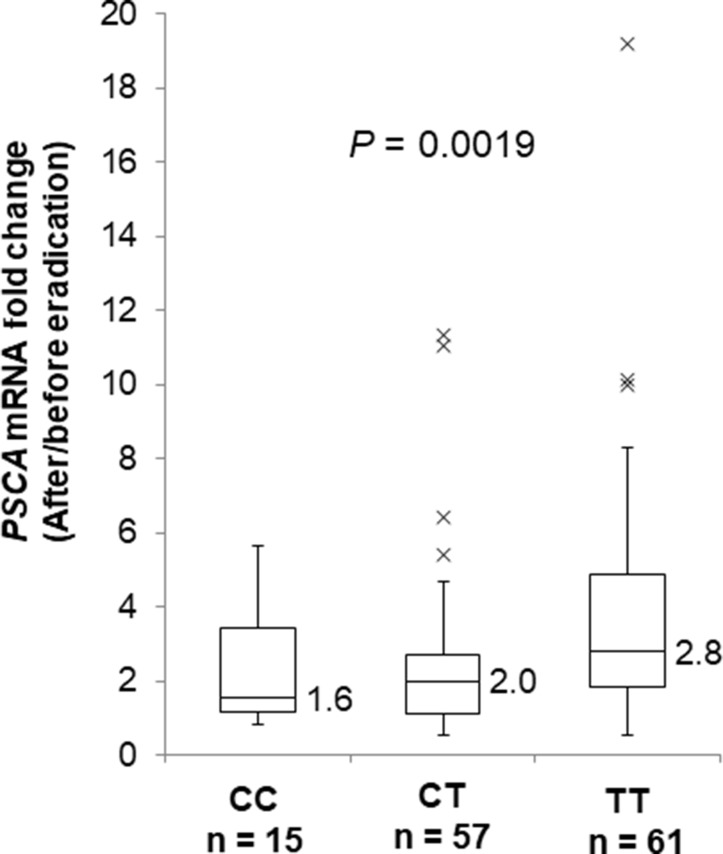
SNP rs2294008 in Prostate Stem Cell Antigen (PSCA) and decreased PSCA expression are associated with gastric cancer. The objective of this study is to investigate the role of rs2294008 and PSCA expression in the gastritis-gastric cancer carcinogenic pathway. We conducted a case-control association study of H. pylori-infected gastritis and gastric cancer. rs2294008 was associated with the progression to chronic active gastritis (P = 9.4 × 10⁻⁵; odds ratio = 3.88, TT + TC vs CC genotype), but not with H. pylori infection per se nor with the progression from active gastritis to gastric cancer. We also assessed the association of rs2294008 with PSCA mRNA expression in the gastric mucosa at various disease stages and found that rs2294008 was associated with PSCA expression (P = 1.3 × 10⁻¹²). H. pylori infection (P = 5.1 × 10⁻⁸) and eradication therapy (P < 1 × 10-11) resulted in the reduced and increased PSCA expression, respectively, indicating negative regulation of PSCA expression by H. pylori infection. PSCA expression was decreased in severe gastritis compared with mild gastritis only among T allele carriers. Our findings revealed the regulation of PSCA expression by host genetic variation and bacterial infection might contribute to gastritis progression after H. pylori infection.
Keywords: Gastritis; H. pylori infection; gastric cancer; gene regulation; genetic polymorphism.
Conflict of interest statement
CONFLICTS OF INTEREST The authors declare no conflicts of interest.
Figures

References
-
- Yamaoka Y. Mechanisms of disease: Helicobacter pylori virulence factors. Nat Rev Gastroenterol Hepatol. 2010;7:629–41. https://doi.org/10.1038/nrgastro.2010.154. - DOI - PMC - PubMed
-
- Plummer M, Franceschi S, Vignat J, Forman D, de Martel C. Global burden of gastric cancer attributable to Helicobacter pylori. Int J Cancer. 2015;136:487–90. https://doi.org/10.1002/ijc.28999. - DOI - PubMed
-
- Correa P. Human gastric carcinogenesis: a multistep and multifactorial process--First American Cancer Society Award Lecture on Cancer Epidemiology and Prevention. Cancer Res. 1992;52:6735–40. - PubMed
-
- Lichtenstein P, Holm NV, Verkasalo PK, Iliadou A, Kaprio J, Koskenvuo M, Pukkala E, Skytthe A, Hemminki K. Environmental and heritable factors in the causation of cancer--analyses of cohorts of twins from Sweden, Denmark, and Finland. N Engl J Med. 2000;343:78–85. https://doi.org/10.1056/nejm200007133430201. - DOI - PubMed
-
- Uemura N, Okamoto S, Yamamoto S, Matsumura N, Yamaguchi S, Yamakido M, Taniyama K, Sasaki N, Schlemper RJ. Helicobacter pylori infection and the development of gastric cancer. N Engl J Med. 2001;345:784–9. https://doi.org/10.1056/NEJMoa001999. - DOI - PubMed
LinkOut - more resources
Full Text Sources
Other Literature Sources