Review
. 2018 Feb 1:3:6.
doi: 10.1038/s41541-017-0042-4. eCollection 2018.

Pregnancy and infection: using disease pathogenesis to inform vaccine strategy

Affiliations
Review

Pregnancy and infection: using disease pathogenesis to inform vaccine strategy

Meghan S Vermillion et al. NPJ Vaccines. .

Abstract

Vaccination is the mainstay of preventative medicine for many infectious diseases. Pregnant women, unborn fetuses, and neonates represent three at-risk populations that can be simultaneously protected by strategic vaccination protocols. Because the pathogenesis of different infectious microbes varies based on tissue tropism, timing of infection, and host susceptibility, the goals of immunization are not uniform across all vaccines. Mechanistic understanding of infectious disease pathogenesis and immune responses is therefore essential to inform vaccine design and the implementation of appropriate immunization protocols that optimize protection of pregnant women, fetuses, and neonates.


Conflict of interest statement

The authors declare no competing financial interests.

Figures
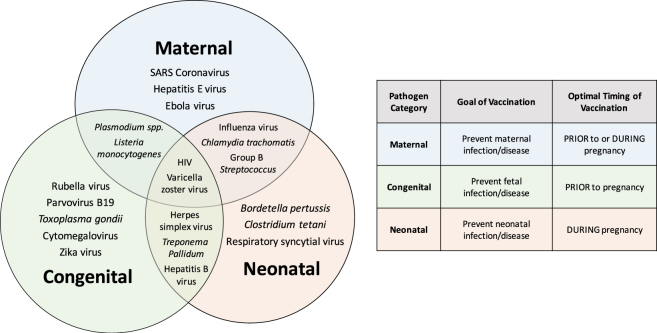
Fig. 1
Fig. 1
Infectious microbes that cause maternal, congenital, or postnatal complications. The infectious microbes are categorized according to the mechanism of transmission and disease, and the population at greatest risk for severe outcome during or after pregnancy. Infection with some pathogens (e.g., SARS coronavirus, hepatitis E virus, and Ebola virus) during pregnancy cause severe disease in pregnant women, but are not transmitted to offspring. Other infectious microbes (e.g., Toxoplasma gondii, rubella virus, parvovirus B19, cytomegalovirus, and Zika viruses) infect and cause mild or asymptomatic disease in pregnant females, but can be vertically transmitted to the fetus and congenital complications. Another category of microbes (e.g., Bordetella pertussis, Clostridium tetani, and respiratory syncytial virus) pose the largest risk to neonates after birth. Many infectious microbes (e.g., Listeria monocytogenes, Plasmodium spp., HIV, VZV, influenza viruses, Chlamydia trachomatis, GBS, Treponema pallidum, and herpes viruses) may cause overlapping syndromes depending on the timing of infection during pregnancy. Understanding the pathogenesis of infectious diseases during pregnancy should inform vaccine design and the implementation of appropriate immunization protocols that optimize protection of pregnant women, fetuses and neonates

References

    1. Robinson DP, Klein SL. Pregnancy and pregnancy-associated hormones alter immune responses and disease pathogenesis. Horm. Behav. 2012;62:263–271. doi: 10.1016/j.yhbeh.2012.02.023. - DOI - PMC - PubMed
    1. Khuroo MS, Teli MR, Skidmore S, Sofi MA, Khuroo MI. Incidence and severity of viral hepatitis in pregnancy. Am. J. Med. 1981;70:252–255. doi: 10.1016/0002-9343(81)90758-0. - DOI - PubMed
    1. Khuroo MS, Kamili S. Aetiology, clinical course and outcome of sporadic acute viral hepatitis in pregnancy. J. Viral Hepat. 2003;10:61–69. doi: 10.1046/j.1365-2893.2003.00398.x. - DOI - PubMed
    1. Emerson SU, Purcell RH. Hepatitis E virus. Rev. Med. Virol. 2003;13:145–154. doi: 10.1002/rmv.384. - DOI - PubMed
    1. Esmonde TF, Herdman G, Anderson G. Chickenpox pneumonia: an association with pregnancy. Thorax. 1989;44:812–815. doi: 10.1136/thx.44.10.812. - DOI - PMC - PubMed

LinkOut - more resources
