


Editorial
doi: 10.1053/j.gastro.2018.02.001.
Epub 2018 Feb 6.
Cellular Plasticity in the Stomach: Insights Into the Cellular Origin of Gastric Metaplasia
Affiliations
- PMID: 29425924
- PMCID: PMC6754248
- DOI: 10.1053/j.gastro.2018.02.001
Item in Clipboard
Editorial
Cellular Plasticity in the Stomach: Insights Into the Cellular Origin of Gastric Metaplasia
Gastroenterology.
2018 Mar.
No abstract available
Conflict of interest statement
The authors declare no conflicts of interest.
Figures
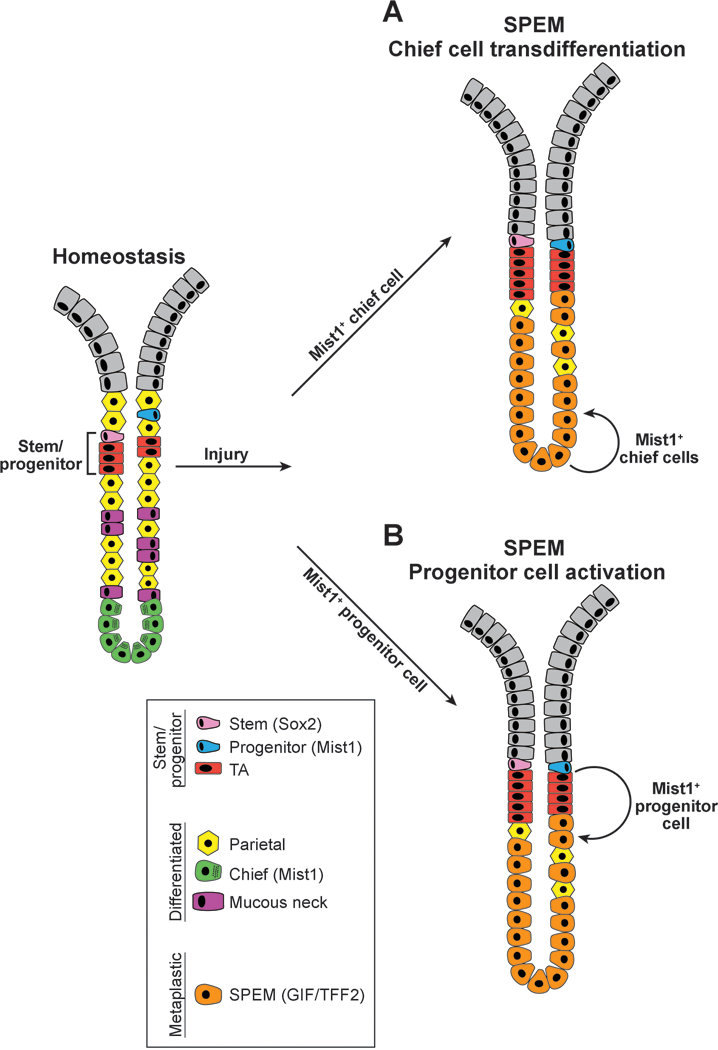
Competing theories for the cellular origin of Spasmolytic Polypeptide-Expressing Metaplasia (SPEM) in the stomach. Schematic representation of gastric chief cell-derived (A) vs. progenitor cell-derived (B) SPEM. Under homeostatic conditions (left), the gastric corpus is maintained by actively cycling stem and progenitor cells that proliferate and differentiate into mature epithelial cell types. After injury that results in parietal cell loss and gastric atrophy, such as observed with Helicobacter pylori infection or tamoxifen treatment, corpus glands undergo cellular remodeling with loss of chief cells and rapid development of the metaplastic cell lineage termed SPEM. The cellular source of SPEM has been controversial due to differing interpretations of genetic lineage tracing data from analysis of Mist1-CreERT2 mice. In model A, SPEM is derived from transdifferentiation of mature MIST1+ chief cells. In model B, SPEM is derived from a slowly cycling MIST1+ progenitor cell that expands in response to injury. The Mills laboratory used a non-lineage tracing method to support Model A that SPEM arises from differentiated chief cells rather than a progenitor cell.
Comment on
-
Metaplastic Cells in the Stomach Arise, Independently of Stem Cells, via Dedifferentiation or Transdifferentiation of Chief Cells.Gastroenterology. 2018 Mar;154(4):839-843.e2. doi: 10.1053/j.gastro.2017.11.278. Epub 2017 Dec 14. Gastroenterology. 2018. PMID: 29248442 Free PMC article.
References
-
- Leushacke M, Tan SH, Wong A, et al. Lgr5-expressing chief cells drive epithelial regeneration and cancer in the oxyntic stomach. Nat Cell Biol 2017;19:774–786. - PubMed
Publication types
MeSH terms
Grants and funding
LinkOut - more resources
Full Text Sources
Other Literature Sources
