


A cross sectional study of urinary phthalates, phenols and perchlorate on thyroid hormones in US adults using structural equation models (NHANES 2007-2008)
- PMID: 29426025
- PMCID: PMC6451439
- DOI: 10.1016/j.envres.2018.01.039
A cross sectional study of urinary phthalates, phenols and perchlorate on thyroid hormones in US adults using structural equation models (NHANES 2007-2008)
Abstract
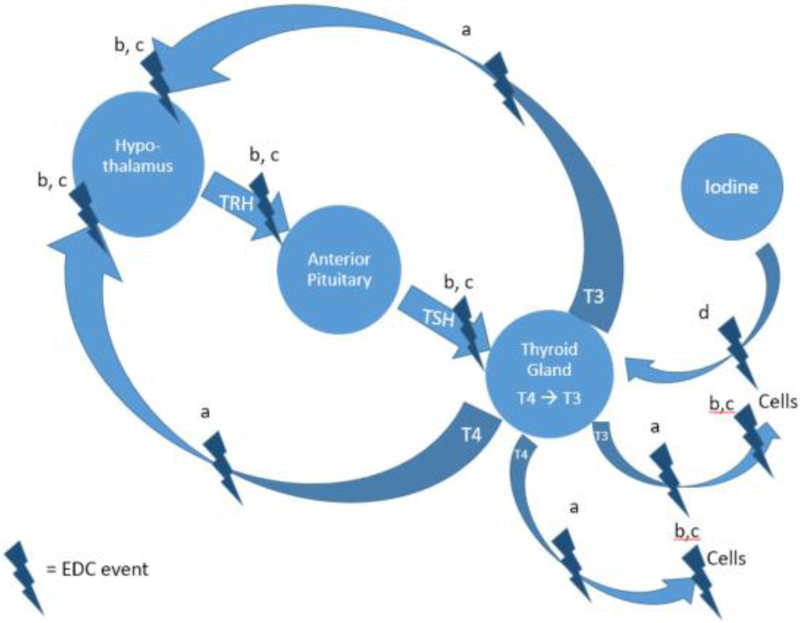
Background: Biomonitoring data shows that people are exposed to phthalates, phenols and perchlorates. Many of these compounds are endocrine disrupting compounds that affect thyroid hormone levels. Yet the effect of these compounds on thyroid hormone levels are often evaluated individually rather than as a mixture. Our objective was to examine the association between 11 urinary endocrine disrupting compounds and thyroid hormones using structural equation models.
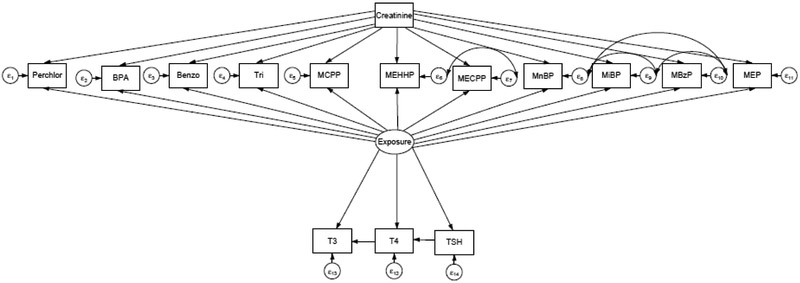
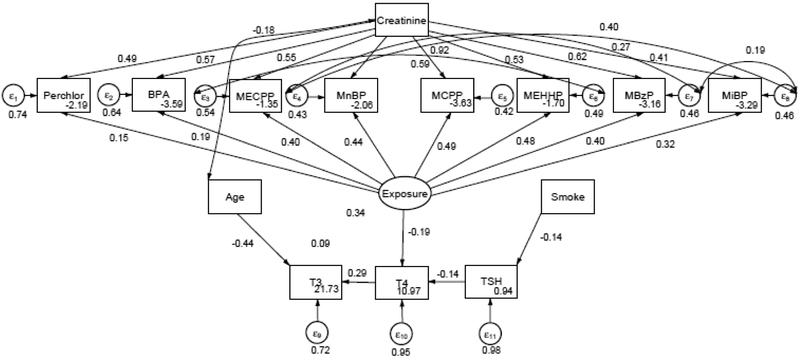
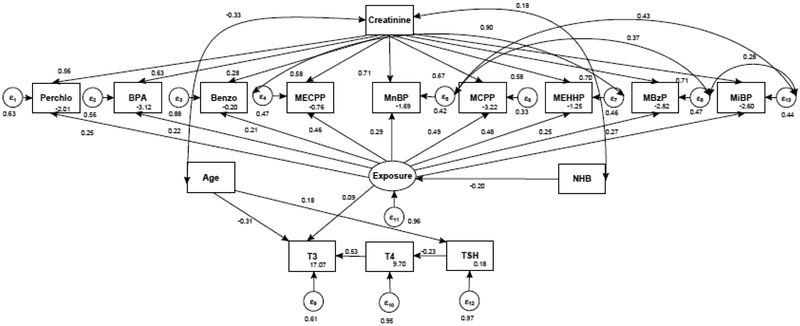
Methods: Using data from the National Health and Nutrition and Examination Survey 2007-2008, we fit a latent variable utilizing urinary measurements of 9 compounds in females (perchlorate, bisphenol A, benzophenone-3, mono-2ethyl5carboxypentyl phthalate, mono-n-butyl phthalate, mono-(3-carboxypropyl) phthalate, mono(2ethyl5hydroxyhexyl) phthalate, mono-benzyl phthalate, and mono-isobutyl phthalate) and 8 compounds in males (without benzophenone-3). The association of the latent variable with serum thyroid hormones (Total T3, Total T4, and Thyroid Stimulating Hormones) was assessed in females (N = 710) and males (N = 850) over the age of 12 controlling for age, race, and urinary creatinine.
Results: In males, urinary endocrine disrupting compound levels were negatively associated with thyroxine (β: -0.19, 95% Confidence Interval (95% CI): -0.31, -0.05). In females, urinary endocrine disrupting compound levels were positively associated with triiodothyronine serum concentrations (β: 0.09, 95% CI: -0.03, 0.21) however this association was not statistically significant.
Conclusions: This cross-sectional analysis provides additional evidence that environmental exposure to phthalates and phenols is associated with endocrine-related processes. Furthermore, these results suggested sex-specific differences in exposure to endocrine disrupting mixtures, and the exposure-response between endocrine disrupting mixtures and thyroid hormone levels. Specifically, higher exposure to a mixture of endocrine disrupting compounds was associated with lower levels of total T4 in males but not in females. While a structural methodological framework was used to assess these complex relationships, the cross sectional nature of this analysis limits causal inference and further research is needed to determine the clinical significance of these findings.
Keywords: EDCs; Endocrine disrupting compounds; Structural equation modeling; Thyroid hormones.
Copyright © 2018 Elsevier Inc. All rights reserved.
Figures
References
-
- Zoeller TR: Environmental chemicals targeting thyroid. Hormones (Athens). 2010, 9:28–40. - PubMed
-
- Koniecki D, Wang R, Moody RP, Zhu J: Phthalates in cosmetic and personal care products: concentrations and possible dermal exposure. Environmental research. 2011, 111:329–336. - PubMed
-
- Sandborgh-Englund G, Adolfsson-Erici M, Odham G, Ekstrand J: Pharmacokinetics of triclosan following oral ingestion in humans. Journal of Toxicology and Environmental Health, Part A. 2006, 69:1861–1873. - PubMed
Publication types
MeSH terms
Substances
Grants and funding
LinkOut - more resources
Full Text Sources
Other Literature Sources
