


Implementation strategies to improve cervical cancer prevention in sub-Saharan Africa: a systematic review
- PMID: 29426344
- PMCID: PMC5807829
- DOI: 10.1186/s13012-018-0718-9
Implementation strategies to improve cervical cancer prevention in sub-Saharan Africa: a systematic review
Abstract
Background: Developed countries, such as the USA, have achieved significant decreases in cervical cancer burden since the introduction of Pap smear-based programs in the 1960s. Due to implementation barriers and limited resources, many countries in sub-Saharan Africa (SSA) have been unable to attain such reductions. The purpose of this review is to evaluate implementation strategies used to improve the uptake and sustainability of cervical cancer prevention programs in SSA.
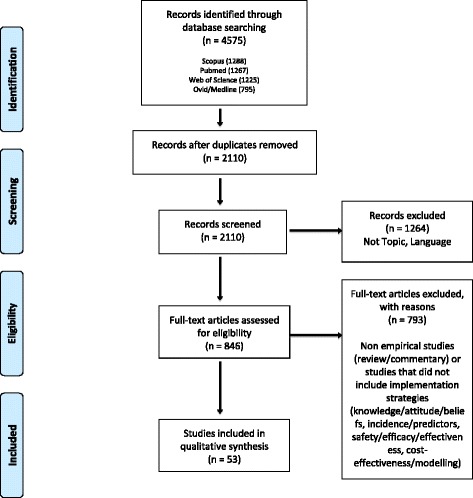
Methods: A reviewer (LJ) independently searched PubMed, Ovid/MEDLINE, Scopus, and Web of Science databases for relevant articles with the following search limits: English language, peer reviewed, and published between 1996 and 2017. The 4575 search results were screened for eligibility (CJ, LJ) to identify original research that empirically evaluated or tested implementation strategies to improve cervical cancer prevention in SSA. Fifty-three articles met criteria for inclusion in the final review. AA, CJ, and LJ abstracted the included articles for implementation-related content and evaluated them for risk of bias according to study design with the National Heart, Lung, and Blood Institute's (NHLBI) Quality Assessment Tools. Results were reported according to PRISMA guidelines.
Results: The 53 included studies are well represented among all sub-Saharan regions: South (n = 16, 30.2%), West (n = 16, 30.2%), East (n = 14, 26.4%), and Middle (n = 7, 13.2%). There are 34 cross-sectional studies (64.2%), 10 pre-posttests (18.9%), 8 randomized control trials (15.1%), and one nonrandomized control trial (1.9%). Most studies are "fair" quality (n = 22, 41.5%). Visual inspection with acetic acid (VIA) (n = 19, 35.8%) was used as the main prevention method more frequently than HPV DNA/mRNA testing (n = 15, 28.3%), Pap smear (n = 13, 24.5%), and HPV vaccine (n = 9, 17.0%). Effectiveness of strategies to improve program implementation was measured using implementation outcomes of penetration (n = 33, 62.3%), acceptability (n = 15, 28.3%), fidelity (n = 14, 26.4%), feasibility (n = 8, 15.1%), adoption (n = 6, 11.3%), sustainability (n = 2, 3.8%), and cost (n = 1, 1.9%). Education strategies (n = 38, 71.7%) were used most often but have shown limited effectiveness.
Conclusion: This systematic review highlights the need to diversify strategies that are used to improve implementation for cervical cancer prevention programs. While education is important, implementation science literature reveals that education is not as effective in generating change. There is a need for additional organizational support to further incentivize and sustain improvements in implementation.
Keywords: Cervical cancer; Implementation strategies; Prevention; Program implementation; Sub-Saharan Africa.
Conflict of interest statement
Ethics approval and consent to participate
Not applicable
Consent for publication
Not applicable
Competing interests
The authors declare that they have no competing interests.
Publisher’s Note
Springer Nature remains neutral with regard to jurisdictional claims in published maps and institutional affiliations.
Figures
References
-
- GLOBOCAN 2012: Estimated cancer incidence, mortality, and prevalence worldwide in 2012. http://globocan.iarc.fr/Default.aspx (2017). Accessed 27 Apr 2017.
-
- Lim JN, Ojo AA. Barriers to utilisation of cervical cancer screening in sub Sahara Africa: a systematic review. Eur J Cancer Care (Engl). 2017;26(1) 10.1111/ecc.12444. Epub 2016 Feb 7 - PubMed
Publication types
MeSH terms
Grants and funding
LinkOut - more resources
Full Text Sources
Other Literature Sources
Medical
Research Materials
Miscellaneous
