


Association of muscle mass and fat mass with insulin resistance and the prevalence of metabolic syndrome in Korean adults: a cross-sectional study
- PMID: 29426839
- PMCID: PMC5807388
- DOI: 10.1038/s41598-018-21168-5
Association of muscle mass and fat mass with insulin resistance and the prevalence of metabolic syndrome in Korean adults: a cross-sectional study
Abstract
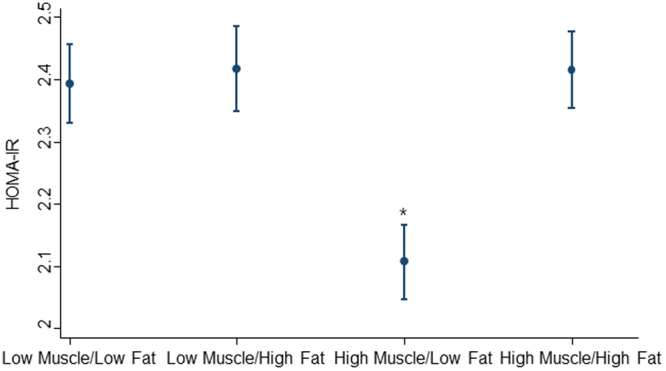
Relationship of muscle mass and fat mass with insulin resistance and metabolic syndrome remains uncertain, especially among Asian population. We performed a cross-sectional study with 14,807 adult participants aged between 18 and 65 in the fourth and fifth Korea National Health and Nutrition Examination Survey with Dual Energy X-ray Absorptiometry (DEXA) data to investigate whether muscle mass and fat mass are associated with insulin resistance and metabolic syndrome. DEXA records were used to categorize the participants into four categories (low muscle/low fat, low muscle/high fat, high muscle/ low fat, and high muscle/high fat). Least square means and incidence rate ratios (IRR) were used to assess the associations of muscle mass and fat mass with insulin resistance and metabolic syndrome. After adjustment for potential confounders, high muscle/low fat was associated with significantly lower insulin resistance (P < 0.001) compared to low muscle/low fat. Low muscle/high fat (IRR: 1.90; 95% confidence interval [CI]:1.44-2.50, P < 0.001) and high muscle/high fat (IRR: 2.30; 95% CI:1.76-3.00, P < 0.001) were significantly associated with the prevalence of metabolic syndrome. Our study suggests that protective association of muscle mass with metabolic syndrome is attenuated by high fat mass in Korean adults.
Conflict of interest statement
The authors declare no competing interests.
Figures
References
-
- Ervin RB. Prevalence of metabolic syndrome among adults 20 years of age and over, by sex, age, race and ethnicity, and body mass index: United States. National health statistics reports. 2009;13:1–8. - PubMed
Publication types
MeSH terms
LinkOut - more resources
Full Text Sources
Other Literature Sources
Medical
