. 2018 Apr 19;25(4):447-459.e4.
doi: 10.1016/j.chembiol.2018.01.011. Epub 2018 Feb 8.

N-Acetyl Cysteine Functions as a Fast-Acting Antioxidant by Triggering Intracellular H2S and Sulfane Sulfur Production

Affiliations

N-Acetyl Cysteine Functions as a Fast-Acting Antioxidant by Triggering Intracellular H2S and Sulfane Sulfur Production

Daria Ezeriņa et al. Cell Chem Biol. .

Abstract

The cysteine prodrug N-acetyl cysteine (NAC) is widely used as a pharmacological antioxidant and cytoprotectant. It has been reported to lower endogenous oxidant levels and to protect cells against a wide range of pro-oxidative insults. As NAC itself is a poor scavenger of oxidants, the molecular mechanisms behind the antioxidative effects of NAC have remained uncertain. Here we show that NAC-derived cysteine is desulfurated to generate hydrogen sulfide, which in turn is oxidized to sulfane sulfur species, predominantly within mitochondria. We provide evidence suggesting the possibility that sulfane sulfur species produced by 3-mercaptopyruvate sulfurtransferase and sulfide:quinone oxidoreductase are the actual mediators of the immediate antioxidative and cytoprotective effects provided by NAC.

Keywords: N-acetyl cysteine; antioxidant; cysteine; cytoprotection; hydrogen sulfide; hydropersulfides; roGFP2; stress resistance; sulfane sulfur; sulfide:quinone oxidoreductase.


Conflict of interest statement

Declaration of Interests

The authors declare no competing interests.

Figures
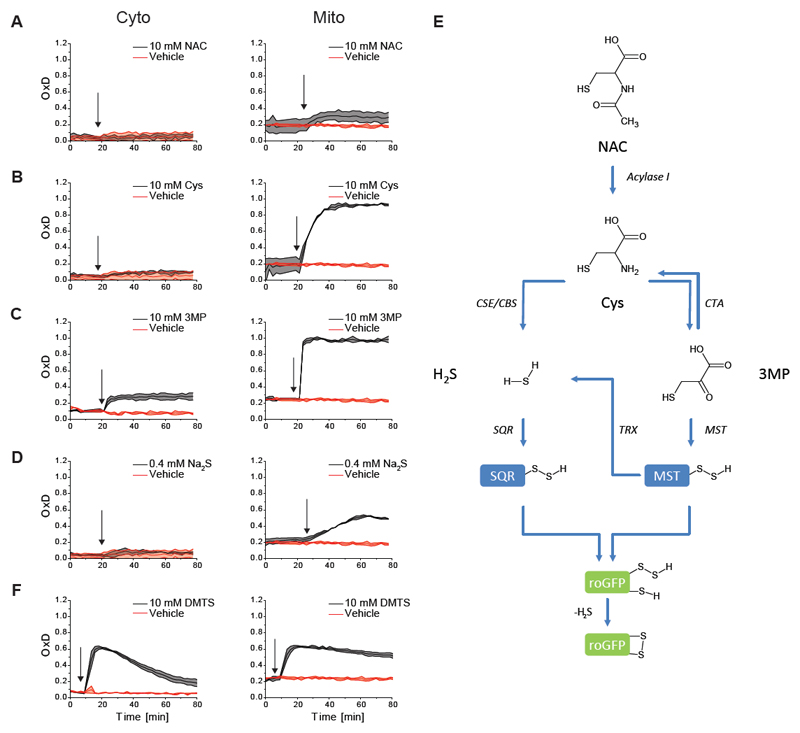
Figure 1
Figure 1. NAC catabolism induces rapid oxidation of mitochondrial, but not cytosolic, roGFP2
(A) Treatment of cells with NAC triggers partial oxidation of mitochondrially localized roGFP2, but not of cytosolic roGFP2. (B-D) The same phenomenon can be provoked more strongly by treating with Cys (B), 3MP (C) and the H2S donor Na2S (D). (E) These findings led to the working hypothesis that NAC, Cys, 3MP and H2S trigger roGFP2 oxidation through production of mitochondrial hydropersulfides. (F) Exogenous application of the sulfane sulfur compound DMTS, which leads to the intracellular formation of persulfides, triggers roGFP2 oxidation in both compartments. All curves represent the mean of three biological repeats, each carried out in technical quadruplicates, the error bars denoting the standard deviation (SD). OxD: degree of probe oxidation. The arrow indicates the time point of addition of the compound.
Figure 2
Figure 2. NAC, Cys and 3MP trigger the generation of H2S and persulfides
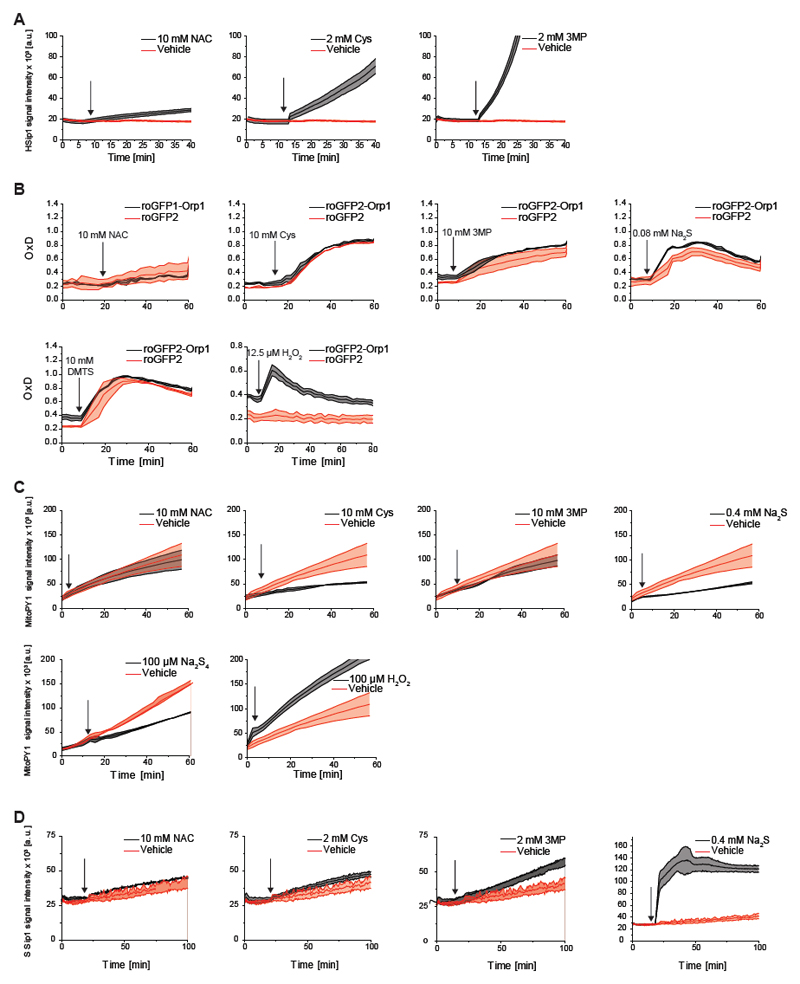
(A) NAC, Cys and 3MP trigger endogenous H2S generation, as detected by the probe HSip-1 DA. (B) The mt-roGFP2 response is not significantly influenced by the translational fusion to Orp1, confirming that the observed response is H2O2-independent. (C) The boronate based mitochondrially targeted chemical H2O2 probe mitoPY1 does not detect increased H2O2 generation in response to NAC, Cys, 3MP, Na2S or Na2S4, but rather a decrease. The last panel shows the response to H2O2 (positive control). The penultimate panel is also part of Fig. 5E. (D) NAC, Cys, 3MP and H2S trigger endogenous sulfane sulfur generation, as detected by the sulfane sulfur probe SSip-1 DA. All curves represent the mean of three biological repeats, each carried out in technical quadruplicates, the error bars denoting the standard deviation (SD). OxD: degree of probe oxidation. The arrow indicates the time point of addition of the compound.
Figure 3
Figure 3. NAC-induced H2S production involves CSE and MST
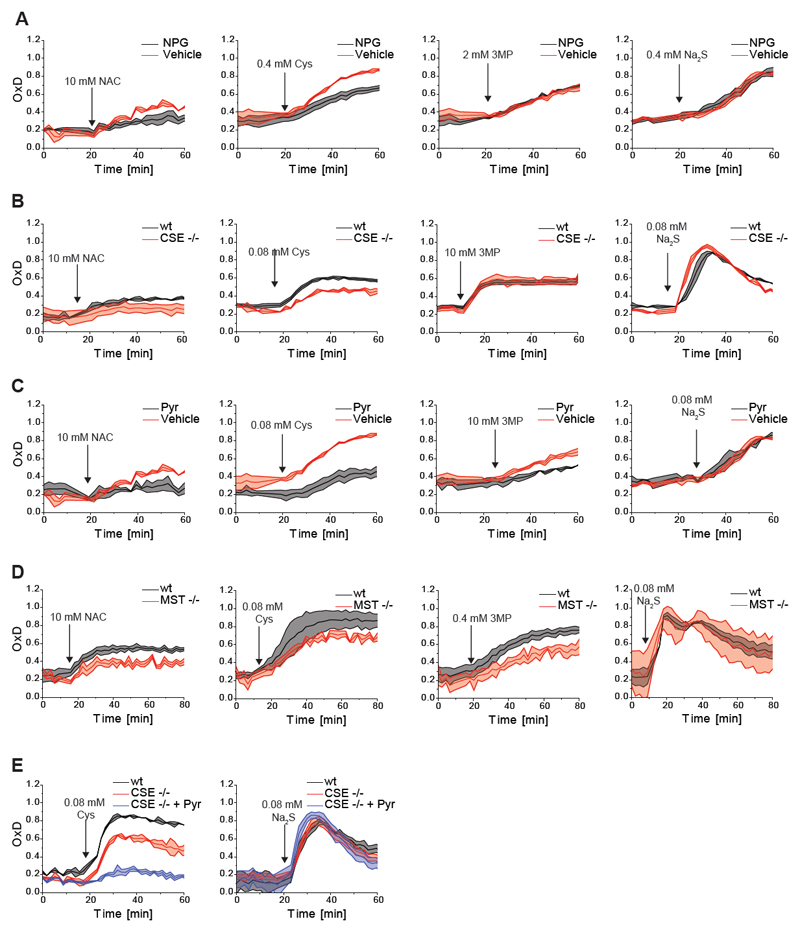
(A) N-propargyl glycine (NPG) partially inhibits NAC- and Cys-induced mt-roGFP2 oxidation, but not 3MP- or Na2S-induced mt-roGFP2 oxidation. (B) Genetic disruption of CSE expression partially inhibits NAC- and Cys-induced mt-roGFP2 oxidation, but not 3MP- or Na2S-induced mt-roGFP2 oxidation. (C) Pyruvate partially inhibits NAC-, Cys- and 3MP-induced mt-roGFP2 oxidation, but not Na2S-induced mt-roGFP2 oxidation. (D) Genetic disruption of MST expression partially inhibits NAC-, Cys- and 3MP-induced mt-roGFP2 oxidation, but not Na2S-induced mt-roGFP2 oxidation. (E) Pyruvate treatment of CSE KO cells leads to a near-complete suppression of Cys-induced mt-roGFP2 oxidation, while Na2S-induced mt-roGFP2 oxidation is not significantly affected. All curves represent the mean of three biological repeats, each carried out in technical quadruplicates, the error bars denoting the standard deviation (SD). OxD: degree of probe oxidation. The arrow indicates the time point of addition of the compound.
Figure 4
Figure 4. NAC-induced persulfide generation involves SQR and MST
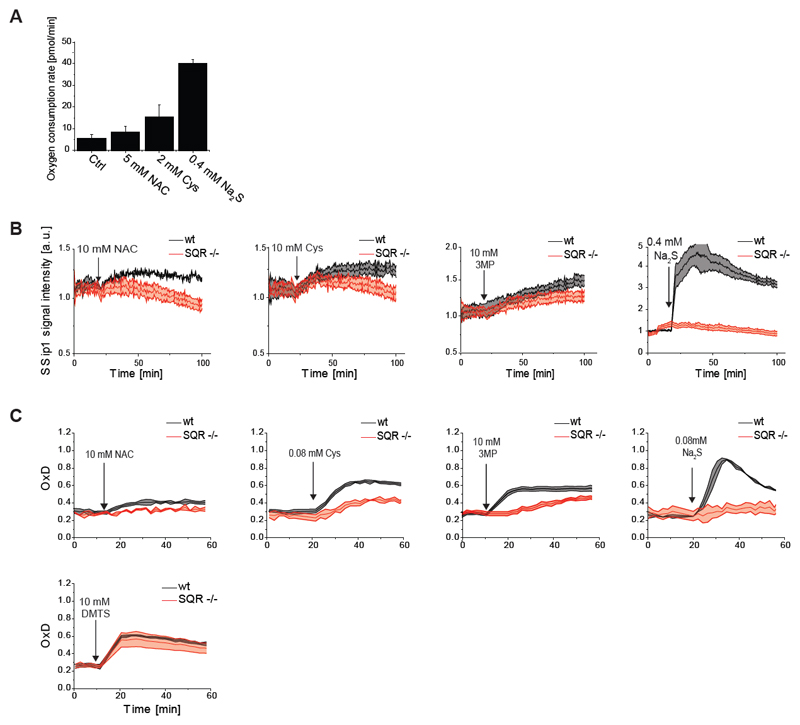
(A) NAC, Cys and Na2S treatment leads to increased cellular oxygen consumption. (B) Disruption of SQR expression suppresses NAC-, Cys- and 3MP-induced sulfane sulfur generation, and completely abolishes H2S-induced sulfane sulfur generation, as detected by SSip-1 DA. (C) Disruption of SQR expression suppresses NAC-, Cys- and 3MP-induced mt-roGFP2 oxidation, and completely abolishes H2S-induced mt-roGFP2 oxidation, but does not influence DMTS induced mt-roGFP2 oxidation. All curves represent the mean of three biological repeats, each carried out in technical quadruplicates, the error bars denoting the standard deviation (SD). OxD: degree of probe oxidation. The arrow indicates the time point of addition of the compound.
Figure 5
Figure 5. NAC induced generation of persulfides determines protection against oxidative stress
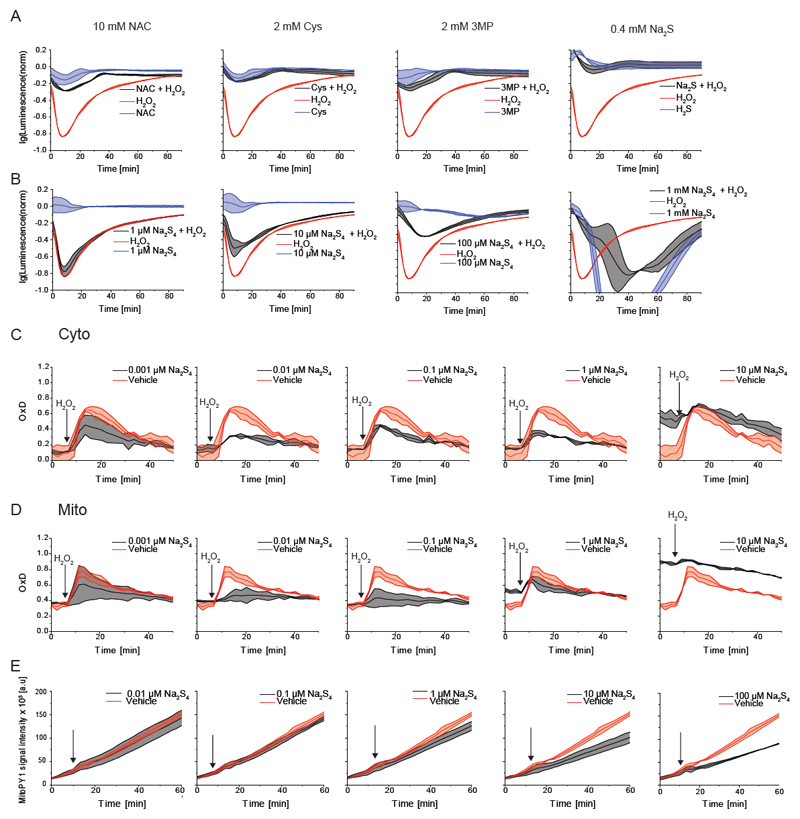
(A) The cytoprotective effect of NAC against acute peroxide stress is mimicked by Cys, 3MP and Na2S. (B) Exogenous provisioning of Na2S4 provides protection against acute peroxide stress within a certain concentration range (around 100 μM), but not at higher concentrations (1 mM). (C-D) The oxidation of the H2O2 probe roGFP2-Orp1 is suppressed by of exogenously applied Na2S4, when applied at low concentrations (C). A very similar effect is observed with mitochondrial roGFP2-Orp1 (D). (E) The response of the chemical H2O2 probe MitoPY1 is suppressed by exogenously applied Na2S4 in a concentration dependent manner. All curves represent the mean of three biological repeats, each carried out in technical quadruplicates, the error bars denoting the standard deviation (SD). OxD: degree of probe oxidation. The arrow indicates the time point of addition of the compound.

Comment in

References

    1. Ahmad A, Olah G, Szczesny B, Wood ME, Whiteman M, Szabo C. AP39, A Mitochondrially Targeted Hydrogen Sulfide Donor, Exerts Protective Effects in Renal Epithelial Cells Subjected to Oxidative Stress in Vitro and in Acute Renal Injury in Vivo. Shock (Augusta, Ga) 2016;45:88–97. - PMC - PubMed
    1. Akaike T, Ida T, Wei FY, Nishida M, Kumagai Y, Alam MM, Ihara H, Sawa T, Matsunaga T, Kasamatsu S, et al. Cysteinyl-tRNA synthetase governs cysteine polysulfidation and mitochondrial bioenergetics. Nat Commun. 2017;8:1177. - PMC - PubMed
    1. Albrecht SC, Barata AG, Grosshans J, Teleman AA, Dick TP. In vivo mapping of hydrogen peroxide and oxidized glutathione reveals chemical and regional specificity of redox homeostasis. Cell Metab. 2011;14:819–829. - PubMed
    1. Asimakopoulou A, Panopoulos P, Chasapis CT, Coletta C, Zhou Z, Cirino G, Giannis A, Szabo C, Spyroulias GA, Papapetropoulos A. Selectivity of commonly used pharmacological inhibitors for cystathionine beta synthase (CBS) and cystathionine gamma lyase (CSE) British journal of pharmacology. 2013;169:922–932. - PMC - PubMed
    1. Benrahmoune M, Therond P, Abedinzadeh Z. The reaction of superoxide radical with N-acetylcysteine. Free Radic Biol Med. 2000;29:775–782. - PubMed

Publication types