. 2018 Feb 20;115(8):1819-1824.
doi: 10.1073/pnas.1716512115. Epub 2018 Feb 5.

Double abdomen in a short-germ insect: Zygotic control of axis formation revealed in the beetle Tribolium castaneum

Affiliations

Double abdomen in a short-germ insect: Zygotic control of axis formation revealed in the beetle Tribolium castaneum

Salim Ansari et al. Proc Natl Acad Sci U S A. .

Abstract

The distinction of anterior versus posterior is a crucial first step in animal embryogenesis. In the fly Drosophila, this axis is established by morphogenetic gradients contributed by the mother that regulate zygotic target genes. This principle has been considered to hold true for insects in general but is fundamentally different from vertebrates, where zygotic genes and Wnt signaling are required. We investigated symmetry breaking in the beetle Tribolium castaneum, which among insects represents the more ancestral short-germ embryogenesis. We found that maternal Tc-germ cell-less is required for anterior localization of maternal Tc-axin, which represses Wnt signaling and promotes expression of anterior zygotic genes. Both RNAi targeting Tc-germ cell-less or double RNAi knocking down the zygotic genes Tc-homeobrain and Tc-zen1 led to the formation of a second growth zone at the anterior, which resulted in double-abdomen phenotypes. Conversely, interfering with two posterior factors, Tc-caudal and Wnt, caused double-anterior phenotypes. These findings reveal that maternal and zygotic mechanisms, including Wnt signaling, are required for establishing embryo polarity and induce the segmentation clock in a short-germ insect.

Keywords: Torso signaling; axis formation; germ cell-less; homeobrain; short-germ segmentation.


Conflict of interest statement

The authors declare no conflict of interest.

Figures
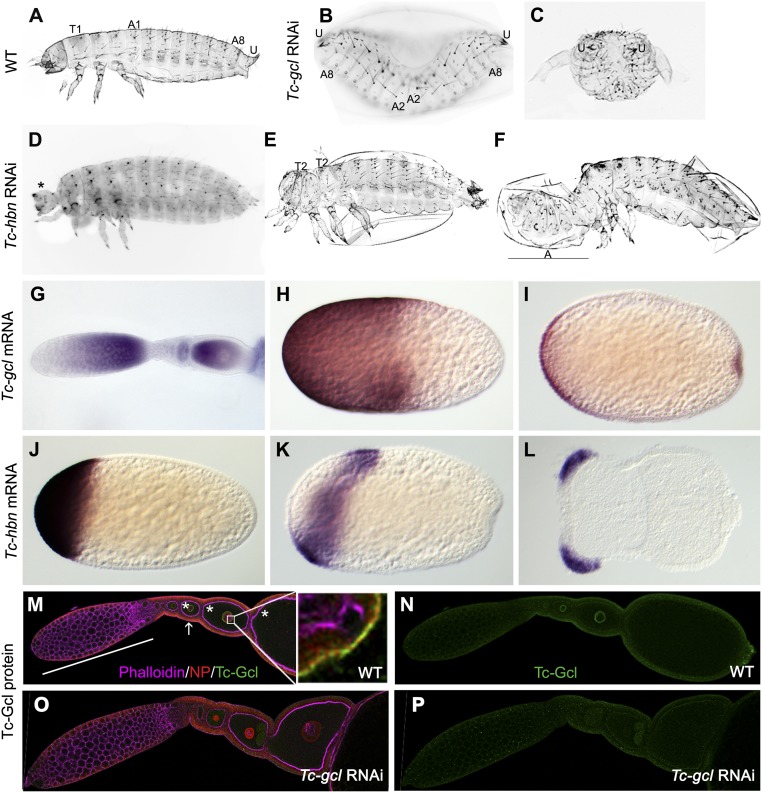
Fig. 1.
Fig. 1.
Tc-gcl and Tc-hbn RNAi phenotypes and expression. (A) Wild-type first-instar larval cuticle with thoracic (T) and abdominal (A) segments and urogomphi (U). (B and C) Tc-gcl RNAi larvae lacking the thorax but displaying mirror image abdomina. (DF) Tc-hbn RNAi phenotypes range from loss of the labrum and antennae (asterisk in D) to specimen with partially duplicated thorax (E) and incomplete double abdomen (F). (GI) Tc-gcl mRNA is found in nurse cells and in the anterior of developing oocytes (G) and in the anterior half of freshly laid eggs (H). In differentiated blastoderm embryos, expression is found at the anterior and posterior poles (I). (JL) Zygotic Tc-hbn mRNA is expressed in an anterior cap (J) but later retracts from the pole (K) to form domains in the head lobes of germ rudiments (L). (M and N) Tc-Gcl protein distribution in ovaries. Tc-Gcl (green signal; single channel shown in N) is found at the nuclear envelope, which is marked by a nuclear pore protein (red signal; see Inset for blow-up). White bar, nurse cells; stars, oocytes; white arrow, follicle cells. (O and P) After Tc-gcl RNAi, the nuclear staining is reduced (single channel shown in P). Anterior is to the Left in AL; AF are not in the same scale.
Fig. 2.
Fig. 2.
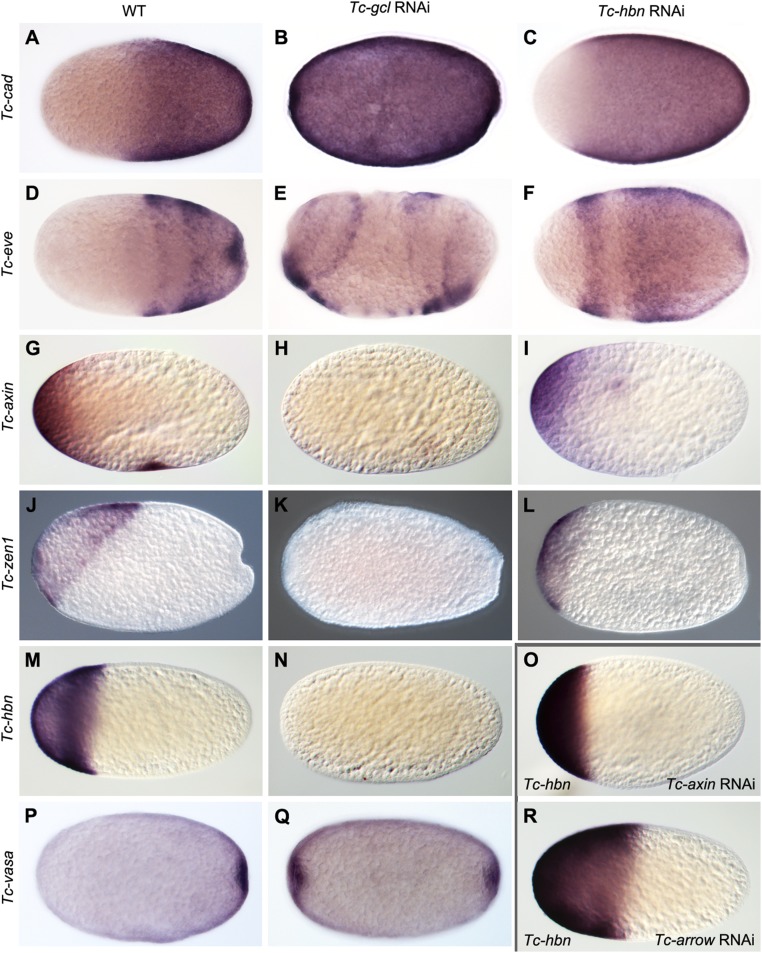
Change of embryo fate map after Tc-gcl and Tc-hbn RNAi. (AC) Tc-cad mRNA is expressed in the posterior half of WT blastoderm embryos (A) but is ubiquitously distributed after Tc-gcl RNAi (B). It is shifted anteriorly after Tc-hbn RNAi (C). (DF) Striped Tc-eve mRNA expression at late WT blastoderm embryos (D) is duplicated after Tc-gcl RNAi (E) but shifted anteriorly in Tc-hbn RNAi (F). (GI) Maternal Tc-axin mRNA at the anterior pole (G) is lost after Tc-gcl RNAi (H) but not affected after Tc-hbn RNAi (I). (JL) Tc-zen1 expression in the serosa (J) is lost after Tc-gcl RNAi (K) and reduced upon Tc-hbn RNAi (L). (MO and R) Tc-hbn expression at the anterior pole (M) is absent after Tc-gcl RNAi (N). In Tc-axin RNAi (Wnt derepression) the boundary is shifted toward anterior (O), while it is shifted posteriorly after Tc-arrow RNAi (Wnt repression; R). (P and Q) Tc- vasa mRNA expression marking the posterior pit in WT (P) is duplicated after Tc-gcl RNAi (Q).
Fig. 3.
Fig. 3.
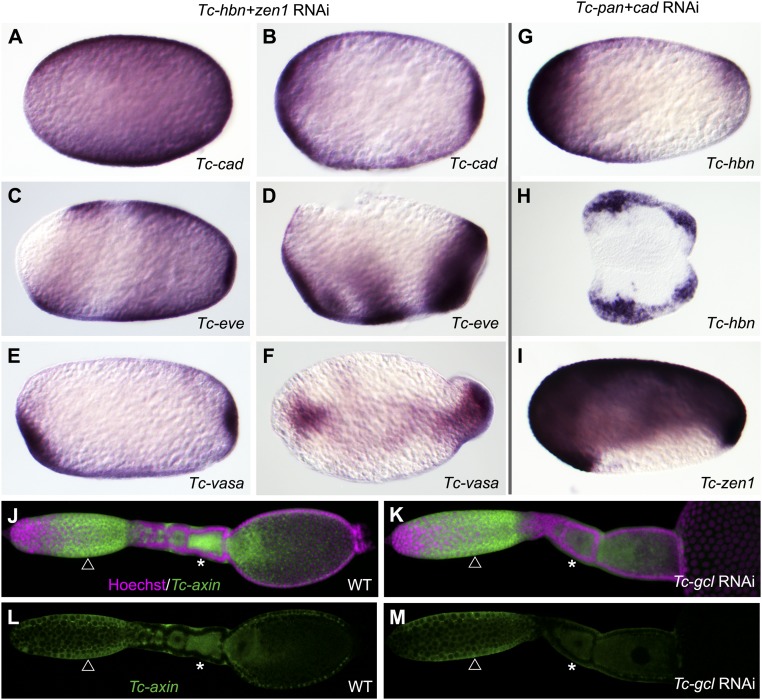
Zygotic genes required for anterior and posterior structures. (AF) Tc-hbn+Tc-zen1 double RNAi leads to mirror image expression of SAZ markers like Tc-cad (A and B), Tc-eve (C and D), and Tc-vasa (E and F). (GI) Upon Tc-pan+Tc-cad double RNAi, anterior markers become expressed at the posterior pole. Tc-hbn mRNA develops an additional posterior domain (G) and marks duplicated posterior head lobes in germ rudiments (H). Tc-zen1 expression covers both poles and dorsal tissue (I). (JM) In Tc-gcl RNAi ovaries, Tc-axin mRNA remains expressed in nurse cells (compare arrow in J and L with K and M) but is reduced in oocytes (compare stars in J and L with K and M). This indicates that Tc-axin transport is affected in Tc-gcl RNAi. Respective WT embryos are shown in Fig. 1.
Fig. 4.
Fig. 4.
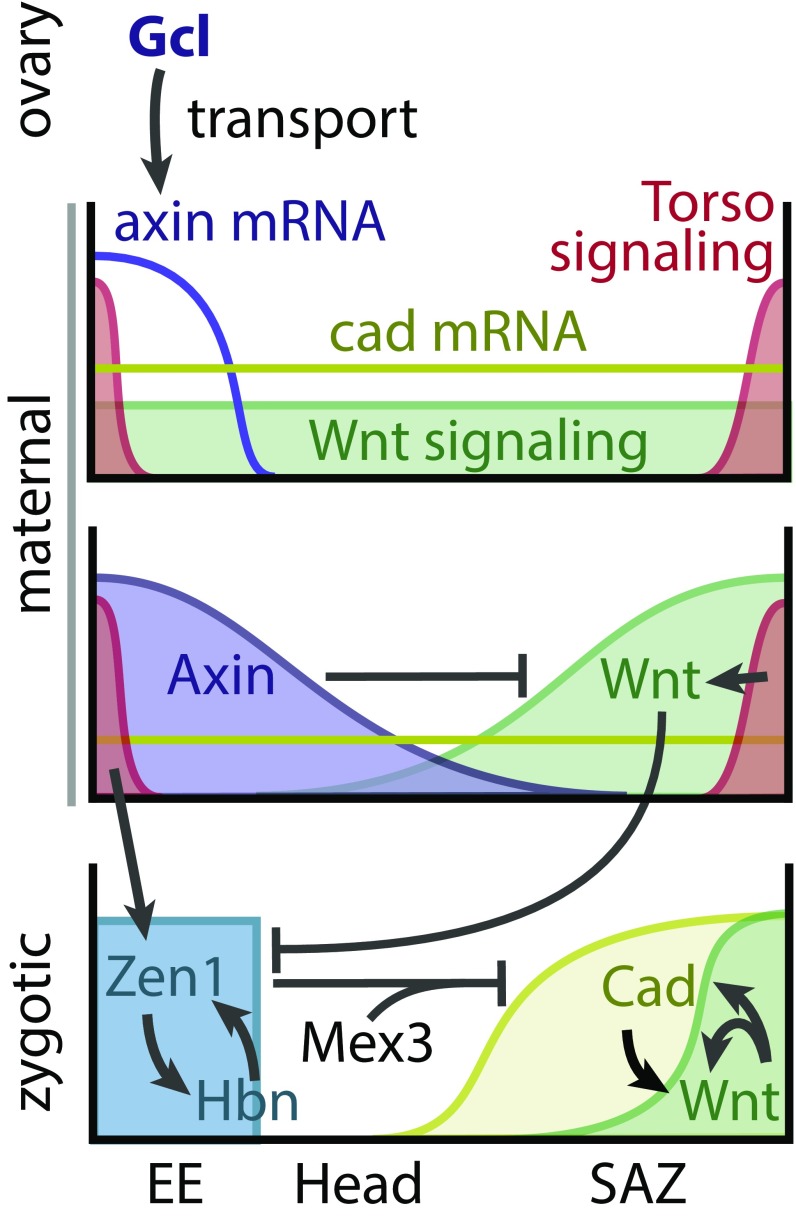
Model for axis formation Tribolium castaneum. See text for details. EE, extraembryonic tissue; SAZ, segment addition zone.

References

    1. Yajima H. Studies on embryonic determination of the harlequin-fly, Chironomus dorsalis. I. Effects of centrifugation and of its combination with constriction and puncturing. J Embryol Exp Morphol. 1960;8:198–215. - PubMed
    1. Sander K. [Reversal of the germ band polarity in egg fragments of Euscelis (Cicadina)] Experientia. 1961;17:179–180. - PubMed
    1. Kalthoff K, Sander K. Der Entwicklungsgang der Mi\s sbildung „Doppelabdomen” im partiell UV-bestrahlten Ei von Smittia parthenogenetica (Dipt., Chironomidae) Dev Genes Evol. 1968;161:129–146. - PubMed
    1. Meinhardt H. A model of pattern formation in insect embryogenesis. J Cell Sci. 1977;23:177–39. - PubMed
    1. Nüsslein-Volhard C, Frohnhöfer HG, Lehmann R. Determination of anteroposterior polarity in Drosophila. Science. 1987;238:1675–1681. - PubMed

Publication types

Substances

LinkOut - more resources